Commercial Outdoor Dining Structures: Capital Region NY
How Restaurants and Breweries in the Capital Region Are Turning Outdoor Spaces into Revenue
Picture a Tuesday evening in mid-October. Light rain is coming down. It's 51 degrees.
At one restaurant on Broadway in Saratoga Springs, the outdoor tables are empty — cleared and covered, season over. Inside, the dining room is full, but the 40-seat patio is contributing nothing. The outdoor bar is dark.
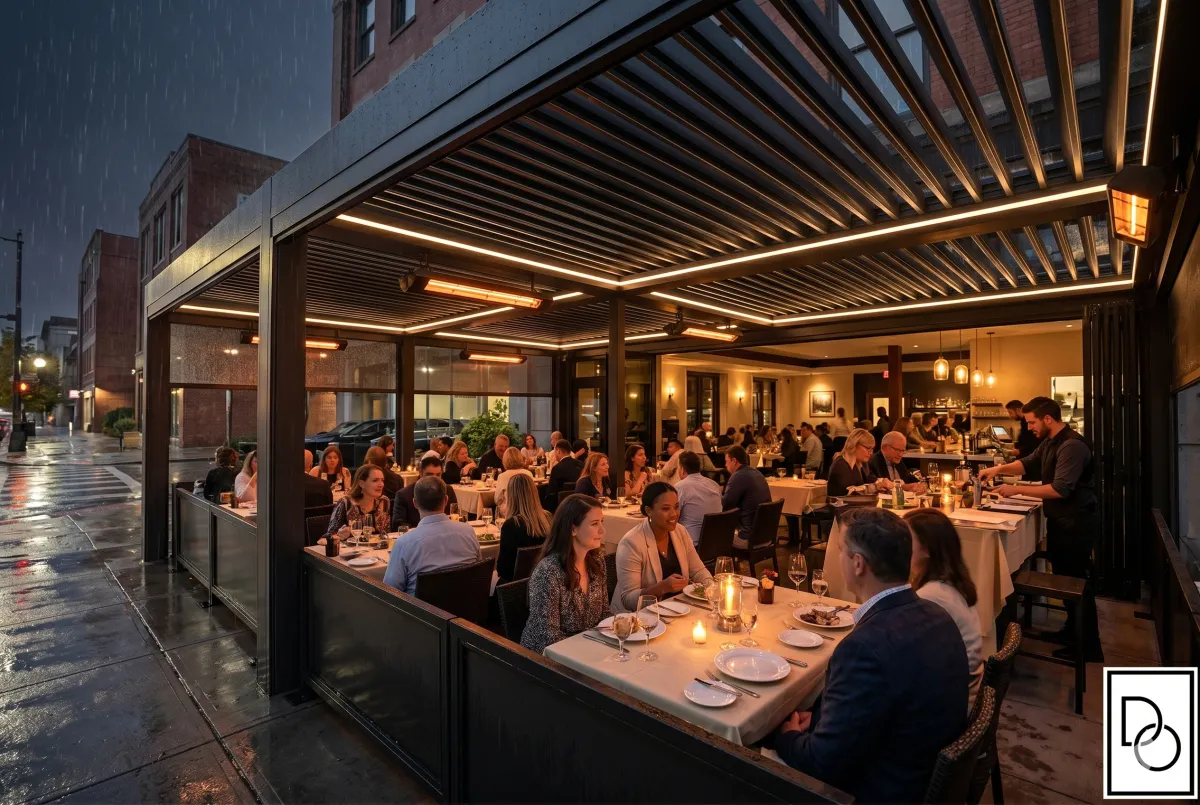
Two blocks away, a different restaurant has a covered outdoor structure with motorized louvered panels closed against the rain and infrared heaters glowing overhead. Every table is occupied. The bar is doing strong numbers. Guests are leaning in close, glasses refilled, in no hurry to leave.
Same city. Same Tuesday. Same rain. Two very different revenue outcomes.
The difference isn't the food, the service, or the location. It's one decision one owner made — to build an outdoor space that works in Upstate New York's climate, rather than one that only works on perfect summer evenings.
This article is for the owner, operator, or manager considering that decision. It covers what all-weather commercial outdoor structures actually look like, what the revenue case genuinely is, and what Capital Region venues need to know before investing in the infrastructure that extends their season.
Quick Answer
How do restaurants and breweries add all-weather outdoor dining in the Capital Region?
Commercial motorized louvered pergola systems — engineered to meet structural load ratings appropriate for commercial use — provide weather-protected outdoor dining that extends the usable season by 3 to 8 months or more in Upstate New York. Combined with commercial-grade radiant heating and optional motorized screens for insect control, a covered outdoor structure creates revenue-generating square footage that functions reliably through rain, shoulder-season temperatures, and Capital Region spring and fall conditions. The commercial installation process differs from residential work in structural requirements, permitting complexity, and operational considerations.
The Shift That Happened — and Why It's Permanent
The outdoor dining expansion that accelerated in 2020 didn't reverse when indoor dining fully reopened. It settled into the industry as a permanent fixture, and in many cases, a primary competitive differentiator. Guests who discovered they preferred outdoor dining — the air, the light, the ambiance, the sense of occasion — kept requesting it. Venues that had invested in outdoor capacity found those spaces driving a disproportionate share of revenue and reviews.
Nationally, the commercial outdoor living structures market has been one of the strongest segments within the broader outdoor living category. Restaurants, breweries, hotels, and event venues that had bare parking lots in 2019 had pergola-covered outdoor dining rooms by 2022. The transformation has been visible and competitive — in markets like Saratoga Springs, Albany, and the Hudson Valley corridor, outdoor spaces have become a standard guest expectation rather than a seasonal bonus.
The problem for Capital Region operators is the climate. Five months of comfortable outdoor dining, generously estimated, is not enough to build a business model around. A patio that fills from Memorial Day to Labor Day but sits empty the rest of the year represents unused capacity — fixed overhead, zero contribution.
Every month an outdoor space sits unusable in the Capital Region is a month of fixed overhead with zero revenue contribution. Three recovered months can represent a six-figure revenue difference at typical restaurant volume.
The operators who are winning this calculation are the ones who stopped thinking about outdoor space as a seasonal amenity and started thinking about it as year-round revenue infrastructure. That shift in framing changes the investment decision entirely.
The Revenue Case: Running the Numbers
Let's be specific because specificity drives decisions.
A restaurant with a 40-seat outdoor dining space that runs for five months per year, May through September, generates outdoor revenue for roughly 150 operating days. At typical suburban Capital Region volumes for a mid-range restaurant, that outdoor space might generate $800 to $1,500 in revenue per service on a moderate evening, more on weekends and during peak racing season in Saratoga.
Extend that season by three months — add April, October, and solid service through part of November — and you're adding 60 to 90 operating days. At conservative mid-week revenue figures, that extension represents $50,000 to $120,000 in additional annual outdoor revenue, depending on volume and pricing. At busier venues or during premium periods, the number is higher.
The investment in an all-weather commercial outdoor structure — motorized louvered pergola, commercial radiant heating, optional motorized screens — for a 40-seat outdoor space typically runs $60,000 to $150,000 depending on configuration, materials, and site requirements. A well-structured investment at this scale pays back within one to two seasons of extended revenue. The structure itself has a 20-plus-year lifespan.
This is not a lifestyle investment. It is a business infrastructure investment with a calculable return. The operators who see it that way make the decision more easily.
What Works for Which Type of Venue
Commercial outdoor structures are not one-size-fits-all. The right configuration depends on the type of venue, the outdoor footprint, the primary use case, and the specific weather conditions that most frequently interrupt outdoor service. Here's how the decision maps across the main venue types in the Capital Region.
Restaurants — Full-Service Dining
Three to four additional months of full outdoor dining service
The problem: Rain and shoulder-season cold eliminate outdoor revenue on otherwise serviceable evenings. A September Friday with light rain shouldn't end outdoor dining.
The structure: Motorized louvered pergola system with commercial radiant heating integrated into the overhead structure. Louvers close against rain while maintaining the outdoor atmosphere guests want. Heating extends comfort to late October. Optional motorized screens for summer insect control.
The revenue angle: Three to four additional months of full-service outdoor dining. Rain-day protection maintains occupancy on evenings when 40-seat capacity would otherwise drop to zero. Private event premium — a covered outdoor space commands higher private event pricing than an uncovered patio.
Breweries & Taprooms
Capture fall peak season — foliage, harvest, Oktoberfest
The problem: The brewery outdoor experience — part of the brand identity for most craft operations — is among the most weather-vulnerable in hospitality. A cloudy, 55-degree Saturday in October shouldn't send tap room visitors inside.
The structure: Louvered pergola with open structural feel that preserves the outdoor brewery aesthetic while providing rain cover and seasonal warmth. Big Ass Fans are integrated into the overhead structure for summer airflow. Fenetex motorized screens for insect control during summer evening events. Aspect LED lighting for ambiance and extended evening service.
The revenue angle: Craft brewery patrons specifically seek outdoor experience. A covered, heated outdoor space that maintains the outdoor brewery feel through October captures fall peak season — foliage, harvest events, Oktoberfest programming — that uncovered spaces lose to weather. Live music and event revenue extend into the shoulder seasons.
Hotels & Hospitality Venues
Premium pricing on guaranteed-comfort wedding and event space
The problem: Courtyards, pool decks, and terrace spaces represent significant property assets that are grossly underutilized for most of the year in cold-climate markets. Wedding and event revenue is weather-dependent in ways that are both revenue-limiting and logistically stressful.
The structure: Larger-footprint louvered structures for courtyard coverage, with commercial heating and full enclosure capability for shoulder-season events. For pool deck applications, retractable shade systems with motorized screens provide summer functionality while the structural frame accommodates season-extension heating.
The revenue angle: Wedding and event revenue is the largest commercial outdoor opportunity for hotel properties. An all-weather, covered outdoor space that can be offered as a guaranteed-comfort venue for spring and fall events — not weather-permitting but weather-proof — commands premium pricing and expands the bookable calendar by months.
Event Venues & Private Clubs
Book more events at higher prices — no weather contingency clauses
The problem: Event venues operate on a booked-in-advance model, where weather uncertainty is a liability. Clients booking outdoor events need certainty, not weather luck. In the Capital Region, that certainty is difficult to offer without infrastructure.
The structure: Fully enclosed louvered systems with rain sealing, commercial heating, and optional glass or screen panels that create a defined, weather-controlled outdoor event space. For venues with existing pavilion or barn structures, louvered additions extend covered square footage with weather flexibility.
The revenue angle: The ability to guarantee outdoor comfort for any event, in any season, is a premium that sells to clients. An event venue that can say "our outdoor space is comfortable in any weather from April through November" books more events at higher prices than one that hedges with weather contingency clauses.
What Makes Commercial Installations Different
Commercial outdoor structure projects differ from residential work in ways that matter to operators considering the investment. Understanding those differences before engaging a contractor helps avoid surprises.
Structural load requirements are higher
Commercial structures need to meet higher occupancy load standards than residential installations. This affects foundation design, column spacing, beam sizing, and connection engineering. A residential pergola spec is not adequate for a commercial installation serving the public. Decadent Outdoors approaches commercial projects with structural engineering appropriate to the use case — not by applying residential specs to commercial square footage.
Permitting is more complex
Commercial outdoor structure permits involve not just building permits but potentially zoning review, fire code compliance (especially where heating elements are involved), ADA accessibility considerations, and in some municipalities, liquor authority notifications for outdoor service areas. This process is manageable, but it takes longer than residential permitting and requires a contractor experienced with commercial permitting in Capital Region jurisdictions. Planning for 8 to 16 weeks of permitting lead time is prudent for most commercial projects.
Operational considerations shape the design
A residential pergola can be designed primarily around aesthetics and personal use patterns. A commercial structure has to work operationally — staff circulation, service flow from indoor kitchen to outdoor tables, electrical access for POS systems, accessibility compliance, maintenance access for cleaning and upkeep. These considerations shape the design from the start and require a designer who understands commercial hospitality operations, not just outdoor structure installation.
The finish and durability requirements are higher
Commercial outdoor structures sustain far heavier use than residential ones — daily service, frequent cleaning, weather exposure, chair and table contact with columns and posts. Finish quality, coating adhesion, and mechanical component durability all need to be specified for commercial use cycles. StruXure's commercial-grade systems meet these requirements. Consumer-grade products do not hold up to commercial service conditions.
The Decadent Outdoors Approach to Commercial Projects
Decadent Outdoors brings a specific background to commercial outdoor structure projects that most residential-focused contractors lack: Jeff Mazzarelli's 35 years of designing outdoor environments for commercial resort and hospitality applications internationally. Before founding Decadent Outdoors, Jeff built outdoor spaces that served paying guests, operated under commercial load conditions, and had to perform reliably through seasons and use cycles that residential spaces never experience.
That background shows up in how commercial projects are approached from the first conversation. The questions are different. What does service flow look like? What is the primary weather condition that currently interrupts outdoor service — rain, wind, cold? What is the event calendar, and what months represent the highest-value outdoor opportunities? What accessibility requirements apply to the site? What is the permit jurisdiction, and what should the timeline look like?
Hank Hudson Brewing Co. is one example of commercial outdoor work completed in the Capital Region. The project demonstrates what a well-designed commercial outdoor structure looks like in a brewery setting — preserving the open, outdoor brewery aesthetic while providing the weather resilience that extends service through shoulder seasons.
A commercial outdoor structure that doesn't work operationally — that looks great in photos but interrupts service flow or creates maintenance burdens — is a liability, not an asset. Design has to start with the operation, not the catalog.
For Capital Region restaurant, brewery, hotel, and event venue operators considering this investment, the conversation starts with your operation — your outdoor footprint, your calendar, your specific weather pain points — before any product discussion begins. That's how commercial outdoor projects get built right.
Frequently Asked Questions
How do restaurants add outdoor dining space in the Capital Region?
The most effective approach for Capital Region restaurants is a motorized louvered pergola system with integrated commercial radiant heating. The louvered roof closes against rain while maintaining an outdoor atmosphere; the radiant heating extends comfortable service into shoulder-season temperatures. For insect control in summer, motorized screen systems are mounted on the pergola structure. The system works as a weather-resilient outdoor dining room rather than a fair-weather patio, adding three to four months of usable service to the typical Capital Region outdoor season.
What outdoor structures work for restaurants and breweries?
For restaurants requiring full rain and weather protection: motorized louvered pergola systems with commercial radiant heating. For breweries seeking to preserve the open outdoor aesthetic while adding weather resilience: a louvered pergola with adjustable panels, overhead fans, and motorized screens for insect control. For event venues and hotels requiring guaranteed-comfort outdoor event space: fully enclosable louvered systems with commercial heating and optional screen or glass panels. The right configuration depends on the venue's primary use case, outdoor footprint, and specific weather conditions that most interrupt service.
How much does a commercial pergola cost?
Commercial pergola costs vary significantly by footprint, configuration, structural requirements, and site conditions. A basic commercial louvered pergola covering 400–600 square feet typically runs $60,000 to $100,000 installed. Larger footprints, full enclosure systems, integrated heating and screens, and complex permitting requirements can push projects to $150,000 or more. Commercial projects require a full site assessment and structural review before accurate pricing can be provided. The revenue context matters: an investment that adds three months of outdoor dining revenue at $1,500 per service typically pays back within two seasons.
How long does it take to install a commercial outdoor structure?
Commercial installations typically take longer than residential projects due to permitting complexity and larger structural scope. Permitting in most Capital Region jurisdictions runs 6–12 weeks for commercial outdoor structures. Material lead times for commercial-grade motorized systems run 6–10 weeks. Active installation time for a 400–600-square-foot commercial structure is 4–8 days. Total project timeline from initial consultation to installation completion: 16–24 weeks is a reasonable planning assumption, making the fall the ideal time to initiate the process for spring-season readiness.
Does an outdoor structure require a commercial permit in New York?
Yes, in virtually all Capital Region jurisdictions, commercial outdoor structures require building permits and may require additional review depending on the municipality. Zoning compliance, fire code review (particularly for structures with integrated heating), accessibility requirements, and, in some cases, liquor authority notification for outdoor service areas are all part of the commercial permitting process. A contractor experienced with commercial permitting in Capital Region municipalities manages this process as part of the project. Operators should plan for 8–16 weeks of permitting timeline in their project schedule.
The Season Is Longer Than You're Using
The Capital Region's hospitality market runs on a seasonal calendar that most operators accept as fixed. Memorial Day to Labor Day, with shoulder use in May and September on good weather days. Everything else is indoors.
That calendar isn't fixed. It's a function of infrastructure — specifically, whether the outdoor space is built to handle the conditions that exist from April through November in Upstate New York.
The restaurants, breweries, and hotels that are pulling ahead of that calendar aren't doing something dramatic. They made one decision: to stop treating the outdoor space as a fair-weather amenity and start treating it as all-weather revenue infrastructure. The investment pays back within a season or two. The competitive advantage — being the venue that's open and comfortable when the weather turns — compounds year over year.
The conversation about what's possible for your specific outdoor space starts with a site visit and a revenue conversation, not a product catalog. If you're running a venue in the Capital Region and your outdoor space shuts down before the foliage season peaks — that's the conversation worth having.