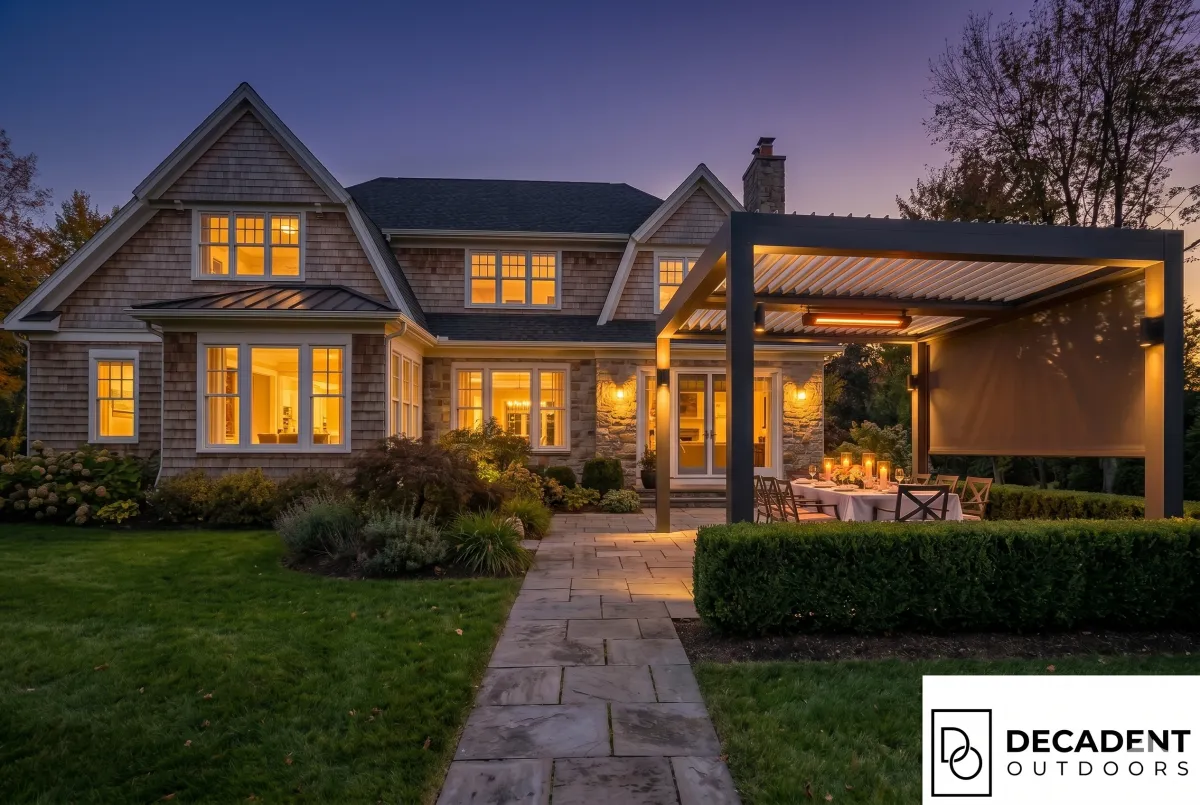
Does a Pergola Add Home Value in Upstate NY?g Post
Does a Pergola Add Value to Your Home in Saratoga Springs? What the Research Actually Shows
There's a conversation that happens in almost every outdoor living consultation. It's not about the product. It's not about the color or the size or the style. It happens near the end, after the excitement has settled and the reality of the investment is sitting in the room.
Someone — usually the person who didn't initiate the conversation — leans back and asks: "But is it actually worth it?"
It's the right question. And it deserves a real answer — not a sales pitch dressed up as data, not inflated ROI claims from a manufacturer's marketing page, but an honest look at what the research shows about outdoor living investments and what the specific dynamics of the Saratoga Springs and Capital Region property market mean for homeowners considering this decision.
That's what this article is.
We'll look at the national data on the return on investment for outdoor living. We'll apply it to the specific demographic and property value context of Saratoga County and the Hudson Valley. And we'll walk through the honest calculation — not just what a pergola returns when you sell, but the full picture of value it creates while you're still living in the home.
Quick Answer
Does a pergola add value to your home?
Yes — with important qualifications. Research from the National Association of Realtors and multiple home improvement cost-vs-value studies consistently shows that well-designed outdoor living structures add 10–15% of their project cost to home value, with some premium installations in high-income markets returning even more. In Saratoga County's property market — median home value $348,600, median household income over $100,000 — a high-quality outdoor living installation from a credentialed installer is a genuine value addition. The qualification: quality and installation matter significantly. A poorly installed structure from a low-tier product line returns far less than a premium installation from an engineered system.
The Fear Behind the Question
The "is it worth it?" question is almost never really about the dollar return. It's about fear of regret.
Specifically: the fear of spending a significant amount of money on something that doesn't deliver, that doesn't get used the way you imagined, or that doesn't hold its value when you eventually sell. The fear that the spouse who asked the question was right to be cautious. The fear that your excitement clouded your judgment.
That fear is legitimate. Home improvement is full of stories of expensive projects that disappointed. Renovations that didn't add value. Outdoor spaces that looked great in photos and sat unused in practice. Contractors who quoted well and delivered poorly.
The right response to that fear isn't reassurance. It's evidence. And the evidence — for outdoor living specifically, and for the Capital Region's property market specifically — is worth walking through carefully.
The fear behind "is it worth it?" is never really about money. It's about whether this particular investment, in this particular space, was the right call. Evidence answers that question better than enthusiasm.
These numbers matter for the ROI conversation. The return on outdoor living investments scales with property values. In a market where homes average $348,600 and income levels are among the highest in Upstate New York, the buyers who purchase properties with premium outdoor living spaces understand and value quality. That buyer pool is exactly where premium outdoor installations command their full return.
What the Research Actually Shows on Outdoor Living ROI
The research on outdoor-living return on investment comes from several consistent sources: the National Association of Realtors Remodeling Impact Report, the annual Cost vs. Value study published by Remodeling magazine, and real estate professional surveys on buyer preferences and home feature premiums. The findings across these sources are consistent enough to draw reliable conclusions.
Outdoor living structures rank among the highest-ROI home improvements
Year after year, outdoor living improvements — decks, patios, pergolas, and outdoor kitchens — rank among the top in cost-recovery rankings for home improvements. The 2024 Cost vs. Value report found that composite deck additions recover an average of 68% of their cost at resale nationally, with higher recovery rates in premium markets. Pergola structures and motorized outdoor systems, which add both architectural presence and functional value, typically outperform basic deck additions in buyer perception.
The reason is straightforward. Buyers in today's market are looking for move-in-ready, lifestyle-complete properties. A home with a defined, well-equipped outdoor room presents as finished, not as a project to be undertaken. That perception premium translates directly into offer strength and sales speed.
The Saratoga County multiplier
National averages understate the return in premium markets. A home improvement that returns 10% in the national median market often returns significantly more in a market where buyer income, property values, and lifestyle expectations are above average.
Saratoga County sits at the 75th percentile of New York State for median household income. The buyer pool for homes in Saratoga Springs, Clifton Park, Ballston Spa, and surrounding communities includes professionals, executives, and retirees with the financial sophistication to recognize quality and the resources to pay for it. These buyers specifically notice — and pay for — the difference between a backyard with an open patio and a backyard with an architecturally defined, all-weather outdoor room.
Real estate agents serving the Capital Region consistently report that outdoor living features differentiate listings in a competitive market. Homes with superior outdoor spaces spend fewer days on the market and receive stronger initial offers. The precise premium varies by property and installation quality, but the directional effect is consistent.
The quality multiplier — what it means for your return
This is the part of the ROI conversation that matters most and gets discussed least.
Not all pergola installations yield the same results. A structural-grade motorized louvered pergola from a manufacturer with documented engineering standards — installed by a designer with the background to ensure it integrates properly with the property and performs through two decades of Upstate New York weather — returns more than a kit pergola assembled by a general contractor. Both might look similar in photos taken the day of installation. At year three, year seven, and at resale, they look very different.
Buyers and their inspectors notice. Real estate agents notice. The return on a premium installation is meaningfully higher than on a budget installation, and the gap widens over time as the quality differential becomes apparent.
The Full Value Picture: Beyond Resale
Focusing only on resale value misses most of the return. A pergola investment that you live with for ten years before selling pays you in two currencies — the eventual home value bump at sale, and the daily quality-of-life return for a decade before that.
The second category is harder to put a number on. But it's also larger.
The cost-per-year calculation
Here's a framing that consistently changes the conversation for homeowners wrestling with the investment. A quality motorized pergola system, properly installed and maintained, has a functional lifespan of 20 to 25 years. Over a 20-year period, the annual cost of that investment — spread across its useful life — is modest.
If the structure extends your outdoor season from four months to eight, you're also doubling the per-year use you get from the space, which roughly halves the effective cost per outdoor day. The math, worked out, often surprises people. Not because it's cheap — it isn't — but because the per-use cost over the life of a quality structure is far lower than it appears when you're looking only at the up-front number.
The protection value — what's already being lost
There's a less-obvious component of the return equation: what you're currently losing without the structure.
Outdoor furniture exposed to direct UV light degrades. Cushion fabric fades in two to three seasons. Teak and composite surfaces weather and discolor. Metal furniture oxidizes. The replacement cost for quality outdoor furniture runs $1,500 to $5,000 every few years for most homeowners, and that cycle accelerates without any weather protection. A covered structure extends the useful life of everything beneath it by years.
The same principle applies to decking materials, flooring, and any painted or stained surfaces exposed to direct sunlight. UV and weather protection provided by a covered structure slows the deterioration of existing investments. That's a return on the pergola investment that doesn't show up in any ROI study but is absolutely real.
The Honest Caveats — When a Pergola Isn't the Right Investment
This article would be incomplete without acknowledging the circumstances where the ROI case is weaker. A guide who only tells you what you want to hear isn't worth listening to.
If you're planning to sell within 18 months
Outdoor living investments return most of their value over time — through daily use and through the compounding effect of a well-maintained space on long-term property positioning. If you're selling in 18 months or less, the resale return alone may not fully cover the cost of a high-tier investment. A more modest outdoor improvement — quality landscaping, a clean patio surface, a simple fixed pergola — may offer better short-term return than a premium motorized system. Be honest with yourself about your timeline before the investment decision.
If the primary motivation is resale, not use
The homeowners who get the best return from outdoor living investments are the ones who genuinely want the space and use it. The investment pays off twice — first in quality of life, then in resale value. If you don't actually want to sit outside in October, the season extension component of the value disappears, and the return equation changes. The right question is whether you'd genuinely use the space more if it were built well — if the honest answer is yes, the investment works. If the honest answer is no, a different investment probably makes more sense.
If the structure is purchased to match the neighborhood, not exceed it
In real estate, improvements that exceed neighborhood norms yield lower returns than those that match them. A $60,000 outdoor living installation on a $200,000 property in a neighborhood of $200,000 properties will not return $60,000 at sale. The same installation on a $400,000 property in a neighborhood of $400,000 to $600,000 properties is much more likely to earn its return and then some. The Saratoga County and Hudson Valley markets, with their high median property values and affluent buyer pools, sit comfortably in the zone where quality outdoor investments make financial sense.
A Word on Financing
One aspect of the outdoor living investment conversation that many homeowners don't explore early enough is financing. For many Capital Region homeowners, a quality outdoor living project is financeable through home equity lines of credit, home improvement loans, or manufacturer financing programs — spreading the investment over time while the value begins working immediately.
The math of financing a long-lived investment is different from the math of financing a depreciating purchase. A motorized pergola that lasts 20 years and extends your outdoor season by 4 months per year generates ongoing value throughout the financing period. The monthly payment for a financed outdoor living project is often less than what homeowners spend on a single weekend vacation — and unlike the vacation, it compounds.
Decadent Outdoors offers financing options for qualifying projects. It's worth having that conversation before ruling out an investment based on the up-front number alone.
Frequently Asked Questions
Does adding a pergola increase home value?
Yes, consistently. Research from the National Association of Realtors and annual Cost vs. Value studies shows outdoor living structures among the highest-ROI home improvements, with well-designed pergola installations typically adding 10–15% of their project cost to home value at resale. The return is stronger in premium markets — like Saratoga County, where median home values exceed $348,000 — because the buyer pool includes higher-income purchasers who specifically value and pay for quality outdoor living spaces.
How much does a pergola cost in New York?
Pergola costs in New York vary widely depending on size, material, and system type. A traditional wood or basic aluminum pergola might range from $8,000 to $20,000 installed. A motorized louvered pergola system from a premium manufacturer like StruXure, custom-sized and professionally installed by a credentialed outdoor living designer, typically ranges from $25,000 to $60,000 or more depending on dimensions and included features. The higher investment in an engineered system reflects structural performance standards, a 20+ year lifespan, and the design expertise that makes the installation appropriate for Upstate New York's specific climate demands.
Is outdoor living worth the investment in Upstate New York?
The investment case in Upstate New York is actually stronger than in many markets, for a specific reason: the season extension value. A homeowner in a mild climate who can already use their outdoor space 10 months per year gains less from a covered, heated structure than a Capital Region homeowner who currently uses their space 4 months per year and can extend that to 8 or more. The delta — the recovered outdoor time — is the largest part of the lifestyle value, and it's proportionally larger in a cold-climate market. Combined with Saratoga County's property values and buyer demographics, the investment case is clear for homeowners who genuinely want the space.
What outdoor improvements add the most value to a home?
Nationally, outdoor kitchens, well-designed decks, and pergola or covered patio structures consistently rank among the highest-ROI outdoor home improvements. The highest returns come from improvements that create usable, defined living space — not decorative additions. In the Capital Region, the premium is specifically on structures that demonstrate year-round or extended-season usability, since buyers in this market know what Upstate winters are like and pay attention to which homes have solved the seasonal limitation problem intelligently.
Does financing an outdoor living project make sense?
For many homeowners, yes — particularly for a long-lived investment like a motorized pergola with a 20+ year lifespan. Financing through home equity, home improvement loans, or manufacturer programs spreads the investment over time, while the value begins immediately: the extended outdoor season, daily use, and the impact on home value. The monthly cost of financing a quality outdoor living project is often comparable to other regular discretionary expenditures, except that an outdoor structure builds equity rather than generating only experience.
The Answer to the Question
Is it worth it?
For most Capital Region homeowners considering a quality outdoor living investment — people who own their homes, who plan to be in them for five or more years, who genuinely want to use the space and have specific frustrations with not being able to — the answer is yes. Unambiguously.
The return comes from multiple directions: a measurable improvement in home value at resale, a daily quality-of-life return that begins the day installation is complete, protection of existing outdoor investments, and the compounding value of a space that works for eight months a year rather than four.
The caveat is quality. The return on a premium, properly installed, engineered-for-this-climate structure is real and consistent. The return on a budget installation that disappoints in three winters is not. That's why the installation decision matters as much as the product decision — and why the conversation about who builds the space is as important as the conversation about what gets built.
The answer to "is it worth it?" is almost always yes. The follow-up question — "with whom?" — is where the real work begins.