Four-Season Outdoor Living in the Capital Region NY
How to Use Your Outdoor Space in October, November, and March in the Capital Region
It's the third Saturday of October. 5:47 in the afternoon.
The light is doing that thing it only does in fall in the Northeast — low and golden, coming in at an angle that makes every surface it touches look like it was painted. The trees along the back property line are somewhere between amber and rust. There's woodsmoke from somewhere nearby. The temperature is 46 degrees.
Inside your house, someone is making dinner. The windows are fogged slightly at the corners. A football game is on.
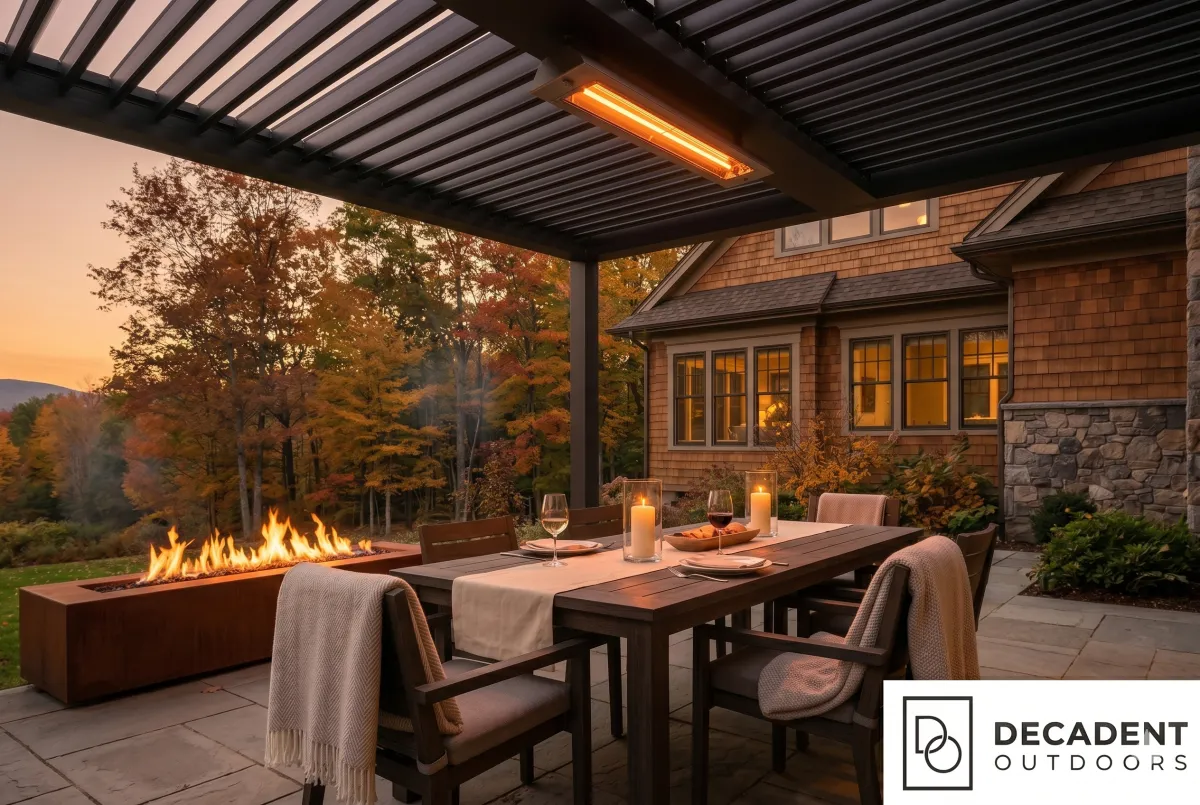
Out back, under a covered outdoor space with a radiant heater glowing overhead and the louvered roof tilted just enough to let in the last of that golden light, two people are sitting with wine glasses, watching the leaves, not saying much. The candles on the table are lit. There's a light blanket on the chair arm, the kind you reach for more out of habit than necessity.
Nobody came inside early. Nobody said it was too cold.
That scene is not a fantasy. It's not a rendering from a California lifestyle magazine shot in 72-degree weather. It happens — in the Capital Region, in mid-October, in backyards that were designed for it.
The question worth sitting with is this: how many of those evenings have you already let go?
Quick Answer
Can you use your outdoor space in October and November in the Capital Region?
Yes — with the right outdoor structure and heating. A motorized louvered pergola closes to block wind and retain warmth, while infrared radiant heaters mounted overhead deliver warmth directly to people and surfaces rather than trying to heat the open air. Together, they extend comfortable outdoor use well into November in the Capital Region — and with the right enclosure, into March as well. The key is designing the space for season extension from the start, not adding heat as an afterthought to a space that wasn't built to hold it.
What You're Actually Losing Every Year
Most Capital Region homeowners lose roughly five months of outdoor living per year. Not because the weather is uniformly brutal — it isn't. May is often beautiful. October is spectacular. Even November has its days, the still ones when the air is cold and clean, and the sky is a particular shade of blue that only happens after the leaves have fallen.
What ends the outdoor season isn't always temperature. It's the wind chill on a May evening that makes the deck too uncomfortable to finish dinner. It's a September rain that cuts a Saturday afternoon short. It's the October night that would have been perfect if there were just somewhere warm to sit outside, somewhere the wind didn't reach.
Add it up. The furniture goes under covers in late September. It doesn't come out until May, and even then, with reservations. Conservatively, that's six months — half the year — when a space you invested in, a space you love, contributes nothing to the way you live.
There's a particular kind of loss that comes with accepting a short outdoor season as inevitable. It's quiet. It accumulates. And it's completely avoidable.
The internal frustration is real, too. You live in a beautiful place. The Adirondacks to the north, the Hudson Valley to the south, the farms and the foliage, and the particular quality of Northeastern fall that people from every other region romanticize. You chose to be here. And yet for the most photogenic months of the year — September, October, early November — you're watching it through glass.
That's not a small thing. And it doesn't have to be that way.
The Months You Can Recover — What They Actually Look Like
Here's what the extended outdoor season looks like for Capital Region homeowners who have designed their spaces to make the most of it. Month by month. Specific. Honest about what it takes and what it gives back.
March
The First Breath
The snow is gone, but the ground is still cold. Afternoons reach 45 degrees on the good days. Under a closed louvered roof with a radiant heater overhead, the space feels noticeably warmer — infrared heat warms surfaces and bodies, not the open air, so even with a light breeze, the space stays comfortable. Coffee at 9 am. A book. The yard is still brown, but the sky is enormous, and it's been months since you sat outside. That first Saturday in March, it matters enormously.
What makes it possible: Louvered pergola closed · Infratech or Bromic radiant heater · windbreak on north side
April
The Real Opening
April is unpredictable — a 65-degree afternoon followed by a 38-degree evening. The right outdoor space absorbs both. Louvers open for the warm afternoons, angled for evening shade, closed against the occasional cold rain. Weekend dinners outside become possible again, not just aspirational. The heating is still running. The screens aren't deployed yet. The space is transitional, and that quality is part of the pleasure.
What makes it possible: Adjustable louvers for shifting conditions · radiant heating for evenings · open structure on warm afternoons
May
When It Gets Easy
May is the month that rewards preparation. Evenings are warm enough that the heater stays off most nights. The screens come out — Fenetex motorized screens drop to block the early-season mosquitoes that arrive around the third week. Friday dinner outside becomes the default, not the exception. This is the month when everyone who built the right space realizes their investment paid off. And everyone who didn't is still watching from inside.
What makes it possible: Motorized screens deployed · louvers open or angled · heating optional · fire feature on cooler nights
October
The Crown Jewel
Forty-six degrees. The light is gold. The leaves are at peak color. This is the month most Capital Region homeowners lose entirely, and it is the most beautiful month the region produces. A covered outdoor space with radiant heating overhead, a fire feature burning nearby, louvered panels closed against the October wind — this is a sitting-outside-on-a-Saturday-evening-in-October situation. Not occasionally. Reliably. The kind of evenings guests talk about afterward.
What makes it possible:Full radiant heating · fire feature · louvered roof fully closed · candles · that particular amber light
November
The Surprise Month
Most people write off November. And most Novembers, they're not wrong — if the space wasn't designed to hold warmth. But November has its moments. The still mornings when the air is cold, and the sky is clear, and the world has gone quiet in that particular post-foliage way. Midday on a 48-degree Sunday. A cup of coffee, a newspaper, and the last of the outdoor season before the real cold comes. It's not every day. But it's more than you'd expect, and every one of them is a small victory over the calendar.
What makes it possible: Radiant heating essential · louvered roof closed · glass panels or screens for wind protection · shorter sessions
The Three Systems That Make Season Extension Real
This isn't about willpower or heavy coats. It's about building the space correctly. Three systems work together to make cold-weather outdoor living comfortable rather than heroic.
Radiant infrared heat — the technology that changes everything
Standard patio heaters — the freestanding propane towers, the orange-glow electric models from the hardware store — heat air. Air moves. Wind takes it away instantly. In Upstate New York, where wind is part of the equation from September through May, an air-heating system loses its battle with the weather before you've finished your first glass of wine.
Infrared radiant heaters work differently. They emit infrared radiation — the same physics as sunlight — that warms surfaces and bodies directly, without heating the intervening air. Infratech and Bromic, the two brands Decadent Outdoors uses, are commercial-grade infrared systems: ceiling-mounted, weatherproof, and precise enough to heat exactly the zone you're sitting in without wasting energy on the surrounding air.
The practical effect is remarkable. In a space with infrared heating overhead, 46 degrees feels like 58. Wind drops to a non-factor because you're not relying on warm air to stay warm. The heater runs silently. There's no smell, no open flame, no propane cylinder to run out at an inopportune moment.
This is the single system that most dramatically expands the usable outdoor season in the Capital Region. Everything else is an enhancement. This is the foundation.
A covered structure — not to block the outdoors, but to hold the warmth
An open-air space, even with overhead heaters, loses warmth to the sky above and through the sides. A louvered pergola with the panels closed creates a low-ceilinged enclosure that traps the warmth generated by the heaters, dramatically reducing the energy required to maintain comfortable temperatures.
The physics is simple: you're not trying to heat the outdoors. You're trying to heat a defined, enclosed volume of space. Reduce the volume and heat loss, and the same heater does far more work. This is why the combination of a covered structure plus radiant heating outperforms either system alone by a significant margin.
Louvered systems have an advantage over solid-roof covers here: on the days when it's warm enough to open up fully, you can. The space doesn't feel like an enclosed porch on a 70-degree October afternoon. It feels like an outdoor room that happens to have a roof available when you need it.
Wind protection — the variable that most people underestimate
Wind is the enemy of outdoor comfort at low temperatures. The windchill effect at 45 degrees with a 15-mph breeze drops the perceived temperature to the mid-30s. Most outdoor heating solutions can't overcome that. The solution isn't more heat — it's less wind.
Motorized screen systems on the north and west sides of a pergola — the primary wind directions in the Capital Region — create a transparent barrier that blocks wind without blocking views or light. Combined with a covered roof and radiant heating, the enclosed space stays genuinely comfortable in conditions that would send everyone on an unprotected deck inside.
This is the three-part system: heat overhead, cover above, and wind protection on the sides. Each component works alone. Together, they fully recover the shoulder seasons.
What Season Extension Actually Looks Like in Practice
Let's be specific because specificity is more useful than aspiration.
A Capital Region homeowner with a well-designed motorized pergola, radiant heating, and motorized screens can reasonably expect to use their outdoor space comfortably from late March through late November — roughly eight months out of twelve. That compares to a national average outdoor living season of about five to six months, and to a typical unprotected deck or patio in Upstate New York that realistically gets serious use for maybe four months.
Eight months versus four. That's a doubling of the outdoor season from the same property, the same backyard, the same square footage. For a homeowner who genuinely loves being outside — morning coffee, afternoon reading, weekend entertaining, evenings by the fire — that difference is substantial. It changes how you use your home. It changes the rhythm of your year.
The homeowners who tell us they use their space more than they thought possible almost always say the same thing: they just stopped thinking of the seasons as limits.
The shift isn't dramatic. Nobody wakes up and announces they've conquered autumn. It's quieter than that. One Saturday in October, you realize you've been outside for three hours without thinking about coming in. One November morning, the coffee is better out there than it would have been anywhere else. The space becomes part of how you live, not an accessory to the months when living outside feels easy.
That's what a well-built outdoor space, designed for the climate it actually lives in, gives you. Not just a beautiful backyard. A different relationship with the place you live.
Frequently Asked Questions
How do I use my patio in cold weather in Upstate New York?
The combination that works best for cold-weather outdoor use is a covered structure — specifically, a louvered pergola that closes to retain warmth — plus overhead infrared radiant heaters, plus wind protection on the exposed sides. Each element addresses a different component of cold-weather discomfort: the cover reduces heat loss to the sky, the radiant heaters warm bodies and surfaces directly (rather than heating the open air), and wind protection eliminates wind chill. Together, they make a 45-degree evening feel closer to 58 degrees. Separately, each has significant limitations.
What outdoor heaters work best in Upstate New York?
Ceiling-mounted infrared radiant heaters — specifically commercial-grade systems like Infratech and Bromic — are the most effective outdoor heating solution for cold-climate use. Unlike propane patio heaters or standard electric heating elements, infrared systems heat bodies and surfaces directly through radiant energy rather than warming the surrounding air. Wind cannot steal infrared heat the way it steals convective heat, which makes these systems dramatically more effective in any outdoor space where wind is a factor. Both Infratech and Bromic are weatherproof, silent, and designed for outdoor installation in climate-demanding environments.
Can you use a pergola in winter in New York?
A fully enclosed glass-panel system (such as a Lumon Glass enclosure) can genuinely extend outdoor use into winter months, as the glass panels create a weatherproof seal that holds heat efficiently. A motorized louvered pergola with radiant heating is more suited to the shoulder seasons — reliably comfortable from March through November with the right heating and wind protection. For true winter use, an additional glass or panel enclosure is recommended. Most Capital Region homeowners find the March–November window more than sufficient, effectively doubling their outdoor season.
Is outdoor heating worth it for an outdoor space in a cold climate?
The calculation is straightforward: if outdoor heating extends your season by three to four months — which is a realistic outcome for the Capital Region with the right system — and you use the space regularly during those months, the investment pays back in quality of life quickly. The cost difference between a space with radiant heating and one without is modest relative to the overall outdoor living investment. The difference in how much you use the space is significant. Very few homeowners who install radiant heating in their outdoor spaces say in retrospect that it wasn't worth it.
What is the best month to use an outdoor space in Upstate New York?
October, by a significant margin — which is exactly why it's the most important month to design for. The light is extraordinary, the temperatures are cool enough to be bracing and warm enough to be enjoyable with the right setup, and there's a quality to the season that nowhere else in the country quite replicates. The fact that most Capital Region homeowners miss it entirely because their outdoor space isn't equipped for it is one of the clearest arguments for investing in season-extension infrastructure. September evenings are a close second.
The Evenings You've Been Watching Through Glass
There are specific evenings in the Capital Region that don't belong inside. The late-afternoon Saturday in October when the light goes amber at 4:30, and the air smells like fallen leaves, and you can hear geese somewhere overhead. It's still Sunday in early November when the sky is that hard, clear blue, and the yard has gone quiet. The first genuinely warm Friday in May, when the kitchen window is open, and the dinner everyone wants to have is outside.
These evenings exist whether you're equipped for them or not. The question is whether you're out in them or looking through the glass at them.
A well-designed outdoor space doesn't fight the Capital Region's climate. It meets it on its own terms. It says: the weather does what it does, and I have a space that works in most of it. That's not a luxury statement. That's the practical logic of living in a place you love and actually using it.
The conversation about what's possible for your specific space starts with a site visit and ends with a clear picture of what you could gain. No pressure. No obligation. Just an honest look at what's there and what it could become.