Outdoor Living Hudson Valley NY: A Local Guide
Why Hudson Valley Homeowners Are Investing in Outdoor Living — And What They're Building
There's a particular kind of homeowner in the Hudson Valley. You know the type because you may be it.
You moved here for the land. Or the views. Or the particular quality of the light in early October when it comes low and golden off the river and turns every fieldstone wall and barn door into something that looks like a painting. You chose this part of New York deliberately — not for the convenience or the commute, but because the Hudson Valley has a character that doesn't exist anywhere else, and you wanted to live inside it.
You have a property that reflects that choice. Maybe it's a restored farmhouse on a few acres outside Chatham. Maybe it's a newer home on an open lot in Schodack with long sight lines east toward the Berkshires. Maybe it's a classic colonial on an established street in Delmar, with mature trees and a backyard that has the bones of something great. Whatever the specifics, you have more outdoor space than most people, and you care more about what you do with it.
The gap — and most Hudson Valley homeowners know this gap — is that the outdoor space rarely matches the property. The land is spectacular. The views are real. And the patio or deck where you could be sitting in October is either underbuilt, underprotected, or simply never designed for the way you actually want to live in this particular place.
This article is for that homeowner. Specifically for the Hudson Valley — its geography, its climate, its particular design sensibility, and the outdoor living investments that work here.
Quick Answer
What outdoor living options are popular in the Hudson Valley?
Hudson Valley homeowners are investing in outdoor living structures that match the character of their properties and extend usability through the region's pronounced shoulder seasons. The most popular investments: motorized louvered pergola systems that provide weather-resilient outdoor rooms without blocking the views that drew people to these properties; radiant heating systems that extend comfortable use from April through November; and screen enclosures that protect against the Hudson Valley's significant summer insect pressure. The Hudson Valley's mix of historic properties, larger land parcels, and view-conscious homeowners creates design briefs that differ meaningfully from suburban outdoor living — the best outdoor structures here are those that enhance rather than interrupt the landscape they're placed in.
Why the Hudson Valley Is a Distinct Outdoor Living Market
The Hudson Valley corridor — Albany south through Rensselaer County, into Columbia County, and across to the Helderberg escarpment on the west — covers a wide geographic range with significant variation in property types, lot sizes, and community character. What unites the homeowners across that range is a specific relationship with the landscape.
People who live in the Hudson Valley, whether in the established suburbs of Guilderland or the open farmland outside Kinderhook, have made a choice about what kind of environment matters to them. They want to see it. They want to be in it. The outdoor space isn't a side yard to be managed — it's a fundamental part of why the property has value.
That orientation shapes every outdoor living decision in specific ways that don't apply in typical suburban markets.
Views are the primary asset — and structures must respect them
In the Hudson Valley, the view from your property — whether it's the Catskills to the southwest, the Berkshires to the east, the river itself, or just a long pastoral sight line across open farmland — is often the most valuable feature of the property. Any outdoor structure that interrupts, blocks, or competes with that view is a failure, regardless of how well it performs functionally.
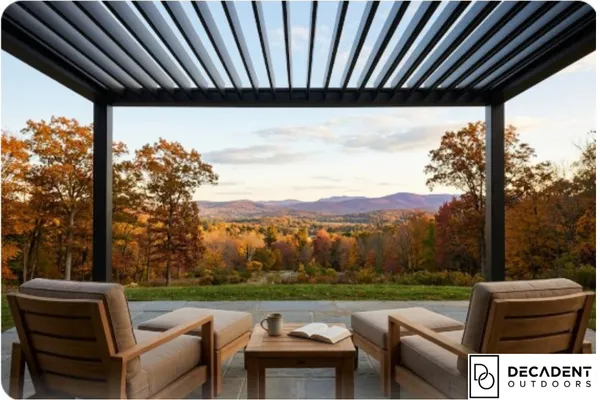
This creates a specific design brief that most contractors don't fully grasp: the structure must provide shelter and weather protection without becoming a visual presence that dominates the space. A motorized louvered pergola, open with louvers fully retracted, creates minimal visual overhead presence — you see sky through it, not structure. A solid-roof patio cover creates a visual ceiling that changes the relationship between the outdoor space and the landscape permanently. The distinction matters enormously in the Hudson Valley context.
Properties are larger — and more complex
The lot sizes across much of the Hudson Valley corridor — particularly in Rensselaer, Columbia, and southern Albany County — are larger than typical suburban lots. Properties have setbacks that provide privacy, slopes that create natural terracing, and existing landscape features that have to be integrated with any outdoor structure rather than ignored.
This complexity requires a designer who thinks about the whole property, not just the patio footprint. Where does the outdoor structure sit in relation to the house? How does it engage with the existing landscape? What happens to drainage when footings are installed on a sloped site? These questions are answered correctly only by someone with a design background, not just an installation background.
The second-home dynamic changes the investment calculus
A meaningful portion of Hudson Valley homeowners — particularly in Columbia County and the areas between Albany and the Massachusetts border — are using their properties as primary residences they moved to deliberately, or as weekend and second-home destinations. For the weekend-home owner, the outdoor space is where the value of the property is concentrated. The hours spent on a weekend property are almost entirely outdoors. A space that underperforms cuts directly into the reason the property exists.
For this buyer, the investment case for a premium outdoor structure is even stronger than for the primary residence homeowner. The cost-per-use calculation works differently when the outdoor space is the entire point of being there.
Hudson Valley homeowners chose their properties for the landscape. The outdoor structure's job is to let them be in that landscape longer, in more conditions, without compromising what they came for.
The Hudson Valley Climate — What It Means for Outdoor Design
The Hudson Valley has a distinct microclimate that differs meaningfully from Saratoga County to the north and the lower Hudson Valley to the south. Understanding these specifics matters for outdoor structure design.
Climate Factor #1
The River Effect — Humidity and Insects
The Hudson River corridor creates higher ambient humidity during summer months than you'd find at higher elevations or further from the river. That humidity, combined with the productive agricultural landscape on both sides of the valley, generates significant insect pressure from late May through September — mosquitoes, gnats, and the full complement of summer insects that make unprotected outdoor evenings genuinely uncomfortable. Motorized screen systems are not optional for Hudson Valley outdoor spaces used in summer evenings. They're the single most impactful addition for improving actual daily use. The view-respect design principle applies here too — Fenetex motorized screens are virtually invisible when retracted and create minimal visual intrusion even when deployed, preserving the landscape views that are the property's primary asset.
Climate Factor #2
Wind Exposure on Elevated and Open Properties
Properties with long views tend to sit on elevated ground or open terrain — which means exposure to prevailing winds that are substantially stronger than what you'd experience in a sheltered suburban yard. Wind is one of the primary comfort-killers for outdoor living on Hudson Valley properties and one of the most underestimated design considerations. The louvered pergola's ability to close partially against wind — adjusting the louver angle to break wind without eliminating airflow entirely — is a significant functional advantage on exposed Hudson Valley properties. Motorized screen systems on the wind-exposed sides of a structure add another layer of wind protection for evenings and shoulder-season use.
Climate Factor #3
The Foliage Season — The Outdoor Living Prize
The Hudson Valley's fall foliage season is internationally renowned. From late September through mid-November, the landscape from the Catskills through the Berkshires produces color that draws visitors from around the world. For Hudson Valley homeowners, this is the outdoor living season they most want to inhabit — and the one most often lost to cold and wind before the investment in outdoor infrastructure has been made. A covered, heated outdoor space with wind protection designed for Hudson Valley conditions recovers the foliage season completely. Sitting outside in mid-October in the Hudson Valley, with the valley spread out in color below the property and a radiant heater taking the edge off the 48-degree evening, is the single most compelling argument for outdoor living investment in this region. The homeowners who have it describe it as the best use of their property. The ones who don't are watching it from inside.
Area by Area — What Outdoor Living Looks Like Across the Hudson Valley
The Hudson Valley service area for Decadent Outdoors covers a wide geographic range with distinct character in different communities. Here's how the outdoor living brief varies across the major areas.
Albany & the Capital District
Delmar, Guilderland, Bethlehem
Character:Established suburban communities with mature properties, significant tree cover, and homeowners who have invested heavily in interior quality and want outdoor spaces that match.
Common project brief:Covered outdoor entertaining space that transitions well from the interior, screens for summer evenings, and radiant heating for the shoulder seasons that the established neighborhoods of Bethlehem and Guilderland offer.
Design note:Design must respect mature landscaping and established architectural character. Privacy screens are often a priority on closer-set lots. The outdoor room should feel like an extension of the home's quality, not a separate installation.
Rensselaer County
Schodack, Nassau, East Greenbush
Character:Mixed properties from established farmland estates to newer suburban development, with generally larger lots and stronger view orientation than the Albany west side.
Common project brief:View-respecting pergola structures that provide shoulder-season weather protection without blocking the eastern sight lines toward the Berkshires. Screen enclosures for summer use on properties near wetland areas.
Design note:Lot size and slope are primary design considerations. Foundation engineering for sloped sites is a frequent requirement. The premium is on structures that sit lightly in the landscape rather than dominating it.
Columbia County
Chatham, Kinderhook, Hillsdale, Austerlitz
Character:The most distinctly rural area in the service range — historic farmhouses, converted barns, properties with genuine acreage and pastoral views. Many are weekend or second homes for New York City and Boston-area professionals.
Common project brief:Outdoor rooms that match the historic and pastoral character of the properties — structures that feel like they belong on a farmstead, not dropped from a suburban catalog. Full season-extension capability for weekend properties used primarily in spring, fall, and summer.
Design note:Architectural coherence with historic property character is the paramount design consideration. Material choices, proportions, and finish must read as deliberate and considered. The outdoor structure is a design statement about the property — it needs to add to the character of a place that already has significant character.
Clifton Park & Northern Saratoga County
Newer construction, planned lots, active social calendars
Character:The most conventional suburban character in the service range — newer construction on planned lots with less view orientation but strong community investment in outdoor entertaining and property quality.
Common project brief:Full outdoor room systems with motorized louvers, integrated heating, and screens. Entertaining-focused spaces for communities with active social calendars. Four-season capability is the most common brief.
Design note:Less constrained by architectural historical considerations — more freedom in product choice and configuration. The brief is about performance and aesthetics equally. High-value projects that can be more architecturally ambitious than historic properties allow.
The View Question — The Most Important Design Consideration in This Market
Hudson Valley homeowners bring this up in every consultation: I don't want to block the view.
It's the right concern, and it deserves a real answer rather than reassurance.
The view concern exists because most outdoor structures homeowners have seen — solid patio covers, traditional fixed pergolas with dense overhead structure, fabric canopy systems — do create a visual ceiling that changes the relationship between the outdoor space and the landscape. A solid roof means you're always looking at the underside of a cover rather than the sky. A dense traditional pergola means the overhead beams break the sight line even when you're trying to see past them.
A motorized louvered pergola with the louvers fully open is different. The louvers are thin horizontal blades — typically three to four inches wide — with significant gaps between them when open. The visual experience from below is open sky with minimal interruption. When the louvers are in the open position, the overhead structure is barely visible. You're not looking through a cage. You're looking through a frame.
The view is preserved. The structural presence — the columns, the beam lines — can actually enhance the sense of a defined outdoor room without blocking the landscape beyond it. The pergola creates foreground and framing without eliminating the background.
This is a design conversation worth having in detail at a site consultation. The exact height, column placement, and orientation of the structure relative to the primary view direction determine whether the installation feels like it enhances the view or competes with it. Getting those decisions right is what the design process is for.
The homeowners who were most worried about losing the view are often the most satisfied with what actually happens. A well-designed pergola frames the view. It doesn't block it.
What Actually Adds Value to Hudson Valley Homes
The Hudson Valley property market has its own value dynamics that differ from the Albany suburban core and from the Saratoga Springs market to the north.
In Columbia County and the rural Hudson Valley specifically, buyers come from a wide geographic catchment — Albany, New York City, Boston — and are often making aspirational purchases. They're buying into a lifestyle that includes the landscape, the character of historic properties, and the sense of being somewhere that has been cared for over time. Outdoor spaces that match that character and perform through the region's real seasons add genuine value. Outdoor spaces that were clearly installed without regard for the property's character, or that have weathered poorly, subtract from it.
For the established suburban communities of Albany County — Delmar, Bethlehem, New Scotland — the outdoor living investment calculus is similar to what it is across the Capital Region: quality installations that extend usable season on established properties add measurable home value in a market where buyers compare properties carefully and notice the outdoor space as part of the overall quality assessment.
The consistent finding, across the Hudson Valley service area: the outdoor living investment that adds value is one that was made thoughtfully, with products appropriate to the climate and design character of the property, installed by someone who understood both. The investment made quickly, with the wrong product for the conditions, either adds nothing at resale or requires remediation before the property can be shown competitively.
Frequently Asked Questions
What outdoor living options are popular in the Hudson Valley?
The most widely adopted outdoor living investments in the Hudson Valley market are motorized louvered pergola systems for covered outdoor rooms, radiant infrared heating for foliage-season and shoulder-season extension, and motorized screen enclosures for summer insect control. The Hudson Valley's combination of view-oriented properties, significant insect pressure, and spectacular fall seasons creates specific demand for structures that extend outdoor use without compromising the landscape views that are the primary property asset.
Who are the best outdoor contractors near Albany NY?
The criteria that matter in the Hudson Valley and Albany area: experience with the specific climate conditions of the Hudson Valley corridor (humidity, wind exposure, frost depth requirements), design background adequate for view-conscious and architecturally sensitive properties, structural knowledge including snow load engineering and proper footing depth for local frost conditions, and product lines with documented performance specifications for cold-climate use. Decadent Outdoors, based in Ballston Lake, serves the full Hudson Valley corridor from Clifton Park south through Albany, Rensselaer, and Columbia County.
What adds value to Hudson Valley homes?
In the Hudson Valley market, the outdoor living investments that add demonstrable home value are those that match the character and quality of the property and extend functional outdoor use through the region's shoulder seasons. In Columbia County and the rural Hudson Valley specifically, where buyers come from wide geographies and are making aspirational lifestyle purchases, a well-designed outdoor room that performs through October and November adds significant perceived and appraised value. Poorly installed or weather-degraded outdoor structures subtract from the aspirational quality buyers are paying for.
What should I consider before adding a pergola in the Hudson Valley?
The four primary considerations specific to Hudson Valley properties: view impact — the structure must preserve the sight lines that give the property its value; wind exposure — elevated and open properties in this corridor experience wind loads that affect structural specification; insect pressure — summer evenings along the Hudson River corridor require insect protection for usable outdoor space; and frost depth — local footing requirements are 48 inches for most of the service area, which must be reflected in the installation specification. Historic properties in Columbia County add architectural coherence as a fifth consideration.
Is outdoor living worth investing in for a Hudson Valley weekend home?
For weekend or second-home properties in the Hudson Valley — particularly in Columbia County and the areas south and east of Albany — the investment case for a quality outdoor structure is especially strong. Weekend property use is concentrated almost entirely outdoors; the outdoor space is the reason the property exists. A structure that extends comfortable outdoor use from May through November recovers the entire foliage season and doubles the useful outdoor living window. The cost-per-use calculation, spread over a 20-year lifespan, is compelling for any second-home owner who genuinely wants to be outside during the Hudson Valley's most spectacular seasons.
The View Is Out There — You Might As Well Be In It
Hudson Valley homeowners chose this region for the landscape. The river in the morning light. The Catskills when the clouds catch on the ridgeline. The October hills turning red and orange and gold in a display that draws travelers from three states to stand on overlooks and take pictures of what you get to look at from your own property.
The question isn't whether the view is worth experiencing. You already answered that when you chose this place. The question is whether your outdoor space lets you experience it — in April when the valley is greening, in July when the evenings are long, in October when the color is at its peak, and on the clear November days that are among the most beautiful the region produces.
An outdoor space designed for the Hudson Valley — respecting the views, managing the wind, handling the humidity of summer, warm enough in fall — doesn't take anything away from the landscape. It gives you more of it. More months, more evenings, more mornings with coffee that are better outside than they would be anywhere else.
The conversation about what's possible for your property starts with a site visit and takes about thirty minutes. It costs nothing. What you find out is worth considerably more.