Outdoor Living Saratoga Springs NY: A Local Guide
The Saratoga Springs Homeowner's Guide to Outdoor Living: What Works Here, What Doesn't, and Why
Saratoga Springs is not a generic market. It never has been.
This is a city that has drawn wealthy visitors and residents for two centuries — first for the mineral springs, then for the racetrack, now for a quality of life that combines small-city character with genuine sophistication. The homes on the east side of town, set back from tree-lined streets on established lots, are owned by people who understand quality and expect it. The newer construction along the Clifton Park corridor and the properties that stretch north toward Ballston Spa attract professionals who moved here deliberately, who chose this particular part of New York for specific reasons, and who invest in their properties accordingly.
When a Saratoga Springs homeowner decides to do something with their outdoor space, they aren't looking for the cheapest option that technically fits. They're looking for the right option — designed for their property, their climate, their specific way of living. The difference between a homeowner in this market and a generic suburban buyer is significant. It shows in the questions they ask, the details they notice, and the long-term expectations they carry.
This guide is written for that homeowner. Specifically for Saratoga Springs. Not a national overview, not a general outdoor living primer — a Saratoga-specific look at what works here, what doesn't, and what the homeowners in this particular market are doing with their outdoor spaces.
Quick Answer
What outdoor living upgrades work best in Saratoga Springs NY?
In Saratoga Springs, the outdoor living investments that perform best are those designed for the specific climate and property character of Saratoga County: motorized louvered pergola systems with documented snow load ratings for the local winter conditions, radiant infrared heating for shoulder-season extension through October and November, and motorized screen systems for summer insect control during the long summer evenings. The Saratoga Springs property market — median home value over $348,000, with established neighborhoods where homes reflect decades of careful investment — rewards outdoor structures that match the quality and permanence of the property they're attached to. Catalog-grade products diminish; premium installations enhance.
What Makes the Saratoga Springs Market Different
A few things about this market are worth naming plainly, because they shape every outdoor living decision in specific ways.
The properties are established — and they show it
The homes on the east side of Saratoga Springs — Union Avenue, Circular Street, the neighborhoods that spread out from the historic district — are mature properties with character that took decades to develop. Large lots. Established trees. Architecture that has presence. The outdoor spaces attached to these properties have to match that character. A basic pergola kit from a home improvement store doesn't fit a Victorian with a wraparound porch on a half-acre lot any more than a chain restaurant fits Broadway.
This is not snobbery. Its design coherence. The outdoor space is part of the property, and the property already has a set standard. Outdoor additions that fall below that standard make the whole property feel less resolved, not more complete.
The racing season changes everything for eight weeks
From late July through Labor Day, Saratoga Springs operates at a different frequency. The population swells. Entertaining becomes more frequent, more visible, and more a reflection of how well the home works as a social space. Homeowners who entertain during the racing season — on properties that attract the kind of guests who move in racing and social circles — are acutely aware of whether their outdoor space performs or disappoints.
The racing season is not the only reason to invest in your outdoor space. But it is a concentrated window when the investment is most visible and most tested. Homeowners who have built their outdoor spaces correctly are proud of them in July and August. Homeowners who haven't noticed the gap more acutely during those eight weeks than at any other point in the year.
The appreciation for quality is genuine and discerning
The Saratoga Springs buyer pool is educated — 53% hold bachelor's degrees or higher, nearly double the national average — and experienced with quality across multiple domains. These are homeowners who buy good wine, who travel, who have seen outdoor spaces done well in other contexts, and know what they look like. A well-designed outdoor room doesn't impress them with its price tag. It impresses them with its coherence, attention to detail, and honest performance under Upstate New York conditions.
That discernment cuts both ways. A premium investment that delivers genuine appreciation. A premium price for a product that underperforms — that looks good in brochure photos but wobbles in the wind or discolors after two winters — is noticed and remembered.
Saratoga Springs homeowners don't need to be impressed. They need to be satisfied. The distinction is important. Impressive is about the pitch. Satisfying is about the result — year after year, in all the weather this region produces.
The Climate Realities — What Saratoga Springs Outdoor Living Actually Requires
The Saratoga Springs climate is demanding in specific ways that are worth understanding before any outdoor investment decision.
Climate Reality #1
Snow Load — The Number That Matters Most
Saratoga County receives significant annual snowfall — averaging 60 to 80 inches per year, with individual storm events capable of depositing 12 to 18 inches in 24 hours. Any outdoor structure with a closed or semi-closed roof profile must be engineered to handle that accumulation without damaging the structure or posing a risk to what's beneath it. This is the question to ask any contractor, first and most seriously: What is the documented snow load rating of this structure? StruXure systems installed by Decadent Outdoors carry specific engineered load ratings that meet and exceed Saratoga County requirements. Many lower-tier systems don't publish load ratings at all, which means either they haven't been tested or the numbers aren't worth publishing. In Saratoga Springs, that distinction is not academic.
Climate Reality #2
Freeze-Thaw Cycles — The Slow Structural Test
The temperature range in Saratoga Springs between January and July spans roughly 80 degrees Fahrenheit. That range subjects every outdoor material — aluminum, wood, composite, fasteners, footings, finish coatings — to repeated cycles of expansion and contraction that act on joints and connections over time. Premium structural aluminum with quality powder-coat or anodized finishes handles these cycles reliably for decades. Consumer-grade materials degrade visibly within a few winters. The difference is not subtle. It's the difference between a space that looks as good in year seven as it did on installation day, and one that needs attention by year three.
Climate Reality #3
The Shoulder Seasons — April, May, October, November
These are the months that most Saratoga Springs homeowners lose entirely — and they're some of the most beautiful months the city produces. The foliage season peaks in mid-October. The first warm Saturdays in April have a quality that no other month replicates. May evenings before the humidity arrives are, objectively, the best outdoor living weather the region offers. A space designed specifically for shoulder-season use — with a covered, weather-resilient structure and radiant heating overhead — fully recovers these months. For Saratoga homeowners who want to use the racing season preparation and the October foliage peak, designing for shoulder-season performance is not optional. It's the primary design brief.
Climate Reality #4
Summer Humidity and Insects
July and August in Saratoga Springs combine heat, humidity, and insects to make unprotected outdoor spaces genuinely uncomfortable in the evenings. Motorized screen systems address the insect problem while preserving airflow and the outdoor feeling. Big Ass Fans integrated into overhead structures address the heat and humidity by moving air efficiently without the noise or visual intrusion of residential ceiling fans. These aren't luxury additions for Saratoga summer use. They're functional necessities for a space that performs through the racing season, when the outdoor space is most used and most visible.
What Saratoga Springs Homeowners Are Actually Building
The outdoor living investments that are performing best for Saratoga Springs homeowners right now follow a few consistent patterns, shaped by the market's specific character.
The full outdoor room — the complete investment
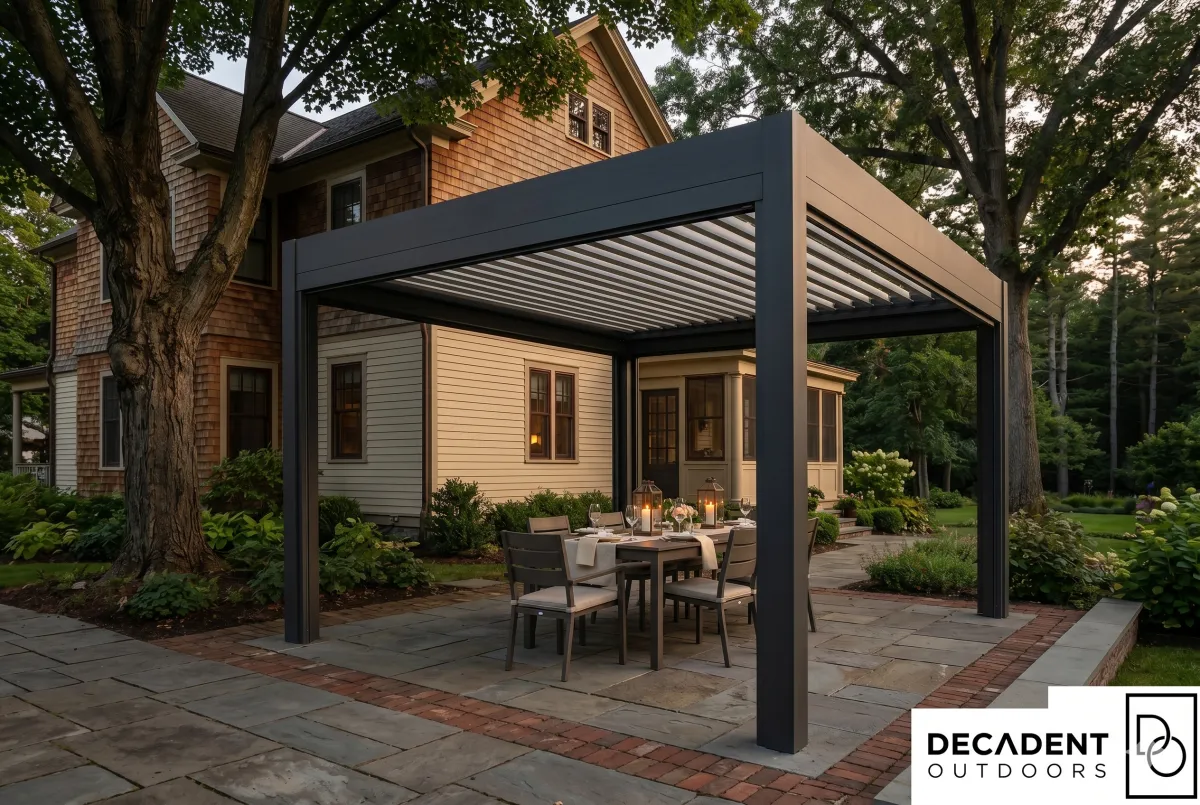
For properties on the east side of town and in the established neighborhoods off Union Avenue and Circular Street, the investment that most consistently satisfies is a complete outdoor room: a motorized louvered pergola that closes against rain and wind, integrated radiant heating for shoulder seasons, motorized screens for summer insect control, and Aspect LED lighting for evening ambiance and year-round use. This is the investment that recovers eight to ten months of outdoor living from a property that currently delivers four.
These spaces are designed to match the character of the properties they serve — not generic catalog installations but measured, proportioned, and finished to the standard the property already sets. The outdoor room feels like it belongs there. Because it was designed to.
The entertaining-focused space — built for the season
Saratoga's racing season creates a specific demand: outdoor spaces that work for entertaining during the peak social calendar of late July through Labor Day. The design brief for these spaces prioritizes capacity, flow, lighting, and the visual impression guests experience upon arrival. A defined outdoor dining area under a louvered pergola with string lights integrated into the overhead structure, radiant heaters deployed on cool evenings, and motorized screens keeping insects away during the golden hours of a racing week Friday — this is what the high-entertaining Saratoga homeowner is building.
The quiet-morning space — the understated investment
Not every Saratoga Springs homeowner is building for parties. Some of the most satisfied outdoor living investments in this market are the quiet ones — a covered outdoor space off the kitchen, designed for morning coffee and weekend reading. Protected from rain. Warm enough in September and October. Nothing elaborate, but designed correctly for the climate and the use. These spaces get used every single day. They're not Instagram-worthy in the way that a fully equipped outdoor dining room is. But the homeowners who have them will consistently tell you that the daily use is more satisfying than any single entertaining moment.
What Doesn't Work in Saratoga Springs — The Honest List
This section matters as much as the previous one.
Fabric-based pergola covers and shade sails
Fabric shade systems — pergola cover fabrics, shade sails, fabric canopies — do not hold up to Saratoga Springs winter conditions. Snow accumulation collapses them. UV exposure fades and weakens fabric over two to three seasons. Wind at the speeds the region generates tears attachment points. These products are designed for mild climates and moderate conditions. They're not designed for here. The homeowners who have tried them are almost uniformly dissatisfied by the third season.
Residential-grade products on established properties
Consumer-grade pergola kits — the aluminum structures available through national home improvement retailers and online — look adequate in photos from installation day. They look tired within a few years. The finish coats thin. The aluminum profiles flex noticeably. The connection hardware corrodes. On a property that was built with quality over decades, a consumer-grade structure reads as exactly what it is. The visual dissonance is real and compounding.
Outdoor furniture without UV and weather protection
This is the most common and most recoverable mistake. Premium outdoor furniture exposed to direct UV light degrades quickly and expensively. Cushion fabrics fade within two seasons. Teak dries and cracks without regular treatment. Metal oxidizes. A covered structure extends the useful life of outdoor furniture by years, contributing to the return on investment in the structure itself. The furniture and structure investments reinforce each other. Made separately, each underperforms. Made together, each amplifies the other.
Structures installed without frost-depth footings
This is a contractor quality issue, not a product issue. In Saratoga County, frost depth is 48 inches — footings must extend below the frost line or the freeze-thaw cycle will heave the structure over time. Footings poured to residential standards from warmer climates, or installed without adequate depth for local frost conditions, produce structures that visibly shift and rack within a few seasons. Ask every contractor: What is your footing depth specification for this site?
Why Working with a Local Installer Matters in This Market
The outdoor living contractor you hire should know Saratoga Springs the way you know it. Not as a market to serve from Albany. Not as a territory on a franchise map. As a place they've driven through in every season, worked in on every kind of day, and built in under the specific conditions this part of New York produces.
Decadent Outdoors is based in Ballston Lake — minutes from Saratoga Springs. Jeff Mazzarelli and the team have worked in this market through every condition it generates. They know what 14 inches of snow in 24 hours looks like on an outdoor structure. They know what the frost heave problem looks like when footings weren't deep enough. They know what the racing season entertaining brief looks like and what it takes to deliver a space that performs through it.
That local knowledge can't be replaced by a national dealer directory listing. It shows up in the questions asked during the consultation, in the footing specifications, in the material selections, and in the design decisions that make a Saratoga Springs outdoor space feel like it was built for Saratoga Springs — because it was.
A contractor who has worked in Saratoga Springs across every season has earned a different kind of knowledge than one who maps the market from a website. The difference shows up the first winter, and every winter after.
Frequently Asked Questions
What outdoor living upgrades work best in Saratoga Springs?
The investments that consistently satisfy Saratoga Springs homeowners are those designed specifically for the local climate: motorized louvered pergola systems with documented snow load ratings, commercial-grade radiant infrared heating for shoulder-season extension, and motorized screen systems for summer insect control. The combination extends the usable outdoor season from four months to eight or more. The specific configuration depends on the property, the use case, and the home's design character — established east-side properties typically warrant more architecturally considered designs than newer construction.
Who are the best outdoor living contractors near Saratoga Springs?
The criteria that matter most in the Saratoga Springs market: documented experience installing in Upstate New York climate conditions; structural knowledge, including frost-depth footing requirements and snow-load engineering; premium product lines with published performance specifications; and a design approach that respects the architectural character of established properties. Decadent Outdoors, based in Ballston Lake, serves Saratoga Springs and surrounding Saratoga County communities with a background in high-end outdoor environment design and an installation standard calibrated for the specific demands of this market.
What should I know about building an outdoor space in Saratoga Springs?
The key local considerations: snow load ratings for any covered structure (Saratoga County receives 60–80 inches of snow annually), frost-depth footing requirements (48 inches is the local standard), material performance through freeze-thaw cycles, and the design coherence question — whether the outdoor structure matches the architectural quality and character of the property. The racing season brief also shapes many Saratoga outdoor projects, as the late July through Labor Day window is when outdoor spaces are most used and most visible in this community.
How much does an outdoor pergola cost in Saratoga Springs?
Costs vary by size, product tier, and site requirements. A motorized louvered pergola system from a premium manufacturer, custom-sized and professionally installed for a Saratoga Springs property, typically ranges from $25,000 to $60,000 or more, depending on dimensions, features, and site conditions. Consumer-grade alternatives are available at lower price points but typically don't meet Saratoga County's winter conditions to the same standard. The investment should be evaluated in the context of property values — Saratoga County's median home value exceeds $348,000 — and against the quality standard the property itself has already set.
What outdoor structures perform well in Upstate New York winters?
Engineered aluminum structures with documented snow load ratings, marine-grade anodized or powder-coat finishes, and frost-depth footings appropriate to the local freeze depth. StruXure motorized louvered pergola systems meet these criteria specifically. Wood structures require annual maintenance and are more susceptible to moisture cycling over time. Fabric-based systems — pergola covers, shade sails, fabric canopies — do not perform well through Upstate New York winters and typically require seasonal removal. For year-round durability in Saratoga Springs conditions, engineered aluminum from a manufacturer with documented cold-climate ratings is the appropriate specification.
Built for Saratoga Springs — Not Adapted to It
There's a difference between a product designed for mild climates and one reluctantly adapted for northern use — and one designed with Upstate New York conditions as a baseline requirement. The first category disappoints eventually. The second performs for decades.
The Saratoga Springs homeowner who has lived through a few winters on an established property knows this distinction intuitively. You've seen it in other contexts. The renovation that was done right and still looks right fifteen years later. The one that was done quickly and is already showing its age.
Outdoor living is the same calculation. The investment made correctly — with the right products, the right installer, and the right design for this specific property in this specific climate — will be part of your home for a generation. The investment made incorrectly will be a redo project.
The conversation about which applies to your property starts with a site visit and thirty minutes of honest conversation. It costs nothing to have. The information you'll leave with is worth considerably more than that.