Pergola vs Awning vs Screen Room: How to Choose in Upstate NY
Pergolas, awnings, and screen rooms solve three different outdoor problems for Capital Region and Hudson Valley homeowners. A pergola defines a permanent outdoor room with motorized control over sun and rain. An awning provides retractable shade from an existing structure. A screen room fully encloses an outdoor space, protecting it from insects and wind. The right choice depends on whether you want year-round flexibility, simple sun protection, or enclosed comfort — and what you're willing to invest.
The short version
Pergola (motorized) — Year-round flexible outdoor room. Highest cost, highest flexibility, smart-home integration. $25K–$75K+ installed.
Awning — Simple retractable shade. Lowest cost, narrowest scope. $2.5K–$8K installed.
Screen Room — Fully enclosed outdoor living. Often adds appraisable square footage. $15K–$40K+ installed.
Hybrid — Combine a motorized pergola with integrated retractable screens for the best of both. The most common premium configuration in Upstate NY.
What's the difference between a pergola, an awning, and a screen room?
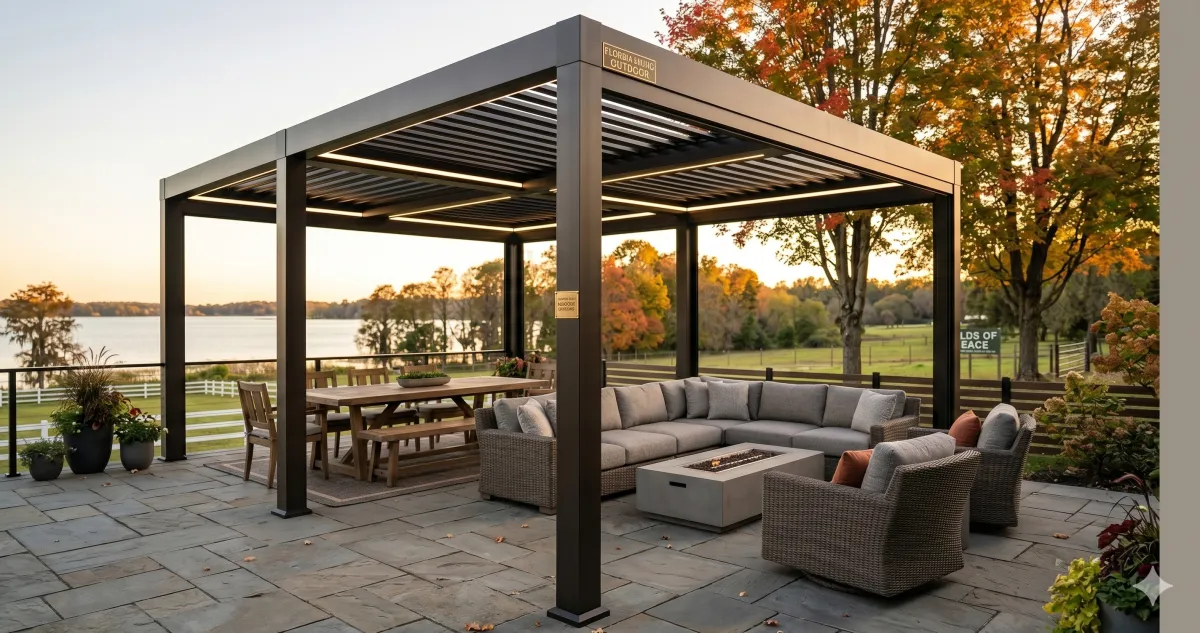
A pergola is a permanent outdoor structure with a roof of slats or louvers. Traditional pergolas have fixed slats — wood or vinyl, attractive but unable to adapt. A motorized pergola, such as a StruXure system, has aluminum louvers that pivot at command. Open them fully for the sun. Close them against the rain. Angle them anywhere in between for shade and airflow. The structure becomes a true outdoor room that works in any weather.
An awning is a retractable fabric covering that extends from an existing wall — typically over a deck, patio, or window. It deploys when you want shade and retracts when you don't. Motorized awnings extend at the push of a button, sometimes with wind and sun sensors. An awning does one job well: shade. It doesn't try to do more.
A screen room is a fully enclosed outdoor structure — walls of screen mesh, a permanent roof, sometimes a finished floor. The screens keep insects out and break the wind, while letting air and light through. A screen room is the most sheltered of the three. In return for that shelter, it gives up openness — you're inside a structure rather than under an open canopy.
All three add usable outdoor time. Where they differ is how, how much, and at what cost.
Pergola vs Awning vs Screen Room: side-by-side comparison
The table below shows realistic numbers and capabilities for the Capital Region and Hudson Valley market — not generic national averages.
The table shows the structural tradeoffs. The right answer for most Upstate NY homeowners depends on four factors covered below: climate fit, home value, lifestyle, and budget.
Which outdoor structure works best in Upstate NY's climate?
The Capital Region and Hudson Valley deliver one of the more demanding outdoor climates in the Northeast — short summers, dramatic shoulder seasons, hard winters, and high-intensity sun in July and August. Each of the three structures handles those conditions differently.
Motorized pergolas perform best across the full range. The louvers close completely during rain, which keeps the space usable through the summer thunderstorm pattern that defines July and August here. They open fully for the sun on cool mornings and shoulder-season afternoons. With integrated heating, the space extends usefully into mid-November and back into late March.
Awnings handle one job — shade — and handle it well in summer. They struggle during shoulder seasons because retractable awnings can't deploy safely in high winds, and the Capital Region's spring and fall winds are unpredictable. Snow load means awnings retract entirely from November through April. They're a four-month product in this climate.
Screen rooms handle wind and insects beautifully and meaningfully extend the season into late October. Their weakness in this region is the same as their strength — the screens reduce direct sun, which is welcome in July but unwelcome in October when you want every photon of warmth. A pergola with integrated screens solves this by letting you screen down when needed and open up when you want sun.
Which adds the most home value in the Capital Region?
Honest answer: It depends on the buyer and the appraiser.
A motorized pergola in the Capital Region typically recoups 50% to 80% of its installed cost in home value, with the upper end more likely in Saratoga County's $348K-plus median property market. The differentiator is that motorized systems are still rare in the region. They signal sophistication and often appear in MLS listings as a featured upgrade.
An awning rarely shows up as a value-add. Appraisers treat awnings as movable improvements rather than permanent square footage. They earn their cost in lifestyle terms, not resale.
A screen room often adds the most measurable square footage. Some appraisers count finished, weather-protected screen rooms as additional living space, which can materially affect the home's appraised value. The catch is that screen rooms read more dated than motorized pergolas — they were the premium outdoor structure of the 1990s, and the market knows it.
For homeowners primarily thinking about resale, the motorized pergola wins on signal, the screen room on measurable square footage, and the awning on neither.
How to choose: a four-question framework
Four questions to ask yourself, in order:
What's the primary problem? Sun and shade only? Add an awning. Rain protection or year-round use? Add a motorized pergola. Insects and a full enclosure? Add a screen room. The primary problem is the right anchor.
How important is flexibility? If you want to choose your weather conditions on demand, the motorized pergola is the only product with that capability. If you want a single mode that runs without you having to think about it, an awning or screen room handles it.
What's the budget reality? Awnings start around $2,500. Screen rooms start around $15,000. Motorized pergolas start around $25,000 and scale with size and integration. The honest budget question is whether you're solving for the lowest-cost solution or the most-flexible solution.
Do you want year-round outdoor living? If yes, a motorized pergola with integrated screens and heating is the only configuration that actually delivers it in Upstate New York. If you're happy with summer-only outdoor use, an awning or a screen room is fine.
Can you combine them? The hybrid approach
Yes. The premium configuration in the Capital Region and Hudson Valley is a motorized louvered pergola with integrated retractable screens and optional radiant heating. The pergola handles sun and rain. The screens deploy when insects or wind become an issue. The heat extends the season into the shoulder months.
This hybrid is more expensive than any single product on its own — typically $40,000 to $90,000 installed, depending on size and integration depth. But it does what all three products do, in one structure, with one warranty and one point of service. For homeowners thinking about a multi-decade investment, the hybrid is what serious buyers in this region build.
What a project looks like in the Capital Region
A typical motorized pergola installation in Saratoga County looks like this. The homeowner books a free consultation. The Decadent Outdoors team visits the site, measures, and discusses how the family actually wants to use the space — morning coffee, evening dinners, watching the kids, hosting friends. The design comes back with motorized louvers, integrated lighting, and usually integrated retractable screens. Engineering, permitting, and material lead time take six to eight weeks. Installation runs three to five days on-site.
The first evening in the new space usually occurs within 8 to 16 weeks of the first consultation. Recent projects have included homes in Saratoga Springs, Clifton Park, and across the Hudson Valley — each one different in scale and configuration, all using the same StruXure base technology adapted to the specific site and family.
Frequently asked questions
What's the difference between a pergola and an awning?
A pergola is a permanent outdoor structure with its own columns and roof — typically built as an outdoor room. A motorized pergola has aluminum louvers that pivot to control sun, rain, and shade on command. An awning is a retractable fabric covering that extends from an existing wall, usually over a deck or window. It provides shade when extended and retracts when not in use. The practical difference: a pergola creates a new outdoor space; an awning extends shade onto an existing one. Pergolas typically cost ten to twenty times more than an awning and last decades longer.
Should I get a pergola or a screen room?
The choice comes down to two questions. First: do you want a permanent enclosed space, or a flexible covered space? A screen room is enclosed and fixed. A motorized pergola is open by default with closeable louvers. Second: How important are bugs? If you live near water or wooded property and insects are a daily issue, a screen room earns its place. If insects are seasonal, a motorized pergola with integrated screens gives you the bug protection only when needed, plus the open feel the rest of the time.
Which outdoor structure adds the most home value in Saratoga County?
In Saratoga County's $348K-plus median property market, the answer splits two ways. Screen rooms add the most measurable square footage, because some appraisers count finished screen rooms as additional living space. Motorized pergolas add the most signal value — they're rare enough in the region to appear as a featured upgrade in MLS listings and to attract buyers willing to pay a premium for the lifestyle. Awnings rarely show up as a value-add. For pure resale ROI, a screen room typically wins. For lifestyle plus resale together, a motorized pergola usually wins.
Can I install all three on the same property?
Yes, though most homeowners don't need to. The more common configuration is a single motorized pergola with integrated retractable screens, combining the functions of all three products into a single structure. Some larger properties install separate structures for specific uses — a screen room near the kitchen for daily family meals, a motorized pergola in the backyard for entertaining, and an awning over a side patio. The right answer depends on how the family actually uses the space.
What's the lifespan of each structure?
A motorized aluminum pergola from a premium manufacturer like StruXure typically carries a 25-year structural warranty and lasts longer with minimal maintenance — no rot, no staining, no annual servicing. A traditional wood pergola lasts 10 to 15 years with regular maintenance, less without. A fabric awning lasts 8 to 12 years before the fabric needs replacement, though the motorized hardware lasts longer. A screen room lasts 20 to 30 years structurally, with screen mesh replacement every 8 to 12 years. In the Capital Region's freeze-thaw climate, aluminum and steel framing dramatically outlast wood.
Ready to figure out which structure is right for your space?
Schedule a free consultation with Decadent Outdoors. We'll visit your property, look at the space, and walk through what each option would mean for your specific situation — your house, your yard, your climate exposure, and how your family actually wants to use the space. No pressure, no high-pressure sales pitch. Just clear answers from people who've been doing this work for a long time.
SCHEDULE YOUR FREE CONSULTATION → decadentoutdoors.com/consultation
Want to see the differences in person before scheduling a consultation? Browse the Decadent Outdoors project gallery — completed motorized pergolas, screen rooms, and hybrid systems across the Capital Region and Hudson Valley. Most of the projects you'll see started with the same question this article answers.