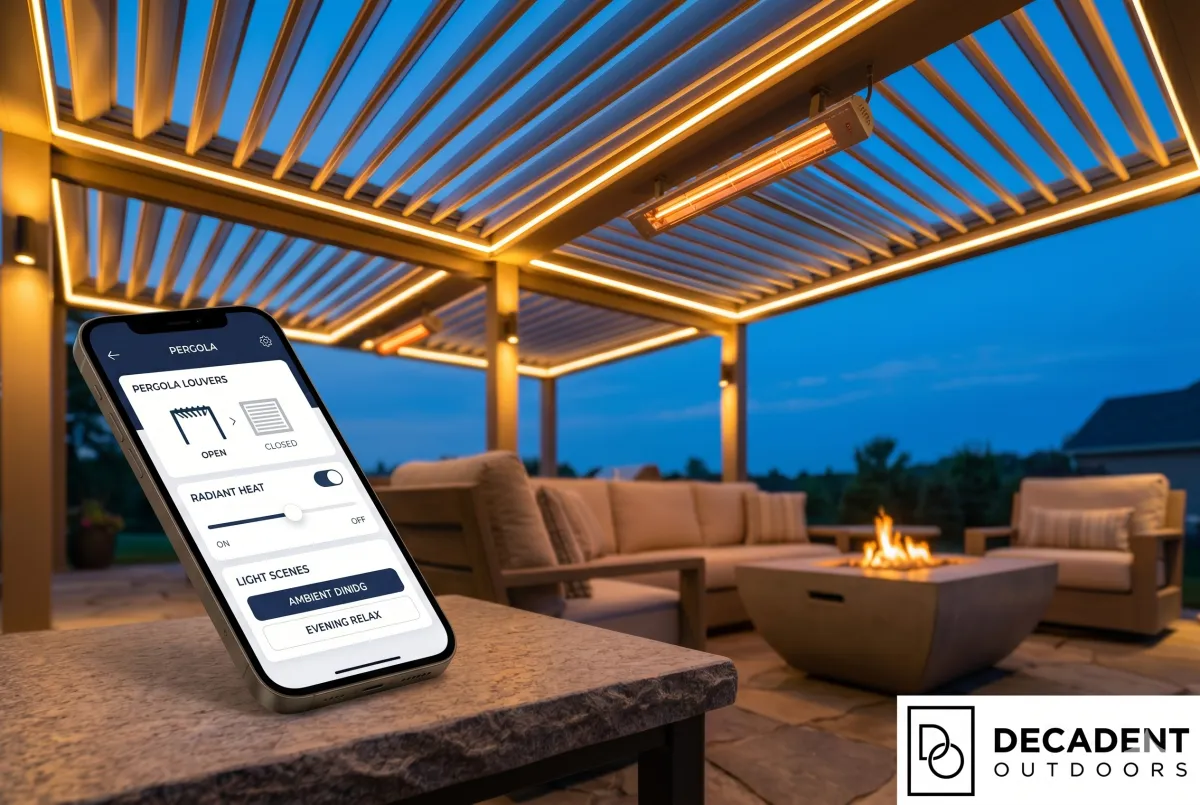
Smart Outdoor Living Technology in the Capital Region
The Smartest Outdoor Space in the Capital Region: How Technology Is Transforming Outdoor Living
Walk through your house and count the things you control from your phone.
The thermostat. The lights. The door locks. The security cameras. The blinds, maybe. The speakers. In a modern home, the gap between your phone and your environment has narrowed to almost nothing. You don't walk to a wall switch anymore. You don't adjust a thermostat manually. The house responds to you.
Now walk out the back door.
Suddenly it's fifteen years ago. The patio is the same temperature it was when you stepped outside. The pergola does what it always does — nothing. The umbrella needs to be physically opened. The patio heater requires a propane check and an igniter click. If rain starts, someone has to go put the cushions away.
The technology gap between your indoor environment and your outdoor environment is real, and for most homeowners it's wider than it has any reason to be.
The outdoor living products Decadent Outdoors installs bridge that gap. This article explains exactly how — what smart outdoor technology exists, how it works in practical terms, and what it changes about the daily experience of using your outdoor space.
Quick Answer
What is a smart outdoor living space?
A smart outdoor living space uses app-controlled, automated, and precision-engineered systems to manage light, weather, temperature, and ambiance without manual intervention. The defining features: motorized louvered pergolas that open, close, and adjust via smartphone app or automation; infrared radiant heaters that activate from your phone and respond to temperature settings; motorized screen systems that deploy by remote or schedule; and integrated LED lighting that sets scenes rather than just providing illumination. Smart outdoor spaces are not a new category — the technology exists and is installed in Capital Region homes now. What's new is how accessible the category has become, and how dramatically it changes the daily usability of an outdoor space when all the components work together.
Why Outdoor Spaces Stayed Analog While Everything Else Got Smart
Smart home technology penetrated indoor living first and most completely because indoor systems — HVAC, lighting, security — were already wired infrastructure that could be upgraded with controllers and connectivity. The technology followed the existing wiring.
Outdoor spaces are different. They're exposed to weather. They require products built to withstand temperature extremes, moisture, UV exposure, and the mechanical stress of opening and closing through thousands of cycles. Consumer smart home technology isn't built to those standards. The outdoor environment chews through products that aren't engineered for it.
The result: smart home investment extended seamlessly through most of the house and stopped at the back door. The gap wasn't philosophical. It was material — the right products for smart outdoor living didn't exist at consumer scale until relatively recently.
That has changed. The products that make a genuinely smart, responsive outdoor space possible now exist, have been proven in demanding commercial applications, and are available for residential installation in the Capital Region. The gap between indoor sophistication and outdoor primitivism doesn't have to exist anymore.
The technology gap between your indoor environment and your outdoor environment is not the result of technology limitations. It's the result of not yet knowing what products are available. That's a solvable problem.
The Smart Outdoor Technology Stack — What It Is and How It Works
A fully integrated smart outdoor space uses five categories of technology that work independently but compound when combined. Here's each one, specifically.
StruXure
Motorized Louvered Pergola System
What it does:StruXure pergolas use precision aluminum louvers driven by weatherproof motors that rotate the louvers from fully open to fully closed — and any angle between — via a handheld remote, a wall-mounted control panel, or a smartphone app. The app provides full control from anywhere, including preset positions for common configurations (morning sun, afternoon shade, full cover).
Why it matters in the Capital Region:In Upstate New York's variable climate, manual adjustment of an outdoor cover is a disincentive to use. When adjusting the space to changing conditions is a phone tap, the space gets used more — because the friction of managing it has been eliminated.
The smart factor:Rain sensor integration. StruXure systems can be configured with weather sensors that automatically close the louvers when rain is detected — without any action required from the homeowner. You're away from home, a summer storm rolls in, the pergola closes automatically. Nothing gets wet. You don't have to worry about it.
Infratech & Bromic
Precision Infrared Radiant Heaters
What it does:Infratech and Bromic infrared heaters are ceiling-mounted, weatherproof systems that emit infrared radiation to heat bodies and surfaces directly — not the surrounding air. Control is via wall switch, remote, or app integration. Zone heating allows different areas of the outdoor space to be heated independently, at different levels, without heating the whole space uniformly.
Why it matters in the Capital Region:In the Capital Region's shoulder seasons — April, May, October, November — the difference between a heater you have to physically walk to and adjust and one you activate from the dinner table is the difference between using the space and going inside. The technology removes the friction that keeps outdoor spaces underused.
The smart factor:Smart home integration. Infratech systems can integrate with major smart home platforms, enabling voice control, schedule automation, and scene coordination — "Outdoor evening mode" activates lights, heaters, and whatever else is on the scene profile.
Fenetex & SummerSpace
Motorized Screen Systems
What it does:Fenetex and SummerSpace motorized screens are large-format exterior screening systems that retract completely into a housing when not in use and deploy by remote control to create a screened enclosure around the outdoor space. Screen types vary from insect mesh to solar-reducing fabric to wind-breaking solid panels — different screens for different functional goals within the same system.
Why it matters in the Capital Region:For Capital Region homeowners, the summer insect problem is the primary screen use case. A screen that deploys in seconds at the touch of a remote eliminates the evening frustration of insects without requiring a permanent screen enclosure that blocks airflow and views all year. The screens appear when you need them and disappear when you don't.
The smart factor:The motorized screen is the technology that converts "I can't use this in the evening in summer" to "I use this every evening in summer." The change is behavioral, but it's driven by the technology removing a friction point. Without motorized deployment, most homeowners don't bother.
Big Ass Fans
Commercial-Grade Outdoor Ceiling Fans
What it does:Big Ass Fans are commercial-grade ceiling fans specifically engineered for outdoor installation — sealed motors, weatherproof finishes, and blade designs that move large volumes of air efficiently at low RPM with minimal noise. Most models include app control, speed presets, and smart home integration. The name is a product of the company's engineering philosophy: the fans are substantially larger than residential ceiling fans and move correspondingly more air.
Why it matters in the Capital Region:The combination of heat and humidity that characterizes Saratoga Springs and Hudson Valley summers makes a ceiling fan the most impactful single summer comfort addition to an outdoor space. A correctly sized Big Ass Fan running at low speed creates a breeze that eliminates the stagnant heat problem completely — at a fraction of the energy cost of any cooling alternative.
The smart factor:Smart scheduling and automation. Set the fan to run at low speed during afternoon hours automatically, increase when the temperature sensor reads above a threshold, and turn off with the lights when the outdoor living scene deactivates. The fan manages the environment without any manual interaction.
Aspect LED
Architectural Outdoor Lighting Systems
What it does:Aspect LED systems are architectural-grade outdoor lighting designed for permanent integration into pergola structures, exterior architecture, and landscape features. Unlike consumer outdoor lighting, Aspect systems are designed for app and automation control, with color temperature adjustment, dimming capability, and scene programming built in.
Why it matters in the Capital Region:Lighting is the most underestimated technology in outdoor living. The right lighting transitions the outdoor space from functional to atmospheric — the difference between a well-lit patio and a space you want to stay in. Aspect LED integrated into a pergola structure provides overhead ambient lighting that creates the same sense of enclosure and warmth as indoor lighting, but outdoors.
The smart factor:Scene programming. "Dining mode" dims the overhead lights to a warm 2700K and activates path lighting. "Reading mode" brings the overhead to full brightness. "Evening ambient" transitions the entire space to a warm, low-light atmosphere at a specific time. Scene control from a smartphone turns the outdoor space into an environment you set intentionally, not just one you walk into.
What Changes When the Technology Works Together
Each system is valuable independently. When they work together — controlled from a single app, responding to common sensors, activated by shared scenes — the experience is qualitatively different from managing each element separately.
Here's what a day in a fully integrated smart outdoor space looks like in the Capital Region.
The through-line across all six scenarios is the same: the technology removes friction between wanting to use the space and actually using it. Weather adaptation, seasonal management, entertaining setup, remote monitoring — all happen with phone taps rather than physical intervention or passive acceptance of whatever conditions exist.
That reduction in friction is not trivial. Behavioral research consistently shows that small friction increases cause large behavioral changes. A space you have to manually manage in response to conditions gets used significantly less than one that manages itself. The technology is not a luxury addition. It's the mechanism that makes the space reliably usable.
Smart Home Integration — What It Looks Like and What's Realistic
The question homeowners most often ask about smart outdoor technology is whether it integrates with their existing smart home system — Alexa, Google Home, Apple HomeKit, or a professional system like Control4 or Savant.
The honest answer: some systems integrate, some don't yet, and the integration landscape changes quickly. Here's the practical reality.
What integrates reliably today
StruXure pergola systems have dedicated apps with full control capability and are moving toward broader smart home platform integration. Infratech heaters can be integrated with smart home systems through compatible controllers. Aspect LED lighting systems support standard smart home protocols. Big Ass Fans offer direct Alexa and Google Home integration on most current models. The practical integration story for a Capital Region outdoor space today: full app-based control of all systems from a single or separate apps, with growing but not yet uniform smart home platform integration.
What's coming
The outdoor living technology category is developing rapidly. The integration roadmap for major smart outdoor platforms is moving toward full compatibility with mainstream smart home ecosystems. The systems installed today are built on open protocols that will accommodate integrations as they become available — which means the investment in smart outdoor technology isn't locked to today's capabilities. The hardware endures; the software improves around it.
What matters most practically
For most Capital Region homeowners, full smart home platform integration is secondary to one question: can I control this from my phone? Yes, comprehensively, for every system in Decadent Outdoors' portfolio. App-based control — a dedicated interface from your phone, wherever you are — is available for all systems. For homeowners with deeper smart home investment, integration capability should be discussed during the consultation so the system architecture supports your specific platform.
The homeowner who can close their pergola louvers from a restaurant when they remember rain was forecast, and turn on the heater from the kitchen so the space is warm when they bring dinner outside — that homeowner uses their outdoor space differently than one who has to do all of that manually.
Who Smart Outdoor Technology Is Actually For
The phrase "smart outdoor technology" can conjure an image of a certain kind of early adopter — someone who has every gadget, who reads technology reviews, who sets up home servers for fun. That's not the primary audience for this category.
The homeowners who benefit most from smart outdoor technology are the ones who are consistently frustrated by the friction of managing their outdoor space. The person who checks the weather before deciding whether to eat outside. The person who leaves the outdoor heater off because getting up to adjust it feels like too much. The person who has gone inside more than once because clouds rolled in and nobody wanted to deal with the umbrella.
The technology doesn't require any particular technical interest or sophistication. Opening an app and pressing a button takes the same skill as turning on a light. The systems are designed to be invisible after setup — you don't maintain them, you don't troubleshoot them, you just use the outdoor space more than you did before.
The demographic for smart outdoor technology in the Capital Region is simply: homeowners who want their outdoor space to work as well as their indoor space, and who are tired of the gap between the two.
In Saratoga County, where median household income exceeds $100,000 and more than half the adult population holds graduate degrees, that description fits a large portion of the homeowner population. The technology exists. The products are available. The gap between indoor sophistication and outdoor primitivism is closeable.
Frequently Asked Questions
What is a smart pergola?
A smart pergola is a motorized louvered pergola with app-based or automated control of the louver position. The louvers — adjustable aluminum blades that form the roof of the structure — open, close, and stop at any angle via a remote, wall panel, or smartphone app. Advanced systems include weather sensors that trigger automatic louver closure when rain is detected, and integration capability with smart home platforms. StruXure is the leading manufacturer of smart pergola systems in North America and the system installed by Decadent Outdoors.
Can you control outdoor spaces with an app?
Yes — comprehensively, across all the major smart outdoor living systems. StruXure motorized pergolas offer full app-based louver control from any location. Infratech and Bromic radiant heaters can be app-controlled through compatible smart home systems. Fenetex and SummerSpace screen systems include remote control as standard. Big Ass Fans offer direct app control and integrate with Alexa and Google Home. Aspect LED lighting systems support app control and scene programming. Taken together, a fully equipped outdoor space can be managed entirely from a smartphone.
What technology options exist for outdoor living upgrades?
The main technology categories for smart outdoor living: motorized louvered pergola systems (app-controlled roof with weather automation), precision infrared radiant heaters (app-controlled zone heating), motorized screen systems (remote-deployed insect and wind protection), commercial-grade outdoor ceiling fans (smart speed control and automation), and architectural LED lighting (scene programming and app dimming). These systems work independently or in coordination, and are all available for residential installation in the Capital Region through Decadent Outdoors.
Do smart outdoor systems integrate with Alexa or Google Home?
Integration varies by system and continues to expand. Big Ass Fans offer direct Alexa and Google Home integration on most current models. Aspect LED lighting systems support standard smart home protocols compatible with major platforms. Infratech heaters can integrate through compatible smart home controllers. StruXure pergola systems have dedicated app control and are developing broader platform integration. For homeowners with existing smart home investment in a specific platform, integration capability should be discussed during consultation to ensure the system architecture is designed to support it.
Is smart outdoor technology worth the additional investment?
The case for smart technology in outdoor living is not primarily about gadget appeal. It's about behavioral change: spaces that manage themselves in response to conditions get used significantly more than spaces that require manual intervention. The homeowner who can close louvers automatically during rain, activate heating from the kitchen before stepping outside, and set a complete outdoor scene for entertaining with a phone tap — that homeowner uses their outdoor space differently and more frequently. The additional investment in smart controls is typically modest relative to the overall project cost, and the return in actual daily use is disproportionately large.
The Outdoor Space Your Indoor Space Deserves
The smart home revolution made the indoor environment responsive, adaptive, and effortless. It never fully arrived outdoors — not because the technology didn't exist, but because the products built for outdoor conditions at that level of sophistication weren't available at scale.
They are now. The systems are proven, installed, and working in Capital Region homes. The StruXure app that closes louvers before rain arrives. The Infratech heater that warms the space before you step outside. The Fenetex screens that drop at the touch of a button as the insects emerge. The Aspect LED lighting that transforms the outdoor room into an evening destination.
Your outdoor space doesn't have to be fifteen years behind your indoor space. The technology that closes that gap is available, specific, and designed for exactly the climate you live in.
The conversation about what's possible for your space starts the same way all the others in this series have: a site visit, thirty minutes of listening, and an honest assessment of what the technology can do for how you actually want to live outside.