Ten Minutes Outside — Biophilia Research for Homeowners
Ten Minutes Outside: The Peer-Reviewed Science Behind Why Your Brain Knows the Difference
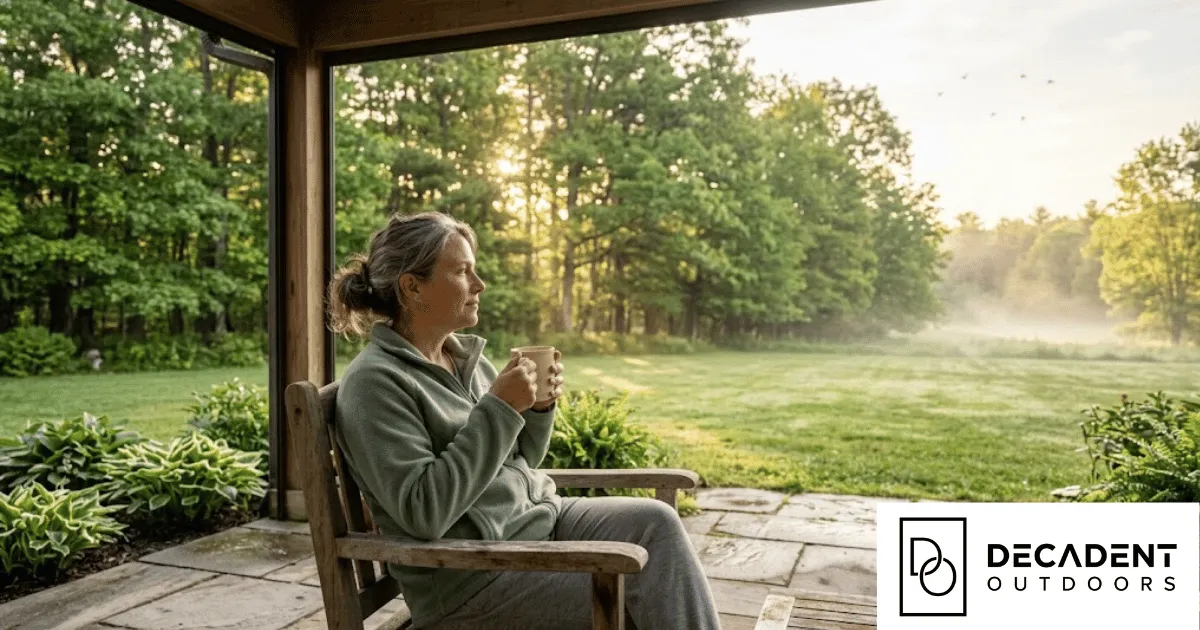
The Capital Region homeowner who walks out the back door with a coffee at 6:45 AM — the one who stands on the patio for ten minutes before the day starts, looking at the foliage edge of the property — isn't doing nothing.
They're not relaxing. They're not procrastinating. They're not avoiding the inbox. They are, whether they articulate it or not, running a biological protocol that their nervous system requires and that thirty years of peer-reviewed research has now documented in measurable, replicable detail. Their cortisol is dropping. Their blood pressure is falling. Their parasympathetic nervous system is activating. Their cognitive bandwidth is being restored. By the time they finish the coffee and walk back inside, the brain they carry into the rest of the day is genuinely different than the brain that walked out the door.
The homeowner who can't do that — because the bugs make it intolerable, or the sun is already too harsh, or the wind is wrong, or the chill of an October morning has shut the patio for the season — isn't just losing a pleasant moment. They are losing the biological infrastructure their property was supposed to provide.
This is the third installment of The Fourth Wall. Blog 1 named the 77% underutilization problem. Blog 2 named what the backyard quietly became after 2020 — the new third place. This piece looks at the third frame: the peer-reviewed science of what nature exposure actually does to the human body, and what gets lost when a homeowner can't access the outdoor portion of their own property.
Quick Answer
What does nature exposure actually do to the human body?
Peer-reviewed research across more than three decades has documented that exposure to natural environments produces measurable physiological change. As little as ten minutes of contact with a natural setting measurably reduces cortisol (the primary stress hormone), lowers blood pressure and heart rate, and activates the parasympathetic nervous system — the body's rest-and-recovery mode. Studies grounded in two major frameworks — Stress Reduction Theory (Roger Ulrich) and Attention Restoration Theory (Rachel and Stephen Kaplan) — show that even brief, regular nature contact improves cognitive function, reduces rumination, lowers symptoms of anxiety and depression, and correlates with reduced risk of cardiovascular disease and improved sleep. The mechanism is not psychological alone — it is autonomic. The body recovers faster from stress when it has access to natural environments. For Capital Region homeowners, the backyard is the property's mental health infrastructure. When it's accessible, the brain benefits accumulate. When it isn't, they don't.
Biophilia: The Hypothesis That Started It
In 1984, the Harvard biologist E. O. Wilson published a slim book titled Biophilia. The argument was deceptively simple. Humans evolved for two million years in close contact with natural environments. The brain, the nervous system, the sensory architecture, the stress-recovery mechanisms — all of it was shaped by that evolutionary history. The shift to fully indoor, screen-mediated, climate-controlled, biologically sterile environments happened on a timescale of decades, not millennia. The mismatch between the environment the human body is built for and the environment most humans now spend their time in had to have consequences.
Wilson called the innate human affinity for nature biophilia. The hypothesis was that humans don't merely prefer natural environments aesthetically — they need them physiologically. The research that has followed Wilson's hypothesis is now substantial. The biophilia framework underlies modern environmental psychology, hospital design, workplace wellness research, and the WELL Building Standard adopted by major commercial real estate. What started as a biologist's hypothesis has become one of the better-replicated claims in applied health research.
The Two Frameworks That Made It Measurable
Two research programs, running in parallel for the last forty years, have produced most of the evidence for what nature exposure actually does. Both are worth understanding because they explain different parts of the same effect.
Stress Reduction Theory (Roger Ulrich)
In 1984, the environmental psychologist Roger Ulrich published a study in Science that became one of the most-cited papers in the field. Ulrich examined hospital records of patients recovering from gallbladder surgery. Half had been assigned, by chance, to rooms with windows facing a small stand of trees. The other half had rooms facing a brick wall. Controlling for every variable he could measure, Ulrich found that the patients with the tree view recovered faster, required less pain medication, reported less anxiety, and were discharged sooner.
The mechanism Ulrich proposed — later refined into Stress Reduction Theory — was autonomic. Exposure to natural environments activates the parasympathetic nervous system, the branch responsible for rest, digestion, and recovery. The body shifts out of sympathetic mode (fight, flight, alertness) and into restoration. Cortisol drops. Heart rate slows. Blood pressure falls. The shift is fast, measurable, and requires no conscious effort. The body does it on its own when given the input.
Attention Restoration Theory (Rachel and Stephen Kaplan)
Around the same time, the University of Michigan environmental psychologists Rachel and Stephen Kaplan were studying a different question: why nature exposure also seemed to improve cognitive function. Their framework, Attention Restoration Theory, distinguishes between two kinds of attention. Directed attention — the kind needed for work, problem-solving, screens, conversation, anything that requires conscious focus — is a finite resource that depletes through use. Effortless attention — the kind that happens when the eye is drawn to a moving leaf, a passing cloud, the surface of a lake — doesn't deplete. It restores.
Natural environments are unusually good at engaging effortless attention. The visual fractals of trees, the irregular but coherent patterns of water, the subtle motion of vegetation in wind — all of it activates effortless attention without making demands on the directed-attention system. The result, after even short exposure, is measurable cognitive recovery. Subjects who have spent time in natural environments perform better on tasks requiring concentration, working memory, and proofreading accuracy than subjects who have spent the same time in urban or indoor environments.
What Ten Minutes Actually Does
The question that anyone living in a busy life would reasonably ask: how much nature exposure does it take? The answer turns out to be encouragingly small.
A 2020 scoping review published in Frontiers in Psychologyexamined fourteen experimental studies of college students exposed to natural settings. The reviewers concluded that as little as ten minutes of sitting or walking in a variety of natural environments produced significant improvements across multiple psychological and physiological markers — reduced perceived stress, lower diastolic blood pressure, lower salivary cortisol, improved mood, and improved cognitive performance. The dose-response wasn't linear, but the threshold was low. A short walk produced measurable change. Longer exposures produced larger change.
A broader 2021 review published in the International Journal of Environmental Research and Public Health aggregated evidence across experimental and observational studies on nature exposure and health. The review documented associations between nature exposure and improved cognitive function, improved brain activity, lower blood pressure, better mental health, increased physical activity, better sleep, and reduced cardiovascular risk. The protective effects of nature exposure on mental health and cognitive function were strongest in the experimental studies — the studies designed to isolate the variable.
The body doesn't argue with the research. It responds whether the homeowner consciously believes in it or not. Cortisol drops. Blood pressure falls. The brain that comes back inside is a different brain than the one that walked out.
What the Pandemic Year Made Visible
In 2022, researchers at the University of Colorado-Boulder published a study of approximately 1,200 Denver-area residents that measured the relationship between green space exposure and mental health during the first year of the pandemic. The study controlled for income, race, education, and pre-existing mental health conditions. The finding was direct: residents who spent more time in parks and green space during 2020 reported significantly lower rates of anxiety and depression than residents who didn't, even after controlling for the confounding variables.
One-third of the Denver sample reported spending more time in nature in 2020 than they had pre-pandemic. The senior researcher, Colleen Reid of CU-Boulder, summarized the implication directly: nature exposure is not a luxury good. It is a public health input. During a period of acute stress, the population that had access to and used green space was measurably better protected against the mental health consequences than the population that didn't.
The 2020 data is particularly useful because the pandemic stress was the same across the sample — the same news, the same isolation, the same uncertainty. The variable that differed was nature access. The population with more access fared better. The population with less access fared worse. The mechanism wasn't psychological self-report. It was measurable physiological and mental health outcomes.
What This Means for the Capital Region Homeowner
The Capital Region homeowner who paid $759,900 for a property in Saratoga County (the late-2025 median sale price per Redfin) was paying for several things. The interior square footage and quality. The neighborhood and school district. And, built into the price — though it doesn't appear on a real estate listing — access to the natural setting. The foliage. The lake views. The Adirondack foothills. The visual depth of a property line that opens onto green space rather than another house's wall.
The biophilia research provides a frame for what the homeowner was actually paying for. Not aesthetics in any superficial sense. Biological infrastructure. The patio, the deck, the porch, the pergola — all of it is the access mechanism for a daily restorative process the body requires. The morning coffee on the patio is not a leisure moment. It is the day's first dose of nature exposure, with measurable consequences for cortisol, attention restoration, and cognitive performance for the next six to eight hours.
When access breaks — when blackflies make the morning unworkable in late May, when mosquito dusk shuts the evening down in July, when shoulder-season chill ends the patio at 6:30 PM in October — what's lost isn't a pleasant moment. The biological process the property was supposed to support stops happening. Over a year, the lost ten-minute exposures add up to roughly sixty hours of nature contact the household paid for and didn't get. Over five years, three hundred hours. The consequences don't show up on a single bad day. They show up in the cumulative felt experience of the household over years.
The Fourth Wall as a Health Input
There is a way of describing motorized screens that misses the point. The way that calls them a luxury accessory. A summer-evening convenience. A bug solution.
The biophilia framing is different. The Fourth Wall — the side of the patio that closes against bugs, sun, wind, or chill when conditions require, and disappears when they don't — is the engineering that protects the homeowner's daily access to nature exposure. Not the convenience. The biological input. The ten minutes of morning coffee outside that the cortisol response requires. The October evening dinner that the attention restoration system needs. The September weekend afternoon that the parasympathetic system uses to recover from a high-stress workweek.
The One Track motorized screen system, viewed through the biophilia lens, is closer to a piece of home health infrastructure than a piece of home decor. It is the mechanism that keeps the property's mental health value delivering on the dose-response curve the research has measured. The household with the screens gets the ten minutes outside, daily, across the calendar. The household without them gets the ten minutes only on the limited days the conditions cooperate — which is closer to ten or twelve weeks per year than it is to fifty-two.
A property's outdoor space is the household's nature access. Anything that blocks the access — bugs, sun, wind, chill — is, biologically speaking, blocking a health input. The fourth wall is what keeps the input flowing year-round.
What the Series Looks at Next
The first three weeks of The Fourth Wall have established the framing. Blog 1: the 77% underutilization gap. Blog 2: the backyard as the new third place. Blog 3: the biological infrastructure the backyard is supposed to be delivering. Together, they make the case that an outdoor space is doing serious social and biological work for the household, and that most outdoor spaces in the Capital Region are unfinished — missing the fourth wall that would let the social and biological work happen on the full annual calendar instead of the ten-week summer window.
The next blog, publishing June 16, looks at the specific cause of most lost outdoor hours in the Capital Region: the bug calendar. Blackflies in May. Mosquitoes through July. Biting midges in August. Not as a marketing villain — as a real biological calendar that determines whether the household gets its daily nature dose or doesn't.
Frequently Asked Questions
What is biophilia, and is it scientifically supported?
Biophilia is the hypothesis — first articulated by Harvard biologist E. O. Wilson in his 1984 book Biophilia— that humans have an innate affinity for and need for contact with natural environments, rooted in the evolutionary history of the species. The hypothesis is now supported by a large body of peer-reviewed research in environmental psychology, public health, and neuroscience. Two major frameworks — Stress Reduction Theory (Roger Ulrich) and Attention Restoration Theory (Rachel and Stephen Kaplan) — have produced extensive experimental evidence that nature exposure measurably reduces stress markers, improves cognitive function, and supports mental health. Biophilic design principles are now standard in hospital architecture, workplace wellness research, and the WELL Building Standard.
How much time outdoors does someone actually need to see benefits?
Less than most people assume. A 2020 scoping review of fourteen experimental studies found that as little as ten minutes of sitting or walking in a natural setting produced significant measurable improvements in cortisol levels, blood pressure, mood, and cognitive performance. The dose-response is not strictly linear — longer exposures produce larger effects — but the threshold for measurable benefit is low. A consistent ten-to-twenty-minute daily exposure appears in the research as a sufficient dose for ongoing mental health and cognitive maintenance. The implication for home design: the patio doesn't need to be used for hours to deliver biological value. It needs to be reliably accessible for short, regular exposures.
Does looking at nature through a window count?
Partially. The Ulrich gallbladder study in 1984 showed that even a view of trees through a hospital window produced measurable physiological benefits compared to a view of a brick wall. Visual contact with nature is real and measurable. However, the larger effects in the research come from direct outdoor exposure — the combination of visual nature contact with fresh air, natural light, sound, and the absence of indoor environmental stressors. A property with both a view of nature and reliable physical access to outdoor space delivers more measurable benefit than a property with only the view. For most Capital Region homeowners, the backyard is the property's primary physical nature-access mechanism.
Are the mental health effects of nature exposure clinically significant?
The research suggests they are. Multiple studies have documented inverse relationships between green space exposure and rates of anxiety, depression, and cardiovascular disease. The University of Colorado-Boulder 2022 Denver study found that residents who spent more time in green space during the first pandemic year reported significantly lower rates of anxiety and depression, even after controlling for income, race, and pre-existing mental health conditions. Nature exposure is not a substitute for clinical mental health treatment when treatment is needed. It is, on the evidence, a meaningful protective and supportive factor in everyday mental health maintenance — particularly during periods of elevated stress.
How does this connect to motorized retractable screens?
The biophilia research treats outdoor space as a health input. Anything that systematically blocks access to that input — bugs, sun glare, wind, shoulder-season chill — functions as a barrier to the biological benefit the outdoor space is supposed to deliver. Motorized retractable screens, deployed on demand against the specific condition that's currently making the outdoor space inaccessible and retracted when not needed, extend the window of usable outdoor exposure across the calendar. The household with motorized screens gets the daily ten-to-twenty-minute exposure on more days per year than the household without them — which, on the dose-response curve documented in the research, produces meaningfully larger cumulative benefit.