The 77%: Why Outdoor Spaces Sit Empty in Upstate NY
The 77%: Why Most Capital Region Homeowners Don't Actually Use the Outdoor Space They Paid For
There is a particular kind of quiet that settles over a Saratoga County backyard on a beautiful evening in late May.
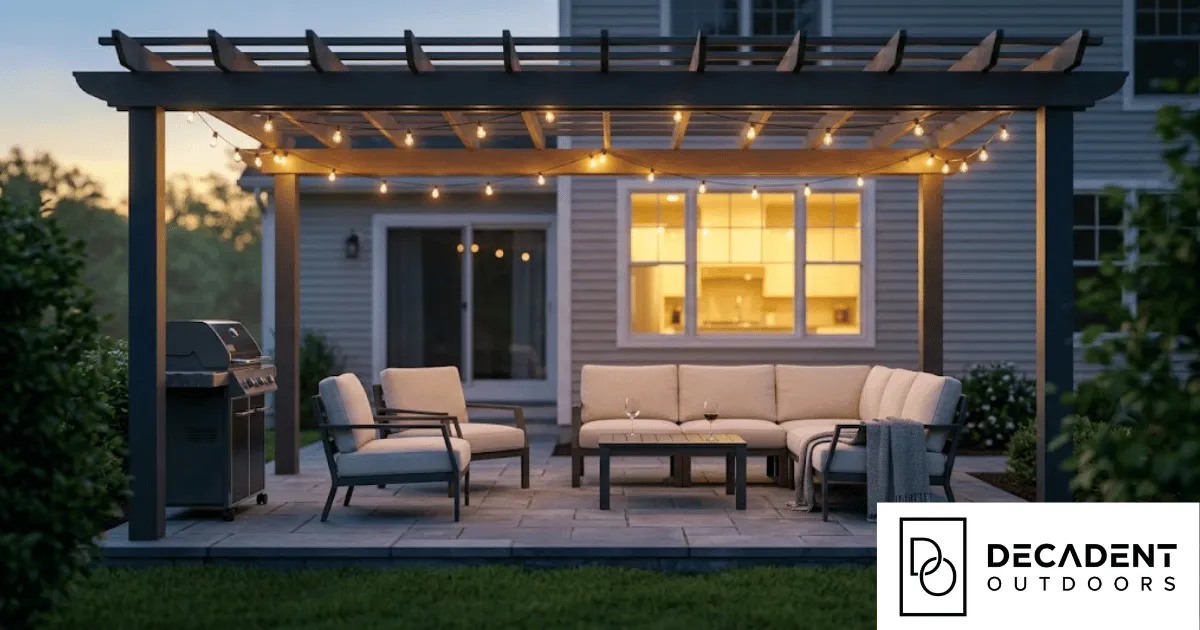
The patio is empty. The chairs are arranged exactly the way the homeowner pictured them when the space was built. The grill is closed. The string lights are on. Through the kitchen window, the same homeowner is finishing dinner inside, watching the space they spent considerable money building, and asking themselves a question they've been asking for years:why don't I use it more?
The answer is that they aren't alone. They aren't the exception. They are the rule. And the rule has a number.
This piece is about that number — what it is, what's driving it, and what the Capital Region buyer who has lived through three winters and one social recession needs to understand before another outdoor season goes by like the last one. This is the first article in The Fourth Wall, a twelve-week series on what actually changes when an outdoor space gets the missing wall it's been waiting for.
Quick Answer
Why don't most homeowners use their outdoor space?
According to the 2025 ICFA/Wakefield Research study of 1,000 U.S. adults, 77% of consumers with outdoor living spaces underutilize them — only 23% report using their outdoor space as much as they want to. In the Capital Region of New York, three forces compound the gap: a short bug-and-weather season (blackflies, mosquitoes, nor'easters, foliage-season chill), a post-pandemic shift that turned the backyard into a primary social and restorative space, and the fact that most outdoor structures stop at three walls — leaving the fourth side open to the conditions that drive people back inside. The space isn't underused because the homeowner is lazy. It's underused because the design doesn't account for the climate it's in.
The Research: It's Not Just You
The International Casual Furnishings Association — the industry's research body for outdoor furnishings and outdoor living — published its 2025 Outdoor Living Trend Report in March of that year. The headline finding, drawn from a nationally representative survey of 1,000 U.S. adults conducted by Wakefield Research, was straightforward.
Of the 85% of American households that have some kind of outdoor space — porch, patio, deck, balcony — only 23% use it as much as they want to.
That leaves 77% who do not. Not 77% who are mildly underwhelmed. 77% who, by their own admission, do not get out of their outdoor space what they wanted to get out of it.
The Wakefield data goes further. A separate survey conducted for the National Association of Landscape Professionals found that 54% of homeowners say their outdoor space activelycauses them stress. Twenty-four percent admit they are embarrassed by the state of it. Twenty-one percent say they do not host because the space isn't ready. And yet 82% of those same homeowners say the outdoor space is something that brings them happiness.
Eighty-two percent expect joy. Twenty-three percent get the amount of use they want. That gap — sixty percentage points of unmet expectation — is the real subject of this article.
The Capital Region homeowner watching their patio sit empty isn't an outlier. Three-quarters of America is watching the same patio.
What People Said They'd Do With the Space — If They Could Actually Use It
The same ICFA study asked respondents what they would do with their outdoor space if it actually worked the way they wanted it to. The answers, ranked by frequency:
Read that list once. Then read it again. These are not luxury aspirations. These are the basic activities of a settled, healthy adult life — the things people are built to want and need. Relax. Be with people you love. Share a meal. Talk. Have friends over.
When 77% of American homeowners can't reliably do any of those things in the outdoor space they paid for, the problem isn't homeowner laziness or unrealistic expectations. The problem is that the space isn't finished. Something is missing.
Why the Capital Region Has a Bigger 77% Problem Than Most
The national 77% is the floor, not the ceiling. In Upstate New York, the gap between the outdoor space a homeowner pictured and the outdoor space they actually use is larger than in most American markets — for reasons specific to this geography.
The season is shorter than people pretend it is
A Capital Region homeowner who tells a visitor that their outdoor season runs May through September is being generous. The functional season — the actual number of evenings where a person can sit on a patio without battling blackflies, mosquito dusk, sun glare, a sudden nor'easter, or the kind of foliage-season chill that turns a dinner party indoors by 7:30 PM — is closer to ten weeks. Maybe twelve in a good year.
That math is brutal when set against the cost of building the space. A homeowner who invested $30,000, $50,000, or $80,000 in a patio, pergola, outdoor kitchen, or full backyard build is amortizing that investment across ten usable weeks per year. The other forty-two weeks, the space sits there — visible, beautiful, paid for, unused.
The bug calendar makes the calendar shorter than that
Blackfly season begins reliably in the second week of May in the Adirondack foothills and the northern reaches of Saratoga County. It peaks through late May and early June. Mosquito dusk then takes over, peaking from roughly 7:30 to 9:00 PM through July and into early August — exactly the window most homeowners had planned to use for dinner outside. Biting midges return in mid-August. By mid-September the bugs have eased, but so has the weather.
Inside the ten-week functional season, roughly six of those weeks contain meaningful bug pressure during the most desirable hours of the day. The homeowner who built their space for sunset dinners with friends has chosen, without realizing it, the exact hours the local insect population also chose.
The Capital Region homeowner spends more time at home than almost anyone
According to U.S. Census data, 22.47% of the Saratoga Springs workforce works from home — a rate that ranks among the highest in the country. The average household income is just under $149,000. The median home sale price as of late 2025 was $759,900. Almost 59% of adults hold a four-year college degree or higher.
What that demographic profile produces is a population that is at home more hours per week than almost any other American demographic. The home is the office, the social space, the gym, the sanctuary, and increasingly — the only third place that's left.
When the outdoor portion of that home doesn't work, the entire week is poorer for it.
What the Backyard Became After 2020
In 1989, the sociologist Ray Oldenburg gave a name to the social infrastructure that sits between home and work: the third place. Cafes, restaurants, libraries, neighborhood bars, community centers, gyms, parks — the spaces where Americans encountered acquaintances, formed weak ties, and built the loose social fabric that makes a community feel like a community.
By 2024, the U.S. Surgeon General had publicly described what was happening to those spaces as a national social recession. Third places had been thinning for two decades. The pandemic accelerated the trend in ways that have not reversed. A Forbes Health survey found that 59% of Americans now say it's harder to form relationships than it was before 2020. Leisure time at home is up. Leisure time away from home is down. The hometainment trend — entertainment, socializing, and connection moving inside the household — was identified by trend forecaster Faith Popcorn as one of the durable consequences of the pandemic. Her prediction: the home is not going back to its 2019 role. It is now doing more work.
For affluent Capital Region homeowners — the population most likely to work from home, host their own social life, and feel the absence of vanished third places — the backyard has quietly become the third place itself. It is the only space outside the four interior walls of the house that the homeowner still has full access to. It is private enough to feel safe, public enough to feel social. It is where the dinner parties happen now, when they happen at all.
The backyard is no longer a weekend amenity. It is doing the social and restorative work that cafes, restaurants, and neighborhood gathering places used to do. When the backyard doesn't function, the household's social and emotional infrastructure doesn't function.
The 77% statistic, read against this sociological backdrop, becomes more serious. It is not that three-quarters of homeowners are mildly underutilizing a backyard feature. It is that three-quarters of homeowners are losing access to the new center of American social life because the space isn't built for the conditions it sits in.
What the Brain Knows About Outdoor Space — And What It Loses When Access Breaks
The third reason the Capital Region homeowner cares about their outdoor space — whether they consciously articulate it or not — is biological. The biologist E. O. Wilson named the principle biophilia: the innate human affinity for nature and natural systems. The research that has followed Wilson's hypothesis is now substantial. Stress Reduction Theory and Attention Restoration Theory, two of the dominant frameworks in environmental psychology, both demonstrate that visual and physical contact with nature produces measurable physiological change.
As little as ten minutes of contact with a natural setting produces meaningful improvements in cortisol levels, blood pressure, heart rate, and mental engagement. Plant exposure in office settings has been linked to a 47% increase in measured well-being. The University of Colorado-Boulder's 2022 Denver study found that residents who spent more time in green space during the first pandemic year reported significantly lower rates of anxiety and depression. The mechanism is not sentimental — it is autonomic. The parasympathetic nervous system activates in the presence of nature. The body recovers from stress more efficiently. The brain functions better.
The Capital Region homeowner who paid $750,000 or more for a property in this geography is, at one level, paying for proximity to nature. The lake, the foothills, the foliage, the seasonal change. That access is not an amenity — it is a measurable component of the home's mental health value. When bugs, sun, wind, or cold prevent access to the outdoor portion of the property, what's lost isn't convenience. It's the biological benefit the property was supposed to deliver. The 77% number, viewed through the biophilia lens, is a measure of nature deprivation in households that bought specifically for the opposite.
The Three Walls Problem — and the Fourth Wall That Closes It
A typical Capital Region outdoor space — even a beautifully designed one with a pergola, outdoor kitchen, and quality furnishings — has three walls. The house forms one. The structure overhead, if there is one, provides shelter. The railing or hedge suggests a third. The fourth side is open to the bugs, the sun, the wind, the cold, and whatever else the climate is currently doing. For most of the year, that fourth side is what determines whether the space gets used.
In May and June, the fourth side is the bug door. In July and August, it's the heat and sun-glare door. In September and October, it's the wind-and-chill door. Every condition that drives the homeowner back inside passes through the fourth wall — because there isn't one.
A motorized retractable screen system — specifically the kind built for Upstate New York conditions rather than imported from Florida design language — closes the fourth wall when conditions require it and disappears when they don't. The result is not a screened-in porch. It is not a four-season room. It is an outdoor space that becomes an outdoor room on demand and reverts to an open patio when the homeowner wants the openness back.
The next eleven weeks of The Fourth Wall series unpack what that means in practice — the bug calendar, the sun and energy math, the cold-weather extension, the integration with existing pergolas, and what installation actually costs in Saratoga County. A full overview of the system itself is available at the OneTrack motorized screens page for readers who want to see the product before the series gets there.
The Capital Region homeowner who has been looking out the kitchen window at an empty patio for three or four years is not in the 23%. Yet. The space wasn't a mistake. It was just a project that stopped one wall short of working. The fourth wall is the one that closes the gap between what the homeowner pictured and what they actually use.
Frequently Asked Questions
Why don't most homeowners use their outdoor space?
According to the 2025 ICFA/Wakefield Research study, 77% of consumers with outdoor living spaces underutilize them — only 23% use them as much as they want to. The reasons cluster around climate (bugs, sun, weather), design incompleteness (the outdoor space lacks the wall or barrier that would make it usable across more conditions), and the post-pandemic reality that home spaces are now expected to do more social and restorative work than they were originally designed for. In the Capital Region of New York, the gap is amplified by a short outdoor season and high concentrations of work-from-home households.
How much of the year can an outdoor space actually be used in Upstate New York?
Without season-extending infrastructure, the Capital Region's functional outdoor season is roughly ten to twelve weeks — from late spring after blackfly peak through early fall before sustained chill. With motorized screens, radiant heat, and proper structure, that window can extend to twenty-five to thirty weeks — effectively doubling the usable outdoor season. The screens close the bug gap in spring and the cold gap in shoulder seasons; heat closes the chill gap in fall and early spring; together, they transform the space from a summer amenity to a year-round room.
Are motorized retractable screens the same as a screened-in porch?
No. A screened-in porch is a permanently enclosed structure with fixed screen panels — the space becomes a screened room and stays that way. Motorized retractable screens deploy on demand and retract completely when not needed, leaving the outdoor space fully open. The same patio can be open-air in the morning, screened-in for a buggy evening, and open again after dusk passes. This is the central design distinction between a screened porch (which trades openness for protection permanently) and a motorized screen system (which gives the homeowner both).
When does blackfly season start in the Capital Region?
Blackfly emergence typically begins in the second week of May in the Adirondack foothills and the northern Capital Region, with peak activity from late May through mid-June. The bugs are most active in the late afternoon and early evening — the same hours homeowners most want to use their outdoor space. By late June, mosquitoes have taken over as the primary biting insect, with mosquito dusk peaking from roughly 7:30 to 9:00 PM through July and into early August. Biting midges return in mid-August. The overall bug calendar runs from mid-May through early September, with the most desirable outdoor hours being the most bug-pressured hours.
Is the cost of motorized screens worth it in a cold climate?
The Capital Region cost-benefit analysis is different from the Florida or Texas analysis — and more favorable in some respects. Cold-climate buyers get bug control, sun and wind moderation, season extension on both ends of the calendar (April and October), and shoulder-season heat retention that compounds with radiant heating systems. The U.S. Department of Energy and the Professional Awning Manufacturers Association have published research showing that exterior shading reduces cooling energy use by 20 to 30% in warm seasons. In Upstate New York, the bigger value is on the season-extension side: a homeowner who gains ten to fifteen additional usable weeks of outdoor living per year is roughly doubling the use-rate of an investment they have already made. This question is the subject of Blog 3 in The Fourth Wall series, publishing June 9.