Hiring an Outdoor Living Contractor: What to Expect
What Actually Happens When You Hire Decadent Outdoors: From First Call to First Evening in Your New Space
The call you're most nervous to make isn't the one to the bank or the permit office. It's the first one to the contractor.
Because that call opens a process you can't fully see. It introduces a person — and a company — into your home, your property, and your life for weeks or months. It starts a sequence of decisions, commitments, and unknowns that, once started, takes on its own momentum. And if something goes wrong somewhere in that sequence, it's your backyard that bears the evidence.
That anxiety — the fear of the unknown process, the fear of the contractor who disappears after the deposit, the fear of a project that goes over budget or over time or simply doesn't deliver what was promised — is the most common reason homeowners sit on outdoor living decisions for years. Not the money. Not the indecision about the product. The process.
So here it is, completely open. Step by step. What actually happens when you reach out to Decadent Outdoors, from the first conversation to the first evening you spend in your new space?
No surprises. That's the commitment.
Quick Answer
What does the process look like for adding a pergola or outdoor structure?
The process has five phases: consultation (site visit and listening session — free, no obligation), design proposal (delivered in 7–14 days), design review and approval (your timeline, no pressure), installation (2–5 days of active work by the same team that designed the project), and commissioning (walk-through, operation demo, warranty handoff on the final day, plus follow-up check-ins at day 3 and day 14). From first consultation to completed installation, most projects run 8–16 weeks depending on permitting and material lead times. Fall and winter offer shorter lead times and better scheduling availability.
Why the Process Fear Is Legitimate — and Why Transparency Fixes It
Home improvement horror stories follow a consistent pattern. The contractor showed up, seemed knowledgeable, quoted well, took the deposit — and then communication slowed. The schedule slipped. Subcontractors arrived who had never met the homeowner. Something got built wrong and had to be redone. The final result was fine, maybe, but the experience left a residue of stress that colored everything.
Most of these stories share a root cause: the homeowner didn't know what the process was supposed to look like. So they couldn't tell when it was going wrong. They had no baseline for what normal communication frequency looked like, no understanding of when delays were acceptable and when they weren't, no framework for evaluating whether what was being built matched what was promised.
Knowledge removes anxiety. Not certainty — surprises happen in any construction project, and any contractor who tells you otherwise isn't being straight with you. But a homeowner who understands the process, knows what each phase looks like, and knows what questions to ask is in an entirely different position than one who handed over a deposit and hoped for the best.
The difference between a home improvement project that feels good and one that doesn't is almost never the finished product. It's whether the homeowner felt informed and respected throughout the process.
Here's the Decadent Outdoors process, phase by phase. Read it before you call anyone — us or anyone else. Knowing what a good process looks like helps you evaluate every conversation you have.
The Five Phases — From First Contact to First Evening
Phase 1
The Consultation — A Conversation, Not a Pitch
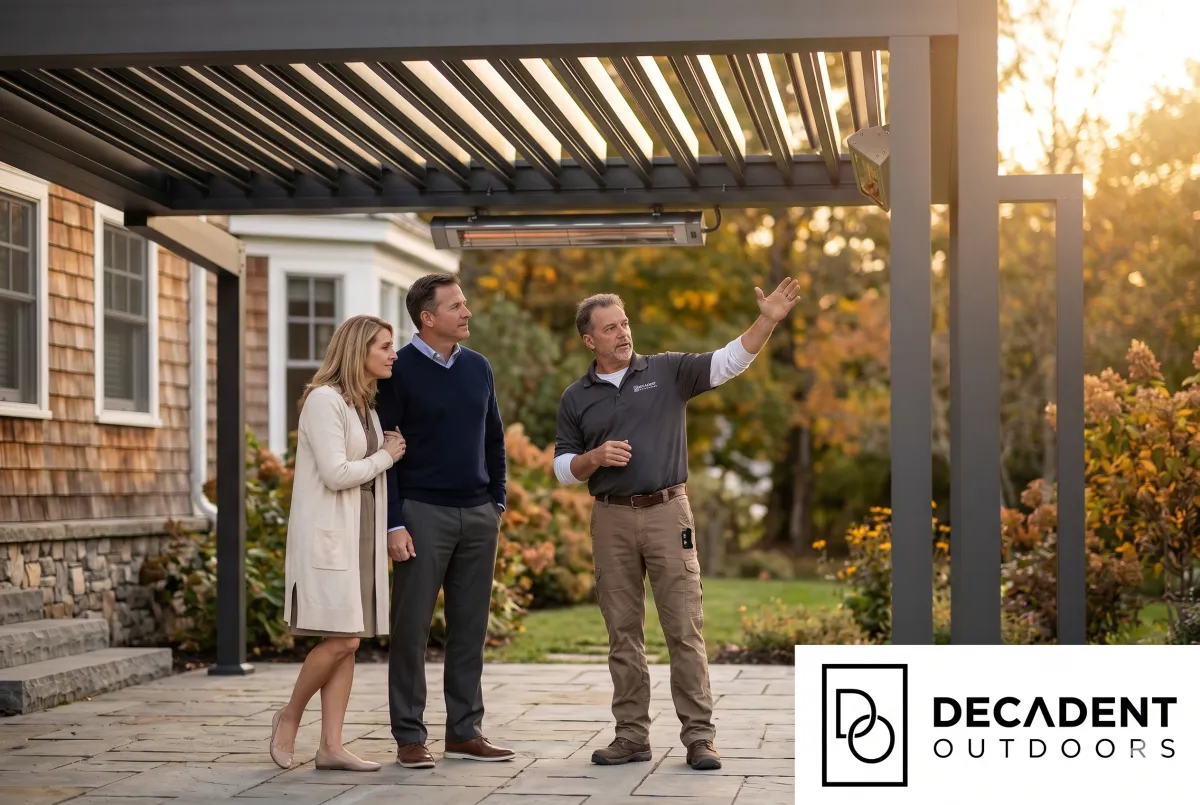
The first meeting is a site visit and a listening session. It is not a sales presentation. Jeff Mazzarelli visits your property, walks the space with you, and spends the majority of the conversation asking questions — not answering them. How do you use your outdoor space now? What frustrates you about it? What does the space look like in your ideal version? Who uses it, and when? What are the moments you want it to enable? This conversation shapes everything that follows. A designer who doesn't understand your life can't design your space. The consultation has no obligation attached to it — you'll receive a proposal afterward, but there's no pressure and no expectation of commitment. The consultation is free.
Phase 2
The Design Proposal — Specific, Not Generic
Within seven to fourteen days of the consultation, you receive a written design proposal. Not a catalog page with a price attached. A specific proposal: the structure type and dimensions appropriate for your space, the product specifications, the site plan showing how the installation integrates with your existing property, the timeline, and the investment summary. This is also the phase where any permitting requirements are identified. Most outdoor living structures in the Capital Region require either no permit or a straightforward residential permit — Decadent Outdoors manages the permitting process as part of the project and keeps you informed throughout. If HOA approval is required, the design documentation needed for architectural review boards is prepared as part of this phase.
Phase 3
Design Review and Approval — Your Timeline, Not Ours
The proposal is yours to review on your schedule. There is no countdown clock, no artificial urgency, no "this price is only good for 48 hours" pressure. Ask every question you have. Request modifications if the design doesn't match your vision. Bring in your spouse or partner for a second review meeting if it's helpful. When you approve the design and sign the agreement, two things happen simultaneously: the material order is placed with the manufacturer, and the installation is scheduled. Lead times for custom-manufactured systems like StruXure typically run four to ten weeks, which is one reason fall and winter are actually ideal times to initiate the process, since spring installation readiness requires fall planning. You'll receive a confirmed installation date when the material order is placed.
Phase 4
Installation — Two to Five Days, Same Team Throughout
Installation day is not the day strangers show up in your backyard. The installation team at Decadent Outdoors is the same team that designed your project — not a subcontracted crew unfamiliar with the specifications. This matters for quality, accountability, and the experience of having people in your space. Most residential outdoor living installations run two to five days of active work depending on size and complexity. The site is cleaned at the end of each working day. You're welcome to observe any part of the process. Communication throughout installation is direct — Jeff or a senior team member is reachable throughout the project, not routing you through an answering service. If something unexpected is discovered during installation — a footing condition, a structural attachment point that requires adjustment — you hear about it immediately, before any decision is made.
Phase 5
Commissioning, Walk-Through, and What Comes After
On the final day of installation, the project doesn't simply end. There is a formal commissioning walk-through — Jeff walks you through the completed space, demonstrates the full operation of every system (louver control, heater operation, screen deployment, lighting), answers every question, and delivers the warranty documentation and care guide for your systems. Three days after installation, you'll receive a personal follow-up check-in — not a form email, a real message — to make sure everything is working as expected and to address anything that needs attention. Two weeks in, another check-in. If anything requires adjustment in the first season of use, that's not a negotiation — it's a conversation, and it gets handled. This transaction does not end at installation. It's a relationship with the space, and with Decadent Outdoors, that begins there.
The Complete Timeline at a Glance
Every project has its own variables — permitting requirements, material availability, and scheduling windows. This table gives you the framework. Your specific timeline will be communicated clearly from the moment the design proposal is delivered.
What Makes This Process Different — And What to Ask Any Contractor
Not every outdoor living contractor operates this way. Here's what to ask — any contractor, including Decadent Outdoors — to understand whether the process will actually protect you.
Who specifically does the installation?
This is the question most homeowners forget to ask until it's too late. Some contractors sell and design, then subcontract the installation to whoever is available. If the person installing your structure has never met the designer, you have a communication gap that can create problems. Ask directly: will the same team that designed this project be present during installation? At Decadent Outdoors, the answer is yes.
How do you handle unexpected conditions discovered during installation?
Every outdoor project involves site conditions that only become visible once work begins — soil conditions, hidden utilities, and existing structural conditions at attachment points. The question is not whether surprises will occur. It's how they're handled. A trustworthy contractor stops, communicates, and presents options. An untrustworthy one makes decisions without you, then justifies them after the fact. Ask this question early and pay attention to whether the answer is specific and confident.
What does your communication look like during the project?
The anxiety of home improvement comes largely from silence. Not knowing whether your material has shipped, whether the installation is on schedule, whether the permit came through. Ask every contractor: how will you communicate with me during the project, and how quickly do you respond to questions? A contractor with a clear, specific answer to that question has thought about it. One who gives a vague assurance hasn't.
What happens if something isn't right after installation?
Warranty documentation is important. The actual answer to this question is more important. A contractor confident in their work answers this clearly and without defensiveness — here is what is covered, how to reach us, and what our response time looks like. Ask it and listen not just to the answer but to how willing they are to discuss it.
The contractor who makes the process completely visible — who answers these questions before you ask them — is the one who has nothing to hide. Transparency is confidence in reverse.
What the First Evening Actually Looks Like
The installation crew leaves. The space is clean. Everything has been walked through and demonstrated. The warranty documents are on the kitchen counter. Your phone has the app installed and is paired with the system.
You walk outside.
For a moment, you just stand there, because the space looks different. Feels different. There's an overhead presence that wasn't there before — a structure that defines the space, frames the view, and makes the backyard feel like a room rather than a yard. The louvers are open to the evening sky. The candles you set on the table before the crew arrived are lit.
You sit down. Maybe your partner is already there. Maybe you pour a drink. Maybe you don't say much for a few minutes because there's nothing that needs to be said.
This is what the process was in service of. Not the proposal or the permit or the installation schedule — that first evening in a space that works exactly the way it was supposed to. That's what every step was aimed at.
The first call is how you get there. It costs nothing. It commits you to nothing. And it starts a process you now know exactly how to navigate.
Frequently Asked Questions
What does the process for adding a pergola look like?
The process has five phases: a free consultation (site visit and listening session with no obligation), a custom design proposal delivered within 7–14 days, design review and approval on your timeline, installation by the same team that designed the project (typically 2–5 days of active work), and a formal commissioning walk-through on the final day plus follow-up check-ins at day 3 and day 14. From the first consultation to the completed installation, most projects take 8–16 weeks, with permitting and material lead times as the primary variables.
How long does it take to install an outdoor structure?
The active installation time for most residential outdoor living structures is 2–5 days, depending on size and complexity. The full project timeline — from initial consultation through design, permitting (if required), material lead time, and installation — typically runs 8–16 weeks. Fall and early winter are often the best times to begin spring installation readiness, as contractor schedules tend to be more open and material lead times are shorter in the off-season.
What questions should I ask an outdoor living contractor?
The four most important questions: (1) Who specifically does the installation — will the same team that designed the project be present? (2) How do you handle unexpected conditions discovered during installation? (3) What does your communication look like during the project, and how quickly do you respond? (4) What happens if something isn't right after installation — specifically, not just "we have a warranty" but what your actual response process looks like. Pay attention to how confidently and specifically the contractor answers these questions. Vague reassurances are a warning sign.
What should I expect from the first consultation?
A good first consultation is a site visit and a listening session, not a sales presentation. The contractor should spend the majority of the time asking questions about how you use and want to use your space — not presenting product options or pricing. You should leave the consultation with a clearer picture of what's possible for your property and no obligation to proceed. At Decadent Outdoors, consultations are free, and no commitment is expected or implied.
What does aftercare look like after an outdoor living installation?
Aftercare from a quality outdoor living contractor includes a formal commissioning walk-through on the final installation day (demonstration of all systems, warranty documentation, care guide), personal follow-up check-ins at day 3 and day 14 post-installation, and responsive communication for any warranty or adjustment needs in the first season of use. These aren't optional extras — they're the standard of care that distinguishes a professional installation from a transaction. Ask any contractor you're considering what their post-installation contract looks like before you sign anything.