The Backyard Is the New Third Place — Capital Region NY
Your Backyard Is the New Third Place: What Changed After 2020 and Why It Hasn't Changed Back
Six years ago, if you wanted to see your friends on a Thursday night in Saratoga Springs, you went somewhere.
You met at a restaurant on Broadway. You grabbed a drink at the bar after work. You ran into someone at the coffee shop on Saturday morning, and the run-in turned into half an hour of conversation. The neighborhood pub had your regular table. The yoga studio had your regular class. The bookstore had your regular Wednesday night reading series. The community wasn't built by any one of those places — it was built by the accumulation of them. Hundreds of small encounters per month, most of them low-stakes, all of them adding up to the felt experience of belonging somewhere.
Most of that is gone now. Some of it came back after 2020 in reduced form. Some of it didn't come back at all. And what hasn't been said clearly enough — either by the people who study this for a living or by the homeowners who are quietly living through it — is that the social infrastructure of American life has been quietly relocating to a different place. The backyard.
This piece is the second installment of The Fourth Wall, a twelve-week series on the research and the reality behind underused outdoor spaces in the Capital Region. Blog 1 established the 77% problem: most homeowners don't actually use the outdoor space they paid for. This piece looks at why the stakes of that gap got higher after 2020 — and why the backyard now carries a kind of weight it wasn't designed to carry.
Quick Answer
What is the "third place," and why does it matter for backyards?
The third place — a concept developed by sociologist Ray Oldenburg in 1989 — describes the social spaces that sit between home and work: cafes, restaurants, neighborhood bars, libraries, gyms, community centers, and parks. These are the places where Americans formed the casual acquaintance ties that hold communities together. After 2020, those spaces thinned dramatically. U.S. Surgeon General Vivek Murthy publicly described what followed as a national social recession. A 2024 Forbes Health survey found that 59% of Americans now say it's harder to form relationships than it was before the pandemic. As traditional third places eroded, the backyard quietly took on the role — particularly for affluent homeowners in suburban and exurban markets like Saratoga County and the Hudson Valley, where work-from-home rates are among the highest in the country. The backyard is no longer a weekend amenity. It is doing the social and restorative work that public gathering places used to do.
Where the Third Place Came From — And Why It Mattered
Ray Oldenburg was a professor of urban sociology at the University of West Florida when he publishedThe Great Good Placein 1989. The book examined what he called the third place — the social infrastructure beyond home (the first place) and work (the second place) that provided the texture of community life. The Parisian cafe. The English pub. The American luncheonette. These were ordinary, accessible, neutral grounds where conversation happened, where regulars knew each other by name, where strangers became acquaintances and acquaintances became neighbors.
Oldenburg's argument, simplified: a society without strong third places becomes lonelier, more anxious, more divided, and less resilient. The third place was where weak ties formed — the social fabric between strong family bonds and formal work relationships. Mark Granovetter's 1973 paperThe Strength of Weak Tieshad already shown how weak ties hold communities together: how people hear about jobs, find help in emergencies, get childcare advice, and feel like they belong somewhere even when they're not at home. By the time Oldenburg published, American third places had already been weakening for decades — suburbanization, car culture, the decline of walkable downtowns, the consolidation of retail. Robert Putnam's 2000 bookBowling Alonedocumented the trend with rigor: Americans spending less time in clubs, lodges, leagues, churches, and civic organizations than at any point in modern history. The decline was already significant before anyone had heard the word coronavirus.
What 2020 Did — and Why It Hasn't Reversed
The pandemic accelerated a trend that was already running. It did not invent the decline of third places — it telescoped twenty years of erosion into eighteen months. Restaurants closed. Coffee shops shifted to takeout-only and never went back. Independent bookstores, neighborhood gyms, small theaters, community centers, and walkable downtowns all took a hit many of them haven't recovered from. The reopening, when it came, didn't undo it. People who had spent eighteen months reorganizing their lives around the home didn't fully un-reorganize. Trend forecaster Faith Popcorn called the durable shifthometainment— the migration of social life, leisure, entertainment, and connection into the household itself.
In 2023, then-U.S. Surgeon General Vivek Murthy issued a public health advisory on what he termed an epidemic of loneliness and isolation. He described the United States as in a state of social recession. The numbers were stark. Americans were spending dramatically less time with friends than they had in 2003 — roughly 75% less for younger adults. Loneliness was now affecting approximately one in two adults. The mortality impact of social isolation was comparable to smoking fifteen cigarettes a day. A 2024 Forbes Health survey of American adults reported that 59% now find it harder to form new relationships than they did before the pandemic.
The social infrastructure of American life is operating at a fraction of its 2019 capacity. The question isn't whether something will replace it. The question is what already has.
How the Backyard Quietly Became the Replacement
Three trends collided in a way that elevated the backyard from amenity to infrastructure.
The first was the work-from-home shift. According to U.S. Census data, 22.47% of the Saratoga Springs workforce now works from home — one of the highest rates in the country. The figure runs comparably high across affluent professional zip codes in the Capital Region. The home stopped being the place workers returned to after work. It became the place they spent the entire day, with errands and occasional in-person meetings as the exceptions.
The second was the contraction of public third places. Where the work-from-home professional in 2019 would step out at lunch for a coffee, run errands at midday, and meet a colleague after work at a wine bar, the 2026 version of the same professional is more likely to make coffee at home, do errands in compressed weekend windows, and decline the wine bar entirely. The third places that used to absorb the social hours of the workday are no longer there to absorb them — or no longer worth the friction.
The third was the rise of the entertaining-at-home pattern. The 2025 ICFA Outdoor Living Trend Report (referenced in Blog 1 of this series) documented exactly what people said they wanted to do with their outdoor space when it actually functioned: relax (72%), spend time with family and friends (60%), eat outside (55%), socialize (48%), entertain (44%). Those are not luxury aspirations. They are the activities of a social life that used to happen at restaurants and is now expected to happen at home.
The backyard, in other words, isn't being asked to do what it used to do. It's being asked to do what the neighborhood used to do.
What the Capital Region Buyer Was Actually Buying
The median home sale price in Saratoga Springs as of late 2025 was $759,900. The average household income was just under $149,000. Nearly 59% of adults hold a four-year college degree or higher. These are the affluent professional households that historically supported the third-place ecosystem — the people who filled the wine bars, the racing-season parties, the SPAC summer audiences, the gallery openings in Hudson, the Saturday morning farmers' markets in Saratoga and Troy.
When affluent professional households moved to the Capital Region or doubled down on it after 2020, they were buying something specific. Not just a beautiful house. Not just access to lake culture and foliage season and the Adirondack foothills. They were buying the conditions of a particular kind of life — one that had room for entertaining, for hosting, for the kind of regular casual connection that used to happen in public and now had to happen on someone's property.
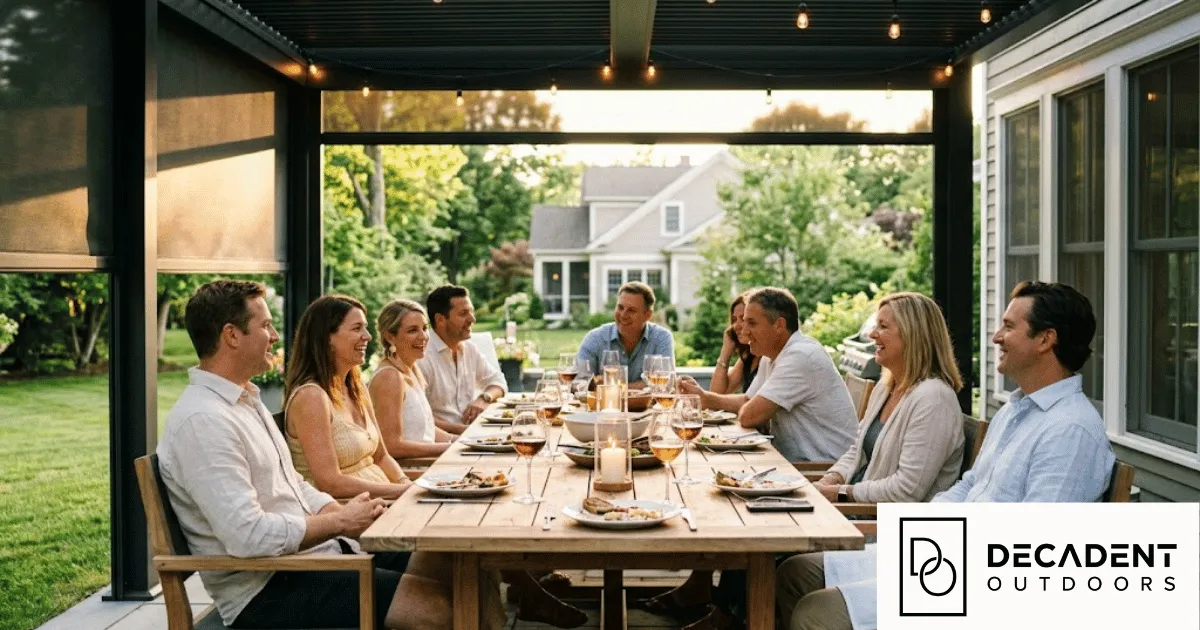
A patio for a dinner party. A pergola for shade on a summer Saturday. An outdoor kitchen for the food. An outdoor table that seats twelve, the way the indoor table seated six. The backyard had to do what the wine bar used to do and the restaurant used to do and the friend's apartment in the city used to do.
And then the homeowner discovered the part of the calculus the listing didn't include: the backyard, even a beautifully built one, doesn't work for the social purposes the household quietly assigned to it. The dinner party that was supposed to happen in June moved indoors at 7:45 PM when the mosquitoes arrived. The Sunday afternoon gathering that was supposed to feel like a Saratoga porch culture moment got cut short by a sudden August thunderstorm. The October foliage-season dinner that was supposed to be the prettiest evening of the year ended at 6:30 PM when it got too cold to stay outside.
The household had been built around the assumption that the backyard would work. The backyard, in roughly three out of four cases — per the ICFA research — didn't.
The Real Cost of a Backyard That Isn't a Third Place
The cost of a non-functioning backyard, in a household that now depends on the backyard for social and restorative life, is not measured in unused square footage.
None of those losses show up on a balance sheet. All of them show up in the felt experience of the household over five, ten, fifteen years. The homeowner who invested $50,000 in an outdoor space and then can't actually use it for social purposes isn't losing $50,000 of furniture and stone. They are losing the social life the $50,000 was supposed to enable.
The Backyard as Built — Versus the Backyard as Required
Most Capital Region backyards being built or renovated right now are still being designed for the old assumptions — summer amenity, weekend leisure, weather-permitting use. The structures are beautiful. The materials are high-grade. And the spaces, in roughly three out of four cases, still don't function as the third places the households have come to depend on them being.
The gap between what was built and what is required is the gap motorized retractable screens close. The Fourth Wall — the side of the patio that's historically been open to bugs, sun, wind, and shoulder-season weather — is the difference between a beautiful patio and a functioning third place. The dinner party that would have ended at 7:45 PM when the mosquitoes arrived now runs to 10:30 PM. The Sunday afternoon gathering that would have moved indoors at the first hint of a storm stays outside under deployed screens. The October foliage dinner that would have ended at 6:30 PM extends to 9:00 with the screens down and a radiant heater on.
None of this is theoretical. It is what Capital Region homeowners with motorized screen systems already installed are reporting back — in hosting rates, drop-in frequencies, and the simple subjective sense that the backyard finally does what the household needs it to do.
The backyard didn't ask to become the third place. The social fabric reorganized around it. The households that adapt the backyard to its new role are the ones doing the hosting now. The households that don't are watching their social calendars shrink in ways they can't quite explain.
What the Fourth Wall Series Is Going to Look At Next
The next blog in the series, publishing June 9, looks at the third frame in this triangle — the biophilia research that explains why the brain knows the difference between a backyard with nature access and a backyard without it. Ten minutes of outdoor exposure measurably changes cortisol levels, blood pressure, and parasympathetic activation. Households that lose the outdoor space don't just lose social hours. They lose the biological benefit that the property was supposed to deliver.
The 77% problem from Blog 1 was about underutilization. This piece is about what that underutilization actually costs in a post-2020 household: the social third place the backyard quietly became and then quietly stopped being. The Capital Region homeowner who wants the dinner parties back, the drop-ins back, the porch culture back — isn't asking for a luxury. They're asking for the social life their property was supposed to support.
Frequently Asked Questions
What is the third place, and who came up with the term?
The third place is a concept developed by sociologist Ray Oldenburg in his 1989 bookThe Great Good Place. The first place is home. The second place is work. The third place is the social space between them — cafes, restaurants, neighborhood bars, libraries, community centers, gyms, parks, and other public gathering grounds where casual acquaintance ties form. Oldenburg argued that strong third places are essential to community resilience and individual well-being. Post-2020, traditional third places contracted significantly, and in many affluent suburban households, the backyard has taken over the role.
Has American social life really not recovered from the pandemic?
The data suggests it hasn't, fully. A 2024 Forbes Health survey found that 59% of Americans say it's harder to form new relationships now than it was before 2020. The U.S. Surgeon General issued a 2023 public health advisory describing an epidemic of loneliness and isolation, citing time-with-friends data showing dramatic declines from 2003 baselines. Trend forecasters have identified the durable shift as "hometainment" — the migration of social, leisure, and entertainment activity into the household. The third places that survived often did so in reduced form. Many did not survive.
Why is the Capital Region particularly affected by this shift?
Three factors compound the third-place gap in the Capital Region. First: the work-from-home rate in Saratoga Springs (22.47% per U.S. Census data) is among the highest in the country, meaning the average professional spends substantially more hours at home than the national average. Second: the affluent demographic that historically supported public third places — restaurants, wine bars, gallery openings, music venues — has shifted hosting activity into private homes. Third: the short functional outdoor season in Upstate New York limits when the backyard can substitute for indoor entertaining, intensifying the importance of any infrastructure that extends usable outdoor hours.
Do motorized screens actually change how often people host?
Yes, in two specific ways. First, by extending usable outdoor hours into the bug-pressure windows (late spring blackfly season, mosquito dusk through summer), screens recover the early evening and dusk hours that most outdoor entertaining requires. Second, by closing the wind and chill gap in shoulder seasons, screens extend the hosting calendar at both ends — meaning April, October, and November become viable outdoor entertaining months rather than indoor-only ones. Capital Region homeowners with OneTrack motorized screen systems consistently report higher hosting frequencies post-installation, though the effect varies based on the household's pre-existing social patterns.
Are motorized screens a substitute for real community?
No. Nothing fully substitutes for the dense network of public third places that healthy communities support. The argument here is narrower and more honest: in households where the backyard has already taken on the role that public third places used to fill, the backyard needs to actually function for that purpose. Motorized screens don't replace the cafe culture that thinned after 2020. They close the gap between the household's social aspirations and what the existing outdoor space can actually deliver. Whether broader third-place infrastructure ever fully recovers is a question for sociologists. Whether your backyard can host a dinner party next Saturday is a question with a more immediate answer.