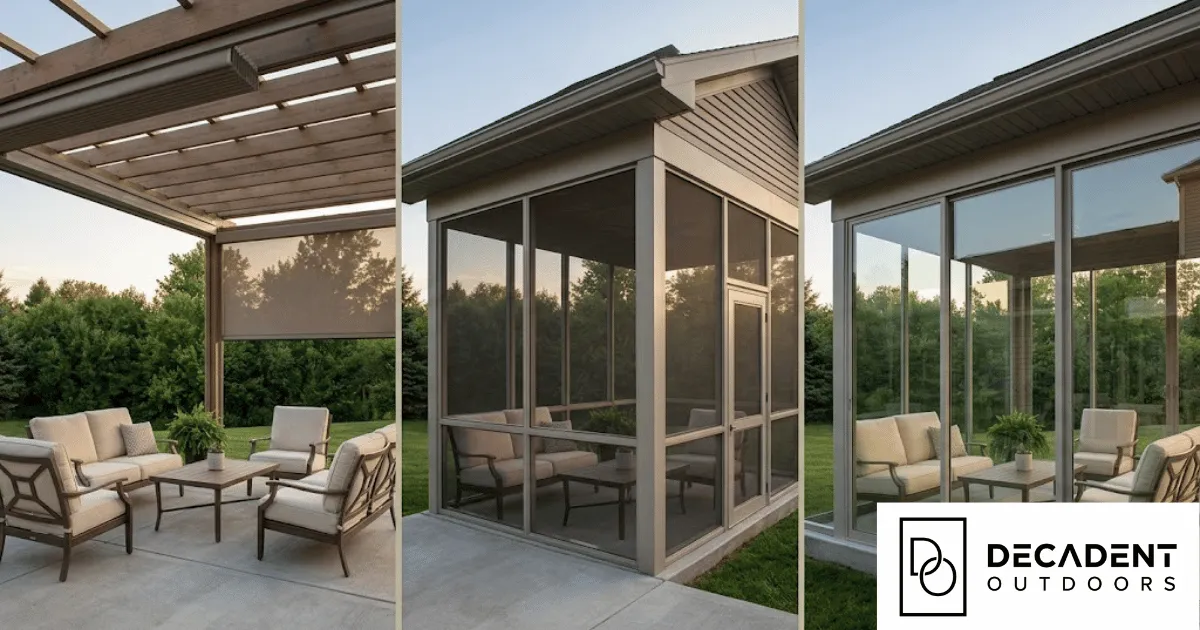
Motorized Screens vs. Screened Porch vs. Four-Season Room
Motorized Screens vs. Screened Porch vs. Four-Season Room: Which One Should a Capital Region Homeowner Actually Build?
The Capital Region homeowner who has gotten past the first three blogs of this series knows what an outdoor space is supposed to do, why it matters more after 2020, and what specifically tends to break it. The next question is the architectural one. What do you actually build?
Three options dominate the conversation. A motorized retractable screen system over an existing or planned patio — the fourth-wall solution this series has been building toward. A traditional fixed-screen porch enclosure, framed and screened, often added to the back of the house. A four-season room or sunroom — a fully enclosed, insulated, climate-controlled addition with glass walls. Each of them solves the bug problem. Each of them solves it differently. And each of them carries a set of trade-offs that doesn't show up in the brochure.
This piece is the honest comparison. The one that names what each option does well, what each one gives up, and the specific question the homeowner needs to answer before they spend $20,000 or $80,000 or $150,000 on the wrong solution for their property.
This is the fifth installment of The Fourth Wall. The first four pieces established what outdoor space is supposed to deliver and what breaks the delivery in the Capital Region calendar. This one stacks the architectural answers honestly — including the trade-offs Decadent Outdoors' own preferred solution carries.
Quick Answer
Which is better — motorized retractable screens, a screened-in porch, or a 3-season room?
The three options solve different problems. Motorized retractable screens preserve the open-patio experience and close the fourth wall on demand — best for homeowners who already have a patio, deck, or pergola and want bug and weather protection across the calendar without permanently losing the open-air experience. Typical Capital Region investment: $15,000-$45,000 depending on opening count and configuration. A traditional screened-in porch is a permanent screened enclosure — best for homeowners who want a dedicated three-season room and don't mind that the patio is now a screened room year-round. Investment: $25,000-$60,000 for new construction. A 3-season room is a fully enclosed, insulated, climate-controlled addition with glass walls — best for homeowners who want indoor square footage with outdoor views and are willing to give up the actual outdoor experience entirely. Investment: $60,000-$150,000+. The honest answer is that each option is the right answer for a different homeowner. The wrong question is which option is "best." The right question is which set of trade-offs you can live with for the next twenty years.
Option One: Motorized Retractable Screens
A motorized retractable screen system installs around an existing or planned outdoor structure — a patio with a pergola overhead, a covered deck, a porch frame, an outdoor kitchen footprint. The screens themselves live in a low-profile track and housing along the perimeter, retracted up into the structure when not in use. A wall switch, remote, or smartphone app deploys them in seconds. Properly specified mesh blocks insects (down to no-see-um size) while preserving roughly 80-90% of the view. Wind-rated systems hold up to 50+ MPH gusts. Most modern systems include automation triggers for wind, rain, and temperature.
What this option does well
The fundamental advantage is reversibility. The patio remains a fully open outdoor space whenever the screens are retracted. The morning coffee, the midday lunch, the early evening drink before bugs arrive — all of it happens in an unscreened, unenclosed space with full sensory access to the outdoors. The screens deploy only when a specific condition (bugs, sun, wind, light chill) makes the open patio temporarily unworkable. When the condition passes, the screens retract and the patio is open again.
The system is also typically the least disruptive to install. A motorized screen system on an existing structure (a patio with pergola, for example) takes two to five days to install and requires no foundation work, no new framing, no roof modifications, and usually no permitting beyond electrical. The cost is the lowest of the three options for most Capital Region projects. Existing pergolas and outdoor kitchens are preserved — the screens are added to the structure, not replacing it.
What this option gives up
The honest trade-off: motorized screens do not provide the same level of insulation, weatherproofing, or year-round use that a fully enclosed structure provides. With screens deployed and a radiant heater running, the system extends the usable outdoor season into the mid-30s Fahrenheit on calm evenings — meaningful for shoulder seasons but not equivalent to a heated Four-season room. The screens themselves require electrical power and have mechanical components (motors, tracks, brackets) that, like any motorized system, can need service over time. And while wind-rated systems handle most Capital Region weather, sustained severe weather is still a reason to retract the screens rather than rely on them as a wall.
The homeowner who wants a fully enclosed, fully climate-controlled space they can use in January with snow falling outside is not best served by retractable screens alone. That's the four-season room conversation, not this one.
Option Two: The Traditional Screened-In Porch
A traditional screened-in porch is a permanent framed structure — typically wood or aluminum framing — with fixed screen panels filling the wall openings. The structure usually has a solid roof, sometimes with skylights or transparent panels. The screens are in place permanently from spring installation through fall close-up. Some Capital Region screened porches are seasonal (taken down or covered for winter); others are year-round structures used primarily in the three-season window.
What this option does well
The screened porch is a known quantity. It has been a feature of Northeastern American architecture for more than a century. Capital Region builders are deeply familiar with the type. The construction is straightforward. The maintenance is well-understood. And the bug protection, properly specified (with fine-mesh screening for midges), is reliable across the entire bug calendar.
The screened porch also doesn't require electrical or mechanical infrastructure. No motors. No tracks. No remotes. The system that fails is one that doesn't exist. For a homeowner who values mechanical simplicity, a traditional porch is the lowest-complexity solution. It also tends to feel more architecturally integrated with the house from the start — especially on older Saratoga, Albany, or Hudson Valley homes where a screened porch is a period-appropriate detail.
What this option gives up
The screened porch is permanent. The space is a screened room from the moment construction finishes through the moment a future homeowner tears it down. The morning coffee that a biophilia researcher would prefer be taken in direct outdoor air is now taken in a screened room. The view is permanently filtered through fiberglass or aluminum mesh, with a ten-to-twenty-percent visual degradation that doesn't go away. Air movement is restricted compared to an open patio. The direct nature-exposure quality of the unscreened patio is no longer available on this part of the property.
Construction is more invasive than a retractable screen install. The porch requires a frame, a roof, potentially a new foundation, and full permitting. Timeline runs eight to sixteen weeks. Cost is typically higher than retractable screens for an equivalent footprint. And the screened porch doesn't help with sun, wind, or chill problems — the screens are screens, they let air, light, and weather through. A cold October dinner on a screened porch ends at the same hour it would have ended on the open patio.
Option Three: The Four-Season Room (Sunroom)
A Four-season room (often marketed as a sunroom) is a fully enclosed, insulated, climate-controlled addition with glass or storm-window walls. It is, architecturally, an indoor room with outdoor-style views — heated in winter, sometimes cooled in summer, accessed from inside the house through a normal interior door. It is the most expensive of the three options. It is also the only one that genuinely extends usable hours into the deep winter.
What this option does well
A Four-season room is the only one of the three options that delivers genuine year-round indoor square footage. A homeowner who wants to sit and watch a January snowfall while reading the paper in a comfortable, fully heated space — with a view of the property — should build a sunroom. A homeowner who wants the room to function as a home office, a yoga studio, a reading room, or an extension of the kitchen — in addition to its outdoor-feeling use — should build a sunroom. The room becomes indoor square footage on the tax records and on the eventual real estate listing.
The bug and weather protection is total. There is no bug calendar that affects a four-season room. There is no shoulder-season chill problem. The space is climate-controlled.
What this option gives up
A four-season room is not an outdoor space. It is an indoor space with an outdoor view. The homeowner is now sitting in a climate-controlled room with glass walls, breathing recirculated air, listening to the HVAC, separated from the property by glazing. The biophilia research from Blog 3 makes clear that a view of nature through glass produces a fraction of the physiological benefit of direct outdoor exposure. The morning coffee in a sunroom is genuinely not the same as the morning coffee on a patio.
The cost reflects what's being built. A four-season room is genuine residential construction — foundation, framing, roof, HVAC, electrical, glazing, insulation, finishes. Capital Region cost typically runs $60,000 at the low end (smaller, more basic) to $150,000 or higher for a larger room with high-end glazing and full HVAC integration. Project timeline runs twelve to twenty-six weeks. Permitting is full residential addition. The home's footprint changes, the roofline changes, the taxes change. If the household genuinely wants the year-round indoor room, this is the right investment. If the household wants the outdoor experience extended across more of the year, this is overbuilding the wrong problem at three to five times the cost.
The Three Options Side by Side
The table below stacks the three options across the dimensions that actually matter for a Capital Region homeowner deciding among them. These are honest assessments — the columns where motorized screens lose are columns where they genuinely lose.
There is no universally "best" option. There is a best option for the homeowner who wants an open patio with on-demand protection. A different best option for the homeowner who wants a permanent screened porch. A third best option for the homeowner who wants an indoor room with outdoor views. The mistake is choosing the wrong category for what the household actually wants the space to do.
The Question That Determines the Right Answer
Asked a different way: what does the household actually want to be doing in the space on a Saturday morning in May?
If the answer is "having coffee outside, in the open air, watching the property come awake before the day starts" — that's the motorized-screen homeowner. They want the open patio most of the time, and the protection only when the conditions require it. The screens are retracted on the May Saturday morning. The space is fully open.
If the answer is "sitting on the screened porch with a coffee, screened in, comfortable, knowing there are no bugs" — that's the screened-porch homeowner. They are happy to trade the open-patio quality for the certainty of always being bug-protected without thinking about it. They don't miss the openness because they never had it in this room. The screened porch is its own thing, and it's the thing they want.
If the answer is "in the sunroom with the morning paper, the temperature comfortable, the snow falling outside the glass" — that's the four-season-room homeowner. They want indoor space with a view. They want the room to do work in January as well as June. They are willing to pay three to five times the cost of motorized screens to get year-round indoor square footage with outdoor views.
All three of those Saturday mornings are valid. None of them is wrong. The mistake homeowners make is answering one of the questions and building a different option than the answer suggested — because the marketing was louder, the contractor's specialty was different, or the comparison was never honestly made.
Where Decadent Outdoors Sits
Decadent Outdoors specializes in motorized retractable screen systems and pergola-screen integration (the Fenetex OneTrack system, paired with StruXure motorized louvered pergolas on full outdoor room builds). The Capital Region homeowner whose answer to the Saturday-morning question is "open patio, on-demand protection" is the homeowner this company is built to serve. For homeowners whose answer is "screened porch" or "four-season room," there are excellent Capital Region contractors with the right scope for that work, and Decadent Outdoors will say so directly during a free consultation if the conversation reveals one of those is the right fit. The job of the consultation is to identify the right answer for the property, not to push a particular product.
The next blog in this series, publishing June 30, looks inside the motorized screen system itself — the engineering, the wind ratings, the mesh specifications, the automation, and what makes the OneTrack system specifically different from competing motorized screen products. For homeowners who already know they want the motorized-screen answer, that's where the technical specifics get unpacked.
Frequently Asked Questions
How much do motorized retractable screens cost in the Capital Region?
For a typical Capital Region project, motorized retractable screen systems run $15,000 to $45,000 installed. The variation comes from the number of screen openings, the size of each opening, the mesh specification (standard insect-rated versus fine-gauge for midge protection), the level of automation included (manual remotes versus full smartphone and weather-sensor automation), and whether the project is a screens-only install on an existing structure or part of a full outdoor room build that includes pergola integration. Most three-to-four-opening projects on existing patios fall in the $20,000 to $30,000 range.
Is a motorized screen system worth it compared to a traditional screened porch?
It depends on whether the household wants the patio to remain an open patio when the screens aren't needed. A traditional screened porch keeps bugs out reliably but the space is a screened room year-round — the open-air experience is permanently traded for the enclosure. A motorized screen system delivers the same bug protection on demand and preserves the open-patio experience for the rest of the time. For homeowners who value the open patio for morning coffee, midday lunch, and the early-evening hour before bugs arrive, motorized screens are typically the better fit. For homeowners who want a dedicated three-season room and don't care about the open-patio experience on this part of the property, a screened porch may be the better answer.
Can motorized screens be used in winter in Upstate New York?
Motorized screens extend the usable outdoor season into late fall and early spring — meaningfully, but not equivalently to a four-season room. With screens deployed and a radiant heater running, the space remains comfortable on calm evenings in the mid-to-high 30s Fahrenheit, which captures most of October and a good portion of April in a typical Capital Region year. For winter use proper — January and February with snow on the ground — the right answer is either a 3-season room (a fully enclosed, heated, climate-controlled addition) or accepting that the screen system delivers its primary value across the eight-or-nine months of shoulder and warm season, not across the depths of winter.
Does a Four-season room add more value to a home than motorized screens?
A four-season room typically adds more to a home's appraised value — because it adds genuine heated square footage that counts on the tax records and the listing. The ROI on a sunroom in the Capital Region market generally runs in the 50 to 70 percent range of project cost recouped at sale. Motorized screens add value differently — they make the existing outdoor space more usable across more of the calendar, which buyers notice in showings even though the screens themselves aren't always called out as a comparable feature. The right question isn't which option adds more dollar-value at sale; it's which option does more for the household across the years they live in the home. A sunroom that's barely used isn't worth its appraised value. Motorized screens that get used 300 times a year are worth substantially more than their installed cost.
Can a homeowner combine these options?
Yes, and many Capital Region homes do. A common configuration is a four-season sunroom off the kitchen for winter and shoulder-season use, plus a separate covered patio with motorized screens and a pergola for the rest of the year. The two spaces serve different purposes — the sunroom handles the deep-winter view-with-coffee role, the screened patio handles the spring-through-fall outdoor-living role. The total investment is higher than either option alone, but the household gets the year-round indoor space and the eight-month open-patio experience without compromising either. This kind of integrated design is covered in more depth in Blog 11 of this series.