
Your Outdoor Space Reclaimed
Motorized pergolas, retractable screens, screen rooms, and awnings — designed and installed for Capital Region homes by Upstate New York's most trusted outdoor living team.
Free in-home visit · No obligation · No pressure · Response within 1 business day

★★★★★ 5.0
Google Reviews

StruXure Authorized
Exclusive Regional Dealer

Certified Fenetex Dealer
Motorized Screens

35+ Years
Design Experience

Fully Insured
New York State
Our Specialties
Outdoor living solutions for the Capital Region.
Your outdoor space should work as hard as you do for it. Whether it's a Saturday evening cut short by mosquitoes, a summer spent avoiding the patio in the afternoon heat, or a backyard that never quite became the gathering space you envisioned — these are design problems. And design problems have solutions.
At Decadent Outdoors, we listen first. Then we design, build, and install outdoor living systems — from motorized pergolas that adjust with the weather to retractable screens that reclaim your afternoons, evenings, and everything in between — engineered specifically for Upstate New York's seasons and the home you've worked to build.
Your vision. Delivered with precision — rain, shine, or the first frost of October.

StruXure Pergolas
The only smart motorized pergola in the Capital Region. Adjustable louvers controlled from your phone. Built to last decades.

Retractable Screens
Motorized screens for porches, patios, and pergolas. Bug-free, rain-protected outdoor living. Deploy in seconds.
Radiant Heating
Ceiling-mounted infrared heating systems extending your season from early spring through late fall.
Here is What We Solve
Outdoor living solutions for Upstate New York.
EXTERNAL
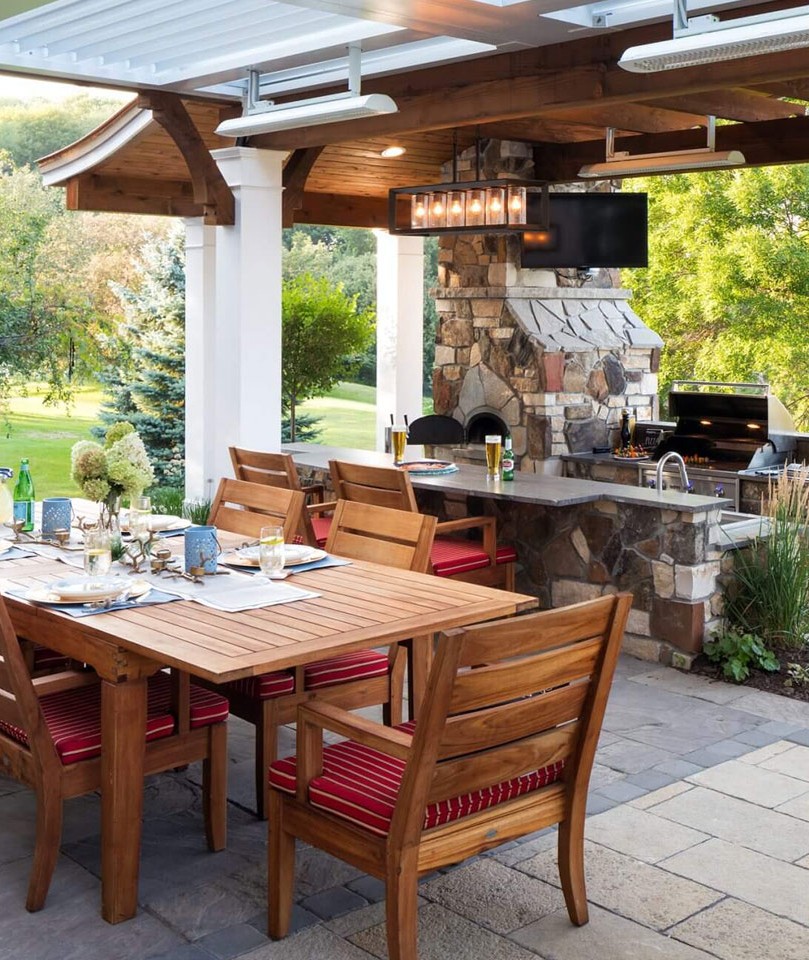
Blackflies. Mosquitoes. Nor'easters in May. Three months of weather that drives you inside and four "shoulder season" months you can barely use.
INTERNAL
You invested in a home that was supposed to be the gathering place — and every summer you end up watching the season pass from inside.
PRINCIPLE
That's not a weather problem. It's a design problem — and it's exactly what we built Decadent Outdoors to solve.
Stop giving up your outdoor season.
We come to you, assess your space, and give you a fixed price — before you decide anything.
how it works
From your first call to your first full day outside.

Design Consultation
We come to you. You show us how you live — where you eat, entertain, watch the sunset. We design around that, not a product brochure.
Free · In-Home · No Pressure

Custom Design & Quote
Detailed proposal with design documentation of your exact space — so you know precisely what you're getting before a single day of work begins.
DETAILED PROPOSAL INCLUDED

Professional Installation
Factory-certified team installs your system precisely. We leave the site cleaner than we found it.
Certified · Clean Site
What Our Clients Say
Real homeowners. Real Capital Region summers,
finally enjoyed.
You worked hard to build this home. Let's bring the outdoors into it.
A free in-home visit is all it takes to see what your outdoor space could become.
Where We Work
Serving the Capital Region and beyond.

Based in Ballston Lake, NY — serving homeowners throughout Saratoga County, Albany County, upstate New York, Vermont, and western Massachusetts.
Saratoga County
Albany County
Rensselaer County
Washington County
Vermont
Western Massachusetts

October in the Capital Region is too good to spend inside.
Radiant heat, motorized screens, and a StruXure pergola — designed together for your property.

Ready to Begin?
Stop giving up your outdoor space.
Tell us where you are and what you're dreaming about. We'll come to you, assess the space, and show you exactly what's possible for your space. No pressure. No obligation. Just clarity.
Free in-home design consultation
Detailed design proposal for your space
Factory-certified installation team
Response within 1 business day
The Resource Center
The outdoor living guide for homeowners.
From motorized pergolas that move with the weather to retractable screens that keep the bugs out — precision-engineered and professionally installed.
Outdoor Living Ideas Upstate NY: Year-Round Spaces
Why Upstate New York Homeowners Are Rethinking Their Outdoor Space — And What They’re Building Instead
Picture this. It’s the third week of October. The leaves along the Northway are doing what they only do here — that particular amber-and-rust combination that people drive hours to see. Your backyard looks beautiful. And you’re watching it from inside the house, through a window, because it’s 44 degrees and there’s nowhere to sit that isn’t cold, exposed, or uncomfortable.
You close the blinds. That’s it. That’s the end of the outdoor season.
If that scene feels familiar, you’re not alone. Most homeowners in the Capital Region and Hudson Valley go through the same quiet resignation every fall. The deck gets covered. The furniture goes into the garage. The grill gets a tarp. And for the next six months, a space you invested in — and genuinely love — simply stops existing.
The honest question isn’t whether that bothers you. It’s whether it has to.
Because a growing number of Upstate New York homeowners have figured something out. They’ve realized that the problem was never the climate. The problem was the approach. They weren’t building outdoor spaces designed for where they actually live.
The Problem No One Talks About: Designing for a Climate You Actually Live In
Here’s what almost never gets said in the outdoor living industry: most products are designed for somewhere else.
The patio furniture photographed for catalog shoots? Shot in California. The pergola designs that appear in home improvement magazines? Usually photographed in Arizona or the Southeast. The standard aluminum patio cover your neighbor put up three years ago has barely been used since. Built to a specification that assumes mild winters and occasional rain.
None of that is designed for a place where temperatures drop to single digits in January, where snow load is a real structural concern, where the wind off the Hudson can take the edge off a July evening, and where you genuinely want to sit outside in November because the foliage is worth it.
The Capital Region loses roughly five months of the outdoor season to cold weather. That’s not a design constraint to work around. For the right builder, it’s a design problem worth solving.
The external problem is clear: you can’t use your outdoor space for more than a few months a year, and even within those months, a cold night or a sudden rainstorm can end an evening before it begins.
The internal frustration runs deeper. You made a real investment in your property. You love your home. You chose to live somewhere with actual seasons, with real character, with that particular Northeast quality that no amount of sunshine can replicate. But somewhere along the way, the outdoor spaces you were sold don’t match the outdoor life you actually wanted. There’s a gap between what you imagined and what you got.
And philosophically, you shouldn’t have to choose between living in a place you love and actually using the property you own.
That’s the real problem. And it’s the one that more and more Capital Region homeowners are finally deciding to solve.
What Upstate New York Homeowners Are Building Now
The shift started somewhere around 2020 and hasn’t slowed down. Nationally, 82 percent of American homeowners report greater interest in outdoor living upgrades than they had before 2020. Pergola sales grew 22 percent between 2021 and 2023. The global outdoor living structures market, valued at 6.8 billion dollars in 2025, is projected to nearly double by 2033.
But the more interesting story isn’t the national numbers. It’s what’s happening specifically in places like Saratoga Springs, Clifton Park, Delmar, and the Hudson Valley corridors — markets where the buyers are sophisticated, the properties are substantial, and the appetite for quality is real.
In these markets, homeowners aren’t asking for patios anymore. They’re asking for outdoor living rooms. Year-round rooms. The question has shifted from “what can I put outside?” to “how do I make outside feel like in?”
Motorized Louvered Pergolas
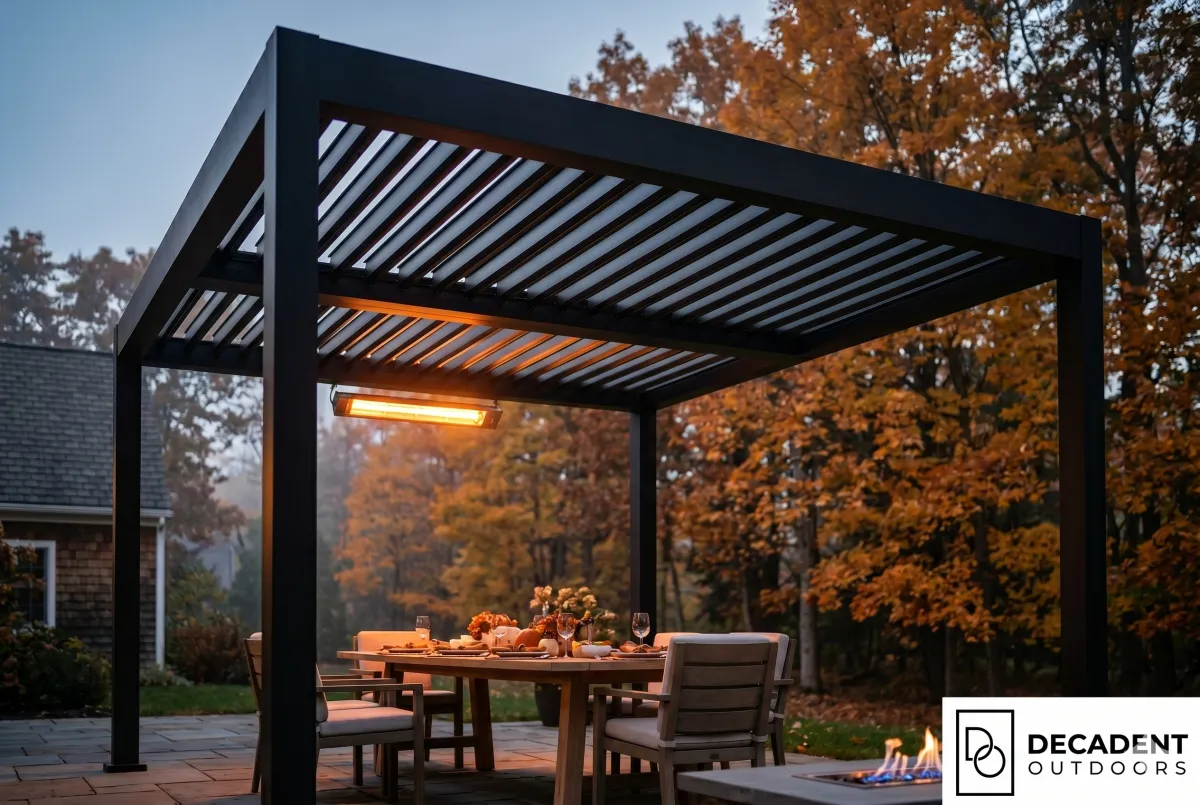
The product that has most changed the conversation is the motorized louvered pergola. Unlike a fixed-roof structure, a louvered pergola lets you dial in exactly how much sun, shade, or air you want — from fully open to fully closed, with stops at any angle in between. When the rain starts, the louvers seal. When the sun breaks through, they open again. You control it from your phone.
Companies like StruXure — the brand Decadent Outdoors carries — have engineered these systems specifically for climate performance. Snow loads. Wind ratings. Thermal expansion in cold temperatures. These aren’t features added as afterthoughts. They’re designed in from the start.
For Upstate New York, this matters enormously. A structure that can close and protect against a November rain while still letting you sit outside is a fundamentally different product from a gazebo or a fixed pergola. It extends the season by months.
Radiant Heating and Outdoor Climate Control
Infratech radiant heaters and Bromic heating systems have changed the look of cold-weather outdoor dining. These aren’t the orange-glow patio heaters from the hardware store. They’re precision-engineered infrared systems that heat bodies and surfaces directly, not the air — which means wind doesn’t steal the warmth. A Friday evening in late October, dinner outside, a fire feature burning nearby, a radiant heater taking the edge off the chill: that’s not a fantasy. That’s a real space, built by people who know what they’re doing.
Retractable Screens and Enclosures
Motorized screen systems by Fenetex and SummerSpace serve double duty: they keep insects out in summer and add a layer of wind and weather protection in shoulder seasons. Combined with a louvered pergola, a screened outdoor room becomes a genuine three-season space without the permanence — or the permit complexity — of a full room addition.
3-Season Rooms and Lumon Glass
For homeowners who want the closest thing to a true year-round space, 3-season enclosures using systems like Lumon Glass — floor-to-ceiling glass panels that open completely or close to form a weather-sealed envelope — bring the outdoors in without sacrificing the feeling of being outside. The light is real. The views are real. And you can use it in March.
Why This Requires a Different Kind of Designer
Not every contractor who installs outdoor structures understands the Capital Region's climate demands. That distinction matters more than most homeowners realize until something goes wrong.
The questions that separate a well-designed Upstate NY outdoor space from one that will disappoint within a few seasons are specific: What’s the snow load rating of this structure? How does the material perform through freeze-thaw cycles? What’s the wind rating? How does the finish hold up after five winters?
These aren’t questions a general contractor thinks to ask. They’re questions a designer asks — someone whose entire background is built around building beautiful things that survive demanding environments.
Jeff Mazzarelli spent 35 years designing and building golf courses and resorts for some of the world’s most discerning clients. The standard he brought to those projects didn’t lower when he came home to the Capital Region.
Decadent Outdoors was built on exactly that premise. The products are chosen because they perform. StruXure’s engineering is tested to real structural standards. Infratech’s heaters are commercial-grade. Fenetex’s screens are warranted for serious weather exposure. The decision to work exclusively with category leaders isn’t a marketing choice — it’s a design philosophy. You build with what works, and you stand behind it.
Every project begins the same way: understanding how you actually want to live in the space, not just what you want it to look like. That distinction — between aesthetics and function — is where most outdoor living projects succeed or fail.
How to Think About Your Outdoor Space if You Live in Upstate New York
If you’re seriously considering an outdoor living investment in the Capital Region or the Hudson Valley, here’s a framework to start with.
Start with how you want to use it, not what you want it to look like
The homeowners who are happiest with their outdoor spaces started the design conversation with use in mind, not aesthetics. Do you want a dinner party space? A quiet morning coffee spot that you use seven days a week? A place for the kids that doubles as an adult space in the evening? Each use case drives a different design. Aesthetics follow function, not the other way around.
Ask what months you want to use it
In the Capital Region, this is the single most important design question. Do you want a space that extends into May and October? Or do you genuinely want to sit outside on a January afternoon when the sun is out and the air is still? The answer determines which products are appropriate and what the budget looks like. Be honest with yourself. A well-designed four-season space costs more than a summer-only one — but it earns back that difference in actual use.
Think about integration, not addition
The best outdoor spaces feel like a natural extension of the home, not an addition bolted onto it. Sightlines from interior rooms. Transition from back door to outdoor dining. The relationship between kitchen access and an outdoor cooking area. These spatial relationships are design decisions that should be made before a single post goes in the ground.
Invest in structure before aesthetics
Furniture can be changed. Lighting can be updated. The structure itself — the pergola, the enclosure, the foundation — is the long-term decision. Spend the money where it matters, and don’t let aesthetics drive what should be an engineering conversation first.
Frequently Asked Questions
Can I actually use an outdoor space year-round in Upstate New York?
Yes, with the right structure. A motorized louvered pergola with radiant heating and retractable screens can extend your usable season to 8–10 months in the Capital Region. Full four-season use is possible with an enclosed system like a Lumon Glass enclosure, which provides weather protection while preserving the feeling of being outside. The key is designing specifically for the climate — not installing products built for milder regions.
What outdoor structures work best in cold climates like Albany and Saratoga Springs?
Motorized louvered pergolas with engineered snow load ratings, radiant infrared heating systems, retractable weather-resistant screens, and glass enclosure systems are the four categories best suited to Upstate New York conditions. Each product should have documented structural ratings for snow load and wind resistance. StruXure pergolas, for example, are engineered to specific load standards — that’s not common across all manufacturers.
Is it worth investing in outdoor living in a cold-weather climate?
The return is real, both in home value and quality of life. Saratoga County has a median property value of $348,600 and a median household income of over $100,000 — buyers in this market expect outdoor spaces of matching quality. Studies consistently show that well-designed outdoor living areas add 10–15

Outdoor Living Ideas Upstate NY: Year-Round Spaces
Why Upstate New York Homeowners Are Rethinking Their Outdoor Space — And What They’re Building Instead
Picture this. It’s the third week of October. The leaves along the Northway are doing what they only do here — that particular amber-and-rust combination that people drive hours to see. Your backyard looks beautiful. And you’re watching it from inside the house, through a window, because it’s 44 degrees and there’s nowhere to sit that isn’t cold, exposed, or uncomfortable.
You close the blinds. That’s it. That’s the end of the outdoor season.
If that scene feels familiar, you’re not alone. Most homeowners in the Capital Region and Hudson Valley go through the same quiet resignation every fall. The deck gets covered. The furniture goes into the garage. The grill gets a tarp. And for the next six months, a space you invested in — and genuinely love — simply stops existing.
The honest question isn’t whether that bothers you. It’s whether it has to.
Because a growing number of Upstate New York homeowners have figured something out. They’ve realized that the problem was never the climate. The problem was the approach. They weren’t building outdoor spaces designed for where they actually live.
The Problem No One Talks About: Designing for a Climate You Actually Live In
Here’s what almost never gets said in the outdoor living industry: most products are designed for somewhere else.
The patio furniture photographed for catalog shoots? Shot in California. The pergola designs that appear in home improvement magazines? Usually photographed in Arizona or the Southeast. The standard aluminum patio cover your neighbor put up three years ago has barely been used since. Built to a specification that assumes mild winters and occasional rain.
None of that is designed for a place where temperatures drop to single digits in January, where snow load is a real structural concern, where the wind off the Hudson can take the edge off a July evening, and where you genuinely want to sit outside in November because the foliage is worth it.
The Capital Region loses roughly five months of the outdoor season to cold weather. That’s not a design constraint to work around. For the right builder, it’s a design problem worth solving.
The external problem is clear: you can’t use your outdoor space for more than a few months a year, and even within those months, a cold night or a sudden rainstorm can end an evening before it begins.
The internal frustration runs deeper. You made a real investment in your property. You love your home. You chose to live somewhere with actual seasons, with real character, with that particular Northeast quality that no amount of sunshine can replicate. But somewhere along the way, the outdoor spaces you were sold don’t match the outdoor life you actually wanted. There’s a gap between what you imagined and what you got.
And philosophically, you shouldn’t have to choose between living in a place you love and actually using the property you own.
That’s the real problem. And it’s the one that more and more Capital Region homeowners are finally deciding to solve.
What Upstate New York Homeowners Are Building Now
The shift started somewhere around 2020 and hasn’t slowed down. Nationally, 82 percent of American homeowners report greater interest in outdoor living upgrades than they had before 2020. Pergola sales grew 22 percent between 2021 and 2023. The global outdoor living structures market, valued at 6.8 billion dollars in 2025, is projected to nearly double by 2033.
But the more interesting story isn’t the national numbers. It’s what’s happening specifically in places like Saratoga Springs, Clifton Park, Delmar, and the Hudson Valley corridors — markets where the buyers are sophisticated, the properties are substantial, and the appetite for quality is real.
In these markets, homeowners aren’t asking for patios anymore. They’re asking for outdoor living rooms. Year-round rooms. The question has shifted from “what can I put outside?” to “how do I make outside feel like in?”
Motorized Louvered Pergolas
The product that has most changed the conversation is the motorized louvered pergola. Unlike a fixed-roof structure, a louvered pergola lets you dial in exactly how much sun, shade, or air you want — from fully open to fully closed, with stops at any angle in between. When the rain starts, the louvers seal. When the sun breaks through, they open again. You control it from your phone.
Companies like StruXure — the brand Decadent Outdoors carries — have engineered these systems specifically for climate performance. Snow loads. Wind ratings. Thermal expansion in cold temperatures. These aren’t features added as afterthoughts. They’re designed in from the start.
For Upstate New York, this matters enormously. A structure that can close and protect against a November rain while still letting you sit outside is a fundamentally different product from a gazebo or a fixed pergola. It extends the season by months.
Radiant Heating and Outdoor Climate Control
Infratech radiant heaters and Bromic heating systems have changed the look of cold-weather outdoor dining. These aren’t the orange-glow patio heaters from the hardware store. They’re precision-engineered infrared systems that heat bodies and surfaces directly, not the air — which means wind doesn’t steal the warmth. A Friday evening in late October, dinner outside, a fire feature burning nearby, a radiant heater taking the edge off the chill: that’s not a fantasy. That’s a real space, built by people who know what they’re doing.
Retractable Screens and Enclosures
Motorized screen systems by Fenetex and SummerSpace serve double duty: they keep insects out in summer and add a layer of wind and weather protection in shoulder seasons. Combined with a louvered pergola, a screened outdoor room becomes a genuine three-season space without the permanence — or the permit complexity — of a full room addition.
3-Season Rooms and Lumon Glass
For homeowners who want the closest thing to a true year-round space, 3-season enclosures using systems like Lumon Glass — floor-to-ceiling glass panels that open completely or close to form a weather-sealed envelope — bring the outdoors in without sacrificing the feeling of being outside. The light is real. The views are real. And you can use it in March.
Why This Requires a Different Kind of Designer
Not every contractor who installs outdoor structures understands the Capital Region's climate demands. That distinction matters more than most homeowners realize until something goes wrong.
The questions that separate a well-designed Upstate NY outdoor space from one that will disappoint within a few seasons are specific: What’s the snow load rating of this structure? How does the material perform through freeze-thaw cycles? What’s the wind rating? How does the finish hold up after five winters?
These aren’t questions a general contractor thinks to ask. They’re questions a designer asks — someone whose entire background is built around building beautiful things that survive demanding environments.
Jeff Mazzarelli spent 35 years designing and building golf courses and resorts for some of the world’s most discerning clients. The standard he brought to those projects didn’t lower when he came home to the Capital Region.
Decadent Outdoors was built on exactly that premise. The products are chosen because they perform. StruXure’s engineering is tested to real structural standards. Infratech’s heaters are commercial-grade. Fenetex’s screens are warranted for serious weather exposure. The decision to work exclusively with category leaders isn’t a marketing choice — it’s a design philosophy. You build with what works, and you stand behind it.
Every project begins the same way: understanding how you actually want to live in the space, not just what you want it to look like. That distinction — between aesthetics and function — is where most outdoor living projects succeed or fail.
How to Think About Your Outdoor Space if You Live in Upstate New York
If you’re seriously considering an outdoor living investment in the Capital Region or the Hudson Valley, here’s a framework to start with.
Start with how you want to use it, not what you want it to look like
The homeowners who are happiest with their outdoor spaces started the design conversation with use in mind, not aesthetics. Do you want a dinner party space? A quiet morning coffee spot that you use seven days a week? A place for the kids that doubles as an adult space in the evening? Each use case drives a different design. Aesthetics follow function, not the other way around.
Ask what months you want to use it
In the Capital Region, this is the single most important design question. Do you want a space that extends into May and October? Or do you genuinely want to sit outside on a January afternoon when the sun is out and the air is still? The answer determines which products are appropriate and what the budget looks like. Be honest with yourself. A well-designed four-season space costs more than a summer-only one — but it earns back that difference in actual use.
Think about integration, not addition
The best outdoor spaces feel like a natural extension of the home, not an addition bolted onto it. Sightlines from interior rooms. Transition from back door to outdoor dining. The relationship between kitchen access and an outdoor cooking area. These spatial relationships are design decisions that should be made before a single post goes in the ground.
Invest in structure before aesthetics
Furniture can be changed. Lighting can be updated. The structure itself — the pergola, the enclosure, the foundation — is the long-term decision. Spend the money where it matters, and don’t let aesthetics drive what should be an engineering conversation first.
Frequently Asked Questions
Can I actually use an outdoor space year-round in Upstate New York?
Yes, with the right structure. A motorized louvered pergola with radiant heating and retractable screens can extend your usable season to 8–10 months in the Capital Region. Full four-season use is possible with an enclosed system like a Lumon Glass enclosure, which provides weather protection while preserving the feeling of being outside. The key is designing specifically for the climate — not installing products built for milder regions.
What outdoor structures work best in cold climates like Albany and Saratoga Springs?
Motorized louvered pergolas with engineered snow load ratings, radiant infrared heating systems, retractable weather-resistant screens, and glass enclosure systems are the four categories best suited to Upstate New York conditions. Each product should have documented structural ratings for snow load and wind resistance. StruXure pergolas, for example, are engineered to specific load standards — that’s not common across all manufacturers.
Is it worth investing in outdoor living in a cold-weather climate?
The return is real, both in home value and quality of life. Saratoga County has a median property value of $348,600 and a median household income of over $100,000 — buyers in this market expect outdoor spaces of matching quality. Studies consistently show that well-designed outdoor living areas add 10–15


COMPANY
PRODUCTS
LEGAL & TRUST
Copyright 2026. Decadent Outdoors . All Rights Reserved.