
DECADENT BLOG
The outdoor living guide for Capital Region homeowners.
Expert guidance on designing, investing in, and maximizing outdoor living spaces in the Capital Region's unique climate.
DECADENT BLOG
Decadent Blog
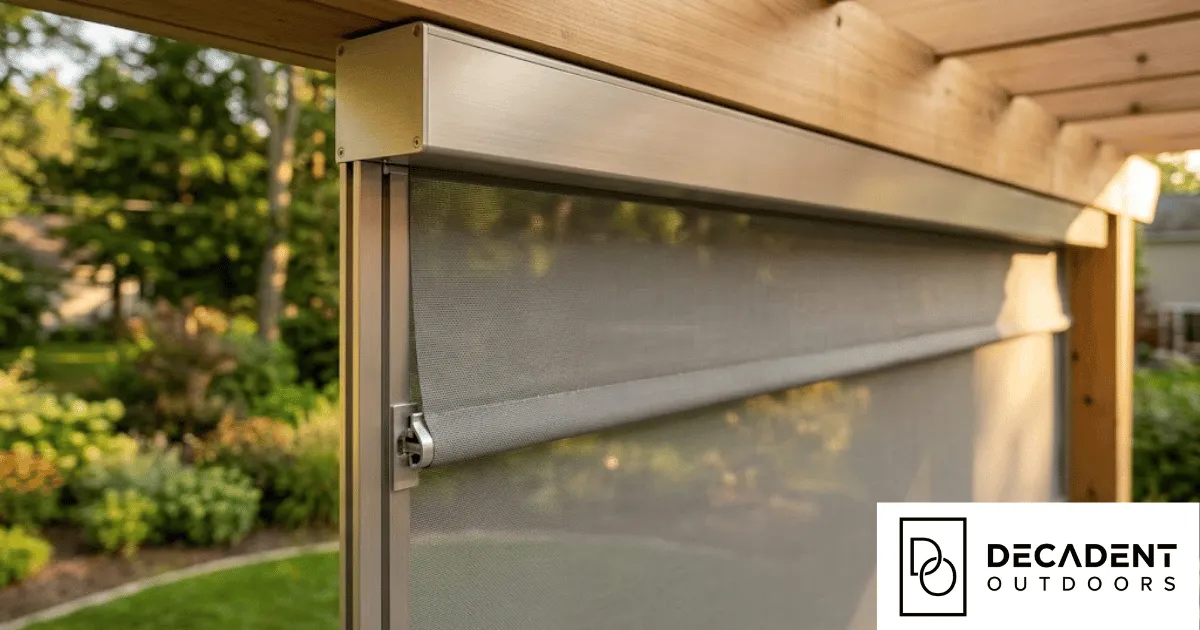
Inside OneTrack: The Engineering Behind a Disappearing Wall
Inside OneTrack: The Quiet Engineering Behind a Wall That Disappears
The best engineering goes unnoticed.
The Capital Region homeowner who has a properly specified OneTrack motorized screen system at the back of their property doesn't think about the engineering on a Tuesday evening in July. They press a button. A screen comes down. The mosquitoes that would have arrived in fifteen minutes don't matter. Dinner continues. Two hours later, they press the button again, the screen disappears into a housing tucked into the structure, and the patio is open again. They don't think about the Lock Tight Keder system holding the screen edge against 30 MPH wind gusts. They don't think about the spring-balanced motor that ran without grinding for the eight seconds it took to deploy. They don't think about the patented track design that adjusted itself for the slight settling the structure has done since last spring. The system worked. They went on with their evening.
This piece is about the engineering they don't have to think about. The reason most motorized retractable screen systems on the market fail within five to ten years and the reason properly engineered ones don't. The specific differences between the Fenetex OneTrack system and the cheaper retractable screen products a homeowner will inevitably encounter while researching this category. And the reason all of that matters more in Upstate New York than in the warm-climate markets where most retractable screen products were originally designed.
This is the sixth installment of The Fourth Wall. The first five established the case for motorized retractable screens as the architectural answer to the Capital Region outdoor-space problem. This one looks inside the system itself.
Quick Answer
What makes Fenetex OneTrack different from other motorized retractable screens?
Three engineered systems distinguish Fenetex OneTrack from the cheaper retractable screen products that dominate the lower price tiers of the category. First, the Lock Tight Keder system, which uses a continuous polymer edge bead captured inside the aluminum track to hold the screen edge securely against wind — eliminating the zipper-based edge retention that is the single most common failure point in competing motorized screens. Second, thepatented Quiet Spring technology, which uses spring-balanced motors to deploy the screens smoothly and quietly while reducing strain on the motor mechanism — resulting in 99% fewer service calls over the system's operating life. Third, theSelf-Adjusting Track System, which compensates for the natural settling of any wood, aluminum, or composite structure over time — ensuring the screen continues to seal properly through years of seasonal thermal expansion and structural movement. The combined result is a system rated to 100 MPH winds and backed by a lifetime warranty — engineered for the Upstate New York climate, not the gentler conditions where retractable screens were first popularized.
The Three Failure Points Cheap Retractable Screens Share
Any homeowner who has spent time researching retractable screen products has noticed the price range. Entry-level retractable screen systems start around $1,500 to $3,000 per opening. Higher-tier systems run $4,000 to $8,000 per opening. OneTrack and other top-tier engineered systems run higher. The instinct of any sensible person is to ask whether the price difference reflects real engineering or just a brand premium.
The honest answer is that it reflects real engineering — specifically, real engineering around three predictable failure points that cheaper systems either ignore or solve badly.
Failure point one: edge retention (zippers)
Most retractable screen products on the market use a continuous zipper sewn or welded along each vertical edge of the screen. As the screen deploys, the zipper engages with a corresponding track along the inside of the frame. The zipper is what holds the screen edge against wind and prevents insects from passing between the screen and the frame.
The zipper is also the part that breaks. Capital Region winters expose the screen system to thermal expansion, freezing, salt air on properties near the river, and UV exposure during the deployed hours of warm season. Zipper failure typically shows up between years three and seven of ownership — an emerging gap at the edge, a snag, a tooth that no longer engages, an insect path that didn't exist when the system was new. The repair, depending on the manufacturer, runs from "send the screen back for re-zippering" to "replace the entire screen panel." Neither is what the homeowner expected when they spent $20,000 on the system.
The Fenetex Lock Tight Keder system eliminates the zipper entirely. Instead of a sewn zipper, the screen has a continuous polymer bead (the "keder") along each vertical edge. The bead slides into a captured channel in the aluminum track and is held mechanically, not by sewing or welding. There are no zipper teeth to fail. There are no sewn seams along the wind-loaded edge. The system holds because of the mechanical geometry of the track, not because of a textile fastener that wasn't designed for fifteen years of Upstate New York winters.
Failure point two: motor strain and noise
Cheaper retractable screen products use stock tubular motors with no spring-balancing system. The full weight of the screen pulls on the motor during every deployment and every retraction. Over thousands of cycles, the motor bearings wear, the gearbox loosens, and the system starts to grind audibly during operation. Eventually the motor fails entirely and the homeowner is replacing a critical component of a system they expected to be set-and-forget.
The Fenetex Quiet Spring technology — patented and unique to the OneTrack product line — uses a spring-balanced motor system. The spring counterweights the screen weight, so the motor's job is to start and stop the screen, not to lift its full weight on every cycle. The result is two qualitative differences the homeowner notices on day one and benefits from across the system's life. The deployment is quiet — closer to a low hum than the grinding most cheaper systems produce. And the motor lasts. The 99% fewer service calls statistic Fenetex publishes for the OneTrack line is, in large part, a function of the spring-balanced motor reducing the wear that causes most motorized screen failures.
Failure point three: structural settling and track misalignment
Every outdoor structure moves. Pergolas settle. Wood frames shift through thermal cycles. Aluminum expands and contracts roughly five-thousandths of an inch per foot for every fifty-degree temperature swing, which means a fifteen-foot opening can vary by a sixteenth of an inch or more between a January morning and an August afternoon. A motorized screen system rigidly fixed to a structure that moves underneath it eventually develops binding, jamming, or seal gaps.
The Fenetex Self-Adjusting Track System uses a track design that accommodates structural movement without losing the seal. The geometry of the track and the keder-edge engagement allows for minor lateral movement at the frame while still holding the screen edge securely against wind and bugs. Over fifteen or twenty years of ownership — through the freeze-thaw cycles, the settling, the seasonal expansion — the system continues to function the way it did at install. A cheaper system at year ten typically needs adjustment, repair, or replacement. A Fenetex OneTrack at year ten is still operating to specification.
The three failure points are predictable. The cheaper a retractable screen system is, the more it leans on textile fasteners, stock motors, and rigid tracks. The more engineered it is, the more it solves those problems before the homeowner ever encounters them.
The 100 MPH Wind Rating — What It Actually Means
Wind ratings on motorized screen products vary widely. Entry-level systems sometimes carry no rating at all — the homeowner is instructed to retract the screens whenever conditions look threatening. Mid-tier systems are rated to 40-60 MPH. Fenetex OneTrack screens are rated to 100 MPH, which puts them in the engineering category typically reserved for hurricane-rated products in Florida and the Gulf Coast.
Most Capital Region homeowners are not going to encounter 100 MPH winds in a typical year. The relevant question is what the rating signals about the engineering margin. A system rated to 100 MPH has been engineered to hold its seal against forces several times higher than what the screens will routinely encounter — which means at the 30, 40, or 50 MPH gusts of an Upstate New York summer thunderstorm or fall nor'easter, the system is operating well within its design envelope. There is no working at the edge of capacity. The screen holds, the keder edge stays seated, the track stays aligned. The homeowner doesn't have to retract the screens every time the wind picks up.
In severe weather — a nor'easter producing sustained 60+ MPH winds, a serious summer microburst — any responsible motorized screen system, including OneTrack, should be retracted to preserve the equipment and the structure. The 100 MPH rating doesn't mean the screens are meant to ride out a hurricane. It means the system has the engineering headroom to handle normal Upstate New York weather without working at its limits.
The Mesh Itself — And Why Specification Matters
The track, motor, and edge retention are the moving parts. The mesh is the part of the system that actually does the work the homeowner cares about. And the mesh is one of the dimensions where the OneTrack system offers more flexibility than most homeowners realize.
Five mesh types are available within the same OneTrack frame, interchangeable as the household's needs change or as different conditions come up across the year.
The interchangeability matters. The same OneTrack frame and motor system can run bug mesh in June, solar mesh by August, and clear vinyl in October — with the homeowner swapping panels as conditions and household needs evolve. Cheaper retractable screen systems often lock the homeowner into a single mesh choice at install, and changing it later means replacing the screen unit entirely.
Why "The Wall That Disappears" Is the Real Thesis
Every blog in this series has used a phrase that is meant literally, not as marketing copy. The fourth wall. The side of the patio that closes against bugs, sun, wind, or chill when conditions require it and disappears when they don't. It is the architectural shorthand for the entire engineering exercise.
The engineering challenge of a wall that disappears is harder than the engineering challenge of a wall that stays. A permanent wall — a screened porch enclosure, a sunroom glazing system, a brick exterior — only has to do its job. It doesn't have to disappear and come back. A motorized screen system has to deploy reliably thousands of times across the life of the property, hold its seal against weather, sun, and insect pressure during the deployed hours, and then retract completely and discreetly when not needed. Every cycle is a stress test on the materials and the mechanism.
The Lock Tight Keder system solves the cycling-edge problem — the keder bead engages and disengages cleanly across thousands of deployments without the textile fatigue that breaks zipper-based systems. The Quiet Spring technology solves the motor-strain problem — the spring-balanced motor handles the deployment load across the system's life without the wear that breaks stock-motor systems. The Self-Adjusting Track solves the structural-movement problem — the screen continues to seal properly even as the structure under it shifts through years of seasonal change.
A wall that disappears, and reappears, and disappears, and reappears, ten thousand times across the homeowner's tenure. That's the engineering brief. The lifetime warranty Fenetex carries on the OneTrack system is a function of the engineering being matched to the brief.
The wall that disappears is the central architectural idea of this series. The engineering inside the wall is what makes the disappearing reliable enough to bet a household's outdoor living on for the next twenty years.
What the Series Looks at Next
The next blog, publishing July 7, returns to the social-life question Blog 2 raised — specifically, why Capital Region homeowners report hosting less than they did pre-pandemic, and what the household's outdoor-space investment has to do with the hosting rate. The engineering inside the OneTrack system matters because of what it enables on a Saturday evening in August. The next piece looks at that Saturday evening directly.
Frequently Asked Questions
What is Lock Tight Keder technology, and why does it matter?
Lock Tight Keder is a screen-edge retention system used in the Fenetex OneTrack product line. Instead of the continuous zipper most retractable screen systems use to hold the screen edge in the track, OneTrack screens have a polymer bead (the "keder") sewn into each vertical edge. The bead slides into a captured channel inside the aluminum track and is held mechanically — without any zipper teeth, sewn seams, or textile fasteners along the wind-loaded edge. This eliminates the single most common failure point in competing motorized screens. Zipper-based systems typically fail between years three and seven; keder-based systems hold for the operational life of the product, which is why Fenetex backs OneTrack with a lifetime warranty.
What is Quiet Spring technology?
Quiet Spring is a patented spring-balanced motor system in the Fenetex OneTrack product line. Most retractable screen products use a stock tubular motor that bears the full weight of the screen during every deployment and retraction. The strain shortens the motor's operational life and produces audible grinding during operation. The Quiet Spring system uses a counterweight spring that offsets the screen weight, so the motor only has to start and stop the screen rather than lift its full weight on every cycle. The results are quieter operation (closer to a low hum than a grinding sound), longer motor life, and a documented 99% reduction in service calls over the system's operating life compared to non-spring-balanced retractable screen products.
Are OneTrack screens really rated to 100 MPH winds?
Yes. Fenetex OneTrack screens carry a 100 MPH wind rating — engineering testing under sustained wind load. The practical importance of the rating is not that Capital Region homeowners regularly encounter 100 MPH winds (they don't), but that the engineering margin means the system operates well within its design envelope at the 30, 40, and 50 MPH gusts that characterize Upstate New York summer storms and fall nor'easters. Most retractable screen products carry no rating or are rated to 40-60 MPH, which means they're operating near the edge of capacity in the same conditions where OneTrack is operating well below its limits. In severe weather above 60 MPH sustained, any responsible motorized screen system should be retracted to protect the equipment.
How many different mesh types can OneTrack run?
Five mesh types are available in the OneTrack system and are interchangeable in the same frame: standard insect mesh (blackflies, mosquitoes, and with the right specification no-see-ums), solar mesh (80-90% sun blocking), privacy mesh (one-way visibility), clear vinyl (full weather protection with view preserved), and wind mesh (heavy weave for wind-blocking). The interchangeability means the household can run different mesh types in different seasons — insect mesh in June, solar mesh in August, clear vinyl for shoulder-season heated dinners — without replacing the frame or the motor system. This is unusual in the retractable screen category; most cheaper systems lock the homeowner into a single mesh choice at install.
Is the lifetime warranty really for the lifetime of the product?
Yes. Fenetex backs the OneTrack system with a lifetime warranty against defects in materials and workmanship — specifically reflecting the company's confidence in the Lock Tight Keder, Quiet Spring, and Self-Adjusting Track engineering. The warranty terms cover the original purchaser and apply to the screen system itself, the motor, and the track hardware. Routine maintenance items (mesh cleaning, lubrication of moving components) are the homeowner's responsibility. Decadent Outdoors, as the authorized OneTrack installer for the Capital Region, also stands behind every installation it performs — meaning the homeowner has both the manufacturer's lifetime warranty and a local installer accountable for the workmanship of the install itself.

Inside OneTrack: The Engineering Behind a Disappearing Wall
Inside OneTrack: The Quiet Engineering Behind a Wall That Disappears
The best engineering goes unnoticed.
The Capital Region homeowner who has a properly specified OneTrack motorized screen system at the back of their property doesn't think about the engineering on a Tuesday evening in July. They press a button. A screen comes down. The mosquitoes that would have arrived in fifteen minutes don't matter. Dinner continues. Two hours later, they press the button again, the screen disappears into a housing tucked into the structure, and the patio is open again. They don't think about the Lock Tight Keder system holding the screen edge against 30 MPH wind gusts. They don't think about the spring-balanced motor that ran without grinding for the eight seconds it took to deploy. They don't think about the patented track design that adjusted itself for the slight settling the structure has done since last spring. The system worked. They went on with their evening.
This piece is about the engineering they don't have to think about. The reason most motorized retractable screen systems on the market fail within five to ten years and the reason properly engineered ones don't. The specific differences between the Fenetex OneTrack system and the cheaper retractable screen products a homeowner will inevitably encounter while researching this category. And the reason all of that matters more in Upstate New York than in the warm-climate markets where most retractable screen products were originally designed.
This is the sixth installment of The Fourth Wall. The first five established the case for motorized retractable screens as the architectural answer to the Capital Region outdoor-space problem. This one looks inside the system itself.
Quick Answer
What makes Fenetex OneTrack different from other motorized retractable screens?
Three engineered systems distinguish Fenetex OneTrack from the cheaper retractable screen products that dominate the lower price tiers of the category. First, the Lock Tight Keder system, which uses a continuous polymer edge bead captured inside the aluminum track to hold the screen edge securely against wind — eliminating the zipper-based edge retention that is the single most common failure point in competing motorized screens. Second, thepatented Quiet Spring technology, which uses spring-balanced motors to deploy the screens smoothly and quietly while reducing strain on the motor mechanism — resulting in 99% fewer service calls over the system's operating life. Third, theSelf-Adjusting Track System, which compensates for the natural settling of any wood, aluminum, or composite structure over time — ensuring the screen continues to seal properly through years of seasonal thermal expansion and structural movement. The combined result is a system rated to 100 MPH winds and backed by a lifetime warranty — engineered for the Upstate New York climate, not the gentler conditions where retractable screens were first popularized.
The Three Failure Points Cheap Retractable Screens Share
Any homeowner who has spent time researching retractable screen products has noticed the price range. Entry-level retractable screen systems start around $1,500 to $3,000 per opening. Higher-tier systems run $4,000 to $8,000 per opening. OneTrack and other top-tier engineered systems run higher. The instinct of any sensible person is to ask whether the price difference reflects real engineering or just a brand premium.
The honest answer is that it reflects real engineering — specifically, real engineering around three predictable failure points that cheaper systems either ignore or solve badly.
Failure point one: edge retention (zippers)
Most retractable screen products on the market use a continuous zipper sewn or welded along each vertical edge of the screen. As the screen deploys, the zipper engages with a corresponding track along the inside of the frame. The zipper is what holds the screen edge against wind and prevents insects from passing between the screen and the frame.
The zipper is also the part that breaks. Capital Region winters expose the screen system to thermal expansion, freezing, salt air on properties near the river, and UV exposure during the deployed hours of warm season. Zipper failure typically shows up between years three and seven of ownership — an emerging gap at the edge, a snag, a tooth that no longer engages, an insect path that didn't exist when the system was new. The repair, depending on the manufacturer, runs from "send the screen back for re-zippering" to "replace the entire screen panel." Neither is what the homeowner expected when they spent $20,000 on the system.
The Fenetex Lock Tight Keder system eliminates the zipper entirely. Instead of a sewn zipper, the screen has a continuous polymer bead (the "keder") along each vertical edge. The bead slides into a captured channel in the aluminum track and is held mechanically, not by sewing or welding. There are no zipper teeth to fail. There are no sewn seams along the wind-loaded edge. The system holds because of the mechanical geometry of the track, not because of a textile fastener that wasn't designed for fifteen years of Upstate New York winters.
Failure point two: motor strain and noise
Cheaper retractable screen products use stock tubular motors with no spring-balancing system. The full weight of the screen pulls on the motor during every deployment and every retraction. Over thousands of cycles, the motor bearings wear, the gearbox loosens, and the system starts to grind audibly during operation. Eventually the motor fails entirely and the homeowner is replacing a critical component of a system they expected to be set-and-forget.
The Fenetex Quiet Spring technology — patented and unique to the OneTrack product line — uses a spring-balanced motor system. The spring counterweights the screen weight, so the motor's job is to start and stop the screen, not to lift its full weight on every cycle. The result is two qualitative differences the homeowner notices on day one and benefits from across the system's life. The deployment is quiet — closer to a low hum than the grinding most cheaper systems produce. And the motor lasts. The 99% fewer service calls statistic Fenetex publishes for the OneTrack line is, in large part, a function of the spring-balanced motor reducing the wear that causes most motorized screen failures.
Failure point three: structural settling and track misalignment
Every outdoor structure moves. Pergolas settle. Wood frames shift through thermal cycles. Aluminum expands and contracts roughly five-thousandths of an inch per foot for every fifty-degree temperature swing, which means a fifteen-foot opening can vary by a sixteenth of an inch or more between a January morning and an August afternoon. A motorized screen system rigidly fixed to a structure that moves underneath it eventually develops binding, jamming, or seal gaps.
The Fenetex Self-Adjusting Track System uses a track design that accommodates structural movement without losing the seal. The geometry of the track and the keder-edge engagement allows for minor lateral movement at the frame while still holding the screen edge securely against wind and bugs. Over fifteen or twenty years of ownership — through the freeze-thaw cycles, the settling, the seasonal expansion — the system continues to function the way it did at install. A cheaper system at year ten typically needs adjustment, repair, or replacement. A Fenetex OneTrack at year ten is still operating to specification.
The three failure points are predictable. The cheaper a retractable screen system is, the more it leans on textile fasteners, stock motors, and rigid tracks. The more engineered it is, the more it solves those problems before the homeowner ever encounters them.
The 100 MPH Wind Rating — What It Actually Means
Wind ratings on motorized screen products vary widely. Entry-level systems sometimes carry no rating at all — the homeowner is instructed to retract the screens whenever conditions look threatening. Mid-tier systems are rated to 40-60 MPH. Fenetex OneTrack screens are rated to 100 MPH, which puts them in the engineering category typically reserved for hurricane-rated products in Florida and the Gulf Coast.
Most Capital Region homeowners are not going to encounter 100 MPH winds in a typical year. The relevant question is what the rating signals about the engineering margin. A system rated to 100 MPH has been engineered to hold its seal against forces several times higher than what the screens will routinely encounter — which means at the 30, 40, or 50 MPH gusts of an Upstate New York summer thunderstorm or fall nor'easter, the system is operating well within its design envelope. There is no working at the edge of capacity. The screen holds, the keder edge stays seated, the track stays aligned. The homeowner doesn't have to retract the screens every time the wind picks up.
In severe weather — a nor'easter producing sustained 60+ MPH winds, a serious summer microburst — any responsible motorized screen system, including OneTrack, should be retracted to preserve the equipment and the structure. The 100 MPH rating doesn't mean the screens are meant to ride out a hurricane. It means the system has the engineering headroom to handle normal Upstate New York weather without working at its limits.
The Mesh Itself — And Why Specification Matters
The track, motor, and edge retention are the moving parts. The mesh is the part of the system that actually does the work the homeowner cares about. And the mesh is one of the dimensions where the OneTrack system offers more flexibility than most homeowners realize.
Five mesh types are available within the same OneTrack frame, interchangeable as the household's needs change or as different conditions come up across the year.
The interchangeability matters. The same OneTrack frame and motor system can run bug mesh in June, solar mesh by August, and clear vinyl in October — with the homeowner swapping panels as conditions and household needs evolve. Cheaper retractable screen systems often lock the homeowner into a single mesh choice at install, and changing it later means replacing the screen unit entirely.
Why "The Wall That Disappears" Is the Real Thesis
Every blog in this series has used a phrase that is meant literally, not as marketing copy. The fourth wall. The side of the patio that closes against bugs, sun, wind, or chill when conditions require it and disappears when they don't. It is the architectural shorthand for the entire engineering exercise.
The engineering challenge of a wall that disappears is harder than the engineering challenge of a wall that stays. A permanent wall — a screened porch enclosure, a sunroom glazing system, a brick exterior — only has to do its job. It doesn't have to disappear and come back. A motorized screen system has to deploy reliably thousands of times across the life of the property, hold its seal against weather, sun, and insect pressure during the deployed hours, and then retract completely and discreetly when not needed. Every cycle is a stress test on the materials and the mechanism.
The Lock Tight Keder system solves the cycling-edge problem — the keder bead engages and disengages cleanly across thousands of deployments without the textile fatigue that breaks zipper-based systems. The Quiet Spring technology solves the motor-strain problem — the spring-balanced motor handles the deployment load across the system's life without the wear that breaks stock-motor systems. The Self-Adjusting Track solves the structural-movement problem — the screen continues to seal properly even as the structure under it shifts through years of seasonal change.
A wall that disappears, and reappears, and disappears, and reappears, ten thousand times across the homeowner's tenure. That's the engineering brief. The lifetime warranty Fenetex carries on the OneTrack system is a function of the engineering being matched to the brief.
The wall that disappears is the central architectural idea of this series. The engineering inside the wall is what makes the disappearing reliable enough to bet a household's outdoor living on for the next twenty years.
What the Series Looks at Next
The next blog, publishing July 7, returns to the social-life question Blog 2 raised — specifically, why Capital Region homeowners report hosting less than they did pre-pandemic, and what the household's outdoor-space investment has to do with the hosting rate. The engineering inside the OneTrack system matters because of what it enables on a Saturday evening in August. The next piece looks at that Saturday evening directly.
Frequently Asked Questions
What is Lock Tight Keder technology, and why does it matter?
Lock Tight Keder is a screen-edge retention system used in the Fenetex OneTrack product line. Instead of the continuous zipper most retractable screen systems use to hold the screen edge in the track, OneTrack screens have a polymer bead (the "keder") sewn into each vertical edge. The bead slides into a captured channel inside the aluminum track and is held mechanically — without any zipper teeth, sewn seams, or textile fasteners along the wind-loaded edge. This eliminates the single most common failure point in competing motorized screens. Zipper-based systems typically fail between years three and seven; keder-based systems hold for the operational life of the product, which is why Fenetex backs OneTrack with a lifetime warranty.
What is Quiet Spring technology?
Quiet Spring is a patented spring-balanced motor system in the Fenetex OneTrack product line. Most retractable screen products use a stock tubular motor that bears the full weight of the screen during every deployment and retraction. The strain shortens the motor's operational life and produces audible grinding during operation. The Quiet Spring system uses a counterweight spring that offsets the screen weight, so the motor only has to start and stop the screen rather than lift its full weight on every cycle. The results are quieter operation (closer to a low hum than a grinding sound), longer motor life, and a documented 99% reduction in service calls over the system's operating life compared to non-spring-balanced retractable screen products.
Are OneTrack screens really rated to 100 MPH winds?
Yes. Fenetex OneTrack screens carry a 100 MPH wind rating — engineering testing under sustained wind load. The practical importance of the rating is not that Capital Region homeowners regularly encounter 100 MPH winds (they don't), but that the engineering margin means the system operates well within its design envelope at the 30, 40, and 50 MPH gusts that characterize Upstate New York summer storms and fall nor'easters. Most retractable screen products carry no rating or are rated to 40-60 MPH, which means they're operating near the edge of capacity in the same conditions where OneTrack is operating well below its limits. In severe weather above 60 MPH sustained, any responsible motorized screen system should be retracted to protect the equipment.
How many different mesh types can OneTrack run?
Five mesh types are available in the OneTrack system and are interchangeable in the same frame: standard insect mesh (blackflies, mosquitoes, and with the right specification no-see-ums), solar mesh (80-90% sun blocking), privacy mesh (one-way visibility), clear vinyl (full weather protection with view preserved), and wind mesh (heavy weave for wind-blocking). The interchangeability means the household can run different mesh types in different seasons — insect mesh in June, solar mesh in August, clear vinyl for shoulder-season heated dinners — without replacing the frame or the motor system. This is unusual in the retractable screen category; most cheaper systems lock the homeowner into a single mesh choice at install.
Is the lifetime warranty really for the lifetime of the product?
Yes. Fenetex backs the OneTrack system with a lifetime warranty against defects in materials and workmanship — specifically reflecting the company's confidence in the Lock Tight Keder, Quiet Spring, and Self-Adjusting Track engineering. The warranty terms cover the original purchaser and apply to the screen system itself, the motor, and the track hardware. Routine maintenance items (mesh cleaning, lubrication of moving components) are the homeowner's responsibility. Decadent Outdoors, as the authorized OneTrack installer for the Capital Region, also stands behind every installation it performs — meaning the homeowner has both the manufacturer's lifetime warranty and a local installer accountable for the workmanship of the install itself.
Stop giving up your outdoor season.
We come to you, assess your space, and give you a fixed price — before you decide anything.


COMPANY
WHO WE SERVE
PRODUCTS
LEGAL & TRUST
Copyright 2026. Decadent Outdoors . All Rights Reserved.