
DECADENT BLOG
The outdoor living guide for Capital Region homeowners.
Expert guidance on designing, investing in, and maximizing outdoor living spaces in the Capital Region's unique climate.
DECADENT BLOG
Decadent Blog
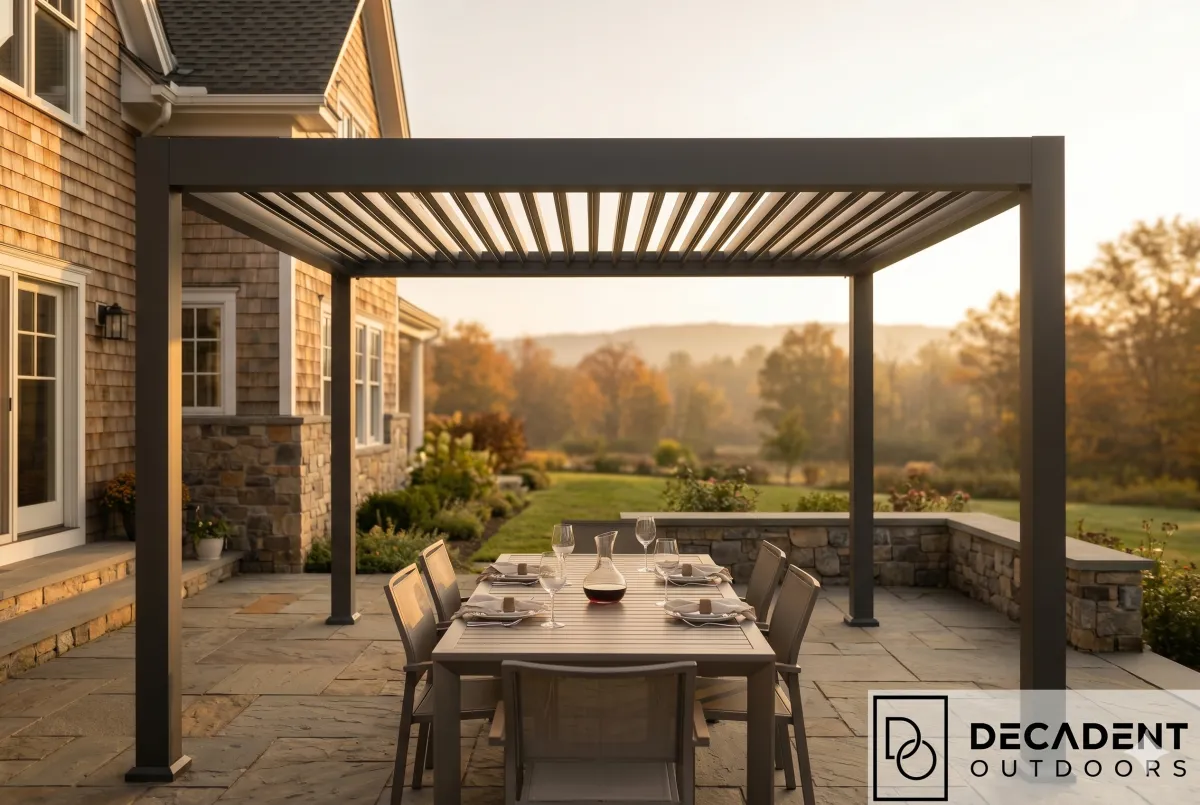
Motorized Pergola Upstate NY: The Complete Guide
What Is a Motorized Louvered Pergola — And Is It Worth the Investment in Upstate New York?
You've probably seen the phrase — motorized pergola, louvered pergola, adjustable-roof pergola — somewhere in your research. Maybe a neighbor mentioned it. Maybe it came up in a magazine or a home improvement website. And now you're trying to figure out what it actually is, whether the hype is real, and whether it makes any sense for a homeowner in Upstate New York, where winter comes early and doesn't apologize.
This article gives you the complete picture. No sales language. No inflated claims. Just a thorough, honest explanation of what a motorized louvered pergola is, how it works, what it can and can't do, and what the investment actually looks like in a market like the Capital Region and Hudson Valley.
By the end, you'll know whether this is the right product for your space — or whether something else makes more sense.
A motorized louvered pergola is a freestanding or attached outdoor structure with a roof made of adjustable aluminum louvers — horizontal blades that rotate from fully open (letting in full sun and sky) to fully closed (forming a weather-resistant, rain-shedding roof). The louvers are controlled by a remote, a wall switch, or a smartphone app, and can stop at any angle between open and closed. In a cold-climate market like Upstate New York, the key advantage is adaptability: the same structure gives you open-air sunshine in July and weather protection in October. High-quality systems like StruXure are engineered to handle snow loads and Northeastern freeze-thaw cycles — not just the mild-weather conditions most outdoor products are designed for.
Why Most Outdoor Structures Fail Upstate New York Homeowners
Before getting into the product, it's worth naming the problem it solves — because it's a specific one, and most outdoor structures don't actually address it.
The Capital Region and Hudson Valley have roughly four to five months of genuinely comfortable outdoor weather. June through early September, weather permitting, is beautiful. The rest of the year is complicated. May can be cold and wet. October is spectacular but often too chilly to sit outside without some kind of protection. November through April is largely off the table without serious infrastructure.
Traditional pergolas — open-beam wood or aluminum structures with no roof — do one thing well: they define a space and provide partial shade. What they don't do is protect you from rain, cold, or anything else the Capital Region sends your way. They extend your season by exactly zero months.
Solid-roof patio covers protect you from rain, but they block all light all the time. The covered space becomes a dim, cave-like area that feels closed off rather than open to the outdoor. You've traded the weather problem for a light problem.
Retractable awnings give you shade and moderate rain protection, but they're fabric — they don't hold up well to heavy rain, snow, or the sustained UV exposure of an Upstate summer. Most need to be retracted in any serious weather.
The problem Upstate New York homeowners face isn't just weather. It's that none of the standard solutions were designed for their specific combination of desires: open sky when it's beautiful, protection when it isn't. That's exactly what a motorized louvered pergola is built to deliver.
How a Motorized Louvered Pergola Actually Works
The mechanics are simpler than the name suggests. The roof of the structure is made of aluminum louvers — flat, angled blades, typically three to six inches wide, running the length of the structure. Each louver is connected to a motor-driven mechanism that rotates it simultaneously and precisely in increments at the touch of a button.
The louver positions and what they do
Fully open — louvers parallel to the ground, gaps between them — gives you open sky above. Sunlight, stars, breeze. It feels like sitting under a beautifully framed outdoor canopy rather than a roof. You get the outdoor feeling without the structure overhead being visible.
Angled positions let you control how much sun reaches the space. Angle the louvers to block the afternoon sun while keeping the light bright. Rotate them the other way to let in morning light while shading the afternoon west side. The adjustment is continuous — you're not choosing between three settings, you're dialing in exactly what you want.
Fully closed — louvers rotated to roughly 45 degrees or beyond, edges overlapping — creates a weather-tight seal. Rain runs off the overlapping louvers the way it runs off a tile roof. A properly installed system in this position will keep the space dry in steady rain. Not a hurricane. But a Capital Region rainstorm? Yes.
The control system
Premium systems like StruXure offer multiple control options: a handheld remote, a wall-mounted control panel, and smartphone app integration. The app control means you can open the louvers before you step outside — or close them from the dinner table when you notice rain starting. Some systems integrate with smart home platforms. Others offer wind and rain sensors that trigger automatic closure when conditions reach a set threshold.
That last feature matters in Upstate New York, where summer afternoon thunderstorms can arrive quickly. An automated system closes before you've finished your sentence about the approaching clouds.
The frame and structure
The quality of the aluminum frame is where the engineering either holds up or doesn't. Cheap systems use thin-wall extrusions that flex in the wind and corrode through freeze-thaw cycles. Premium systems like StruXure use structural-grade aluminum profiles engineered for real weather loads — the same kind of structural thinking that goes into commercial applications, not residential summer-use assumptions.
The connection points — where the structure attaches to the house or to its own posts — are the most critical structural elements. These need to be designed and installed for Upstate NY wind loads and snow accumulation. A system that passes Florida wind ratings but hasn't been evaluated for Capital Region snow loading is not the right system for this market.
What Makes This Product Right — or Wrong — for Upstate New York
Not every motorized pergola on the market is built for the Capital Region's climate. Here's what separates the ones that work from the ones that disappoint within a few seasons.
Snow load: the question you must ask
Upstate New York can receive significant snow accumulation. A louvered pergola in the closed position presents a flat or near-flat surface to falling snow. The structural question is whether the beam spans, column connections, and overall frame can handle the weight of accumulated snow before damage occurs.
Well-engineered systems carry documented snow load ratings — a pounds-per-square-foot figure that tells you what the structure can hold. StruXure's systems carry specific load ratings that exceed typical Upstate New York requirements. Systems from lower-tier manufacturers often don't publish these ratings, which means either they haven't tested for them or the numbers aren't impressive. Either answer is a problem.
Ask every contractor you evaluate: What is the documented snow load rating of this system? The answer tells you immediately whether you're talking to someone who understands your market.
Freeze-thaw cycles and material performance
Water gets into gaps. In Upstate New York, that water freezes, expands, and pries things apart over time. This affects joints, fasteners, finish coatings, and any rubber or plastic components used in weatherstripping or motor housings.
Premium systems use marine-grade aluminum alloys with anodized or powder-coated finishes that resist the expansion and contraction stresses of 80-degree annual temperature swings. The motors and mechanical components are sealed against moisture intrusion. The louver pivots are designed to remain smooth through seasonal changes, not to seize or bind when temperatures drop.
This level of engineering incurs higher upfront costs. It costs dramatically less over ten years.
What a louvered pergola genuinely cannot do
Honesty matters here. A motorized louvered pergola in the closed position handles rain well. It does not handle significant snow accumulation indefinitely — in heavy snowfall, the louvers should be opened to shed the load rather than carrying it. It provides protection from wind but is not a sealed enclosure — air still moves through gaps at the edges. For full four-season, truly weatherproof use in Upstate New York, a glass enclosure system is the more complete solution. For eight to ten months of comfortable use with excellent weather resilience, a motorized louvered pergola with integrated heating does the job better than anything else in its category.
Motorized Louvered Pergola vs. Other Options: A Comparison
The two structures most often weighed against a motorized louvered pergola are a traditional open pergola and a solid-roof patio cover. The tables below summarize the trade-offs.
What to Look for in a Motorized Pergola Installer in the Capital Region
The product is only half the decision. The other half is who installs it and how.
A motorized louvered pergola is a structural addition to your property. The footings need to account for frost depth — in Upstate New York, that means going down 48 inches or below the frost line to prevent heaving. If the house is attached, the attachment needs to integrate properly with your existing structure. The electrical work for the motors, lighting, and any accessories needs to be done to code.
These are not details that a general handyman or landscaping contractor is equipped to manage. They require someone who has done this specific work, in this specific climate, and who understands the engineering requirements that make the difference between a structure that performs for twenty years and one that needs remediation after three winters.
A motorized pergola installed wrong in Upstate New York doesn't fail dramatically. It fails slowly — a little more flex each season, a fastener that pulls slightly, a louver that binds in January. By the time it's obviously wrong, it's expensive to fix.
At Decadent Outdoors, every pergola project starts with a site assessment that includes soil conditions, frost depth, structural connection points, and drainage. The design accounts for the specific snow and wind loads of your property's location. And the installation is done by the same team that designed it — not subcontracted to whoever is available that week.
This is the part of the investment that doesn't show in the catalog photos but shows up every single winter for as long as the structure stands
Frequently Asked Questions
What is a motorized pergola?
A motorized pergola is an outdoor structure with a roof made of motorized, adjustable aluminum louvers. The louvers rotate from fully open — letting in full sky and sunlight — to fully closed, where they overlap to form a rain-shedding, weather-resistant roof. Control is via remote, wall panel, or smartphone app. High-quality systems include automated rain and wind sensors that can trigger closure automatically.
How does a louvered pergola work in the rain?
When the louvers are closed, they overlap at their edges, similar to roof tiles or window shutters. Rain runs off the overlapping surfaces and is channeled to built-in gutters integrated into the side beams, which then drain through the structural columns to the ground. A properly installed system keeps the space below dry in steady rain. In very heavy downpours, some misting at the edges may occur, but the space remains usable in conditions that would otherwise end the evening.
Can a motorized pergola handle Upstate NY snow loads?
Quality-engineered systems carry documented snow load ratings. StruXure's systems, which Decadent Outdoors installs, are engineered to specific structural standards that account for Capital Region snow accumulation. The recommended practice in heavy snowfall is to open the louvers — allowing snow to pass through rather than accumulate — which is why remote and app control matters in this climate. A system without documented snow load ratings should not be considered for this market.
Is a motorized louvered pergola worth the cost?
The value equation depends on how you use your outdoor space. For homeowners who currently lose five to six months of outdoor living per year to weather, a motorized pergola with integrated radiant heating extends the usable season to eight or ten months. That's a doubling or tripling of outdoor use from the same space. Combined with the home value impact — well-designed outdoor structures consistently add to resale value in the Capital Region's $340,000+ median property market — the investment returns both in daily quality of life and in long-term property value.
How long does it take to install a motorized pergola?
Installation timelines vary by project size and complexity. Most residential motorized pergola installations take two to four days of active work. The full project timeline — from initial consultation through design approval, permitting if required, material lead time, and installation — typically runs six to twelve weeks, depending on the season and the contractor's schedule. Fall and early winter are often the best times to initiate the process for spring installation readiness.
What is the difference between StruXure and other motorized pergola brands?
StruXure is the category leader in motorized louvered pergola systems in North America, recognized for structural engineering standards, material quality, and the depth of its smart control integration. The key differentiators are documented load ratings for snow and wind, the quality of the aluminum extrusion profiles, the motor system's durability in cold weather, and the warranty coverage. Many competing systems are designed for warm climates and adapted for colder markets. StruXure systems are engineered from the ground up for real four-season performance.
The Right Product for the Right Climate — Installed the Right Way
A motorized louvered pergola is not the right answer for every outdoor space. If you want pure open-sky aesthetics with no need for weather protection, a traditional pergola does that for less money. If you want a truly weatherproof four-season enclosure, a glass-panel system goes further. If your outdoor use is genuinely limited to summer months and weather is not a concern, there are simpler options.
But for the Capital Region homeowner who wants genuine season extension — a space they can use comfortably in May and October, that handles a summer afternoon storm without sending everyone inside, that opens to full sky on the first warm Saturday of April — a motorized louvered pergola is the product that earns its investment most clearly.
The difference between that product performing for twenty years and disappointing in three comes down to one thing: whether it was designed for your climate and installed by someone who has done this work in exactly these conditions.
That's the conversation worth having before any other decision gets made.

Motorized Pergola Upstate NY: The Complete Guide
What Is a Motorized Louvered Pergola — And Is It Worth the Investment in Upstate New York?
You've probably seen the phrase — motorized pergola, louvered pergola, adjustable-roof pergola — somewhere in your research. Maybe a neighbor mentioned it. Maybe it came up in a magazine or a home improvement website. And now you're trying to figure out what it actually is, whether the hype is real, and whether it makes any sense for a homeowner in Upstate New York, where winter comes early and doesn't apologize.
This article gives you the complete picture. No sales language. No inflated claims. Just a thorough, honest explanation of what a motorized louvered pergola is, how it works, what it can and can't do, and what the investment actually looks like in a market like the Capital Region and Hudson Valley.
By the end, you'll know whether this is the right product for your space — or whether something else makes more sense.
A motorized louvered pergola is a freestanding or attached outdoor structure with a roof made of adjustable aluminum louvers — horizontal blades that rotate from fully open (letting in full sun and sky) to fully closed (forming a weather-resistant, rain-shedding roof). The louvers are controlled by a remote, a wall switch, or a smartphone app, and can stop at any angle between open and closed. In a cold-climate market like Upstate New York, the key advantage is adaptability: the same structure gives you open-air sunshine in July and weather protection in October. High-quality systems like StruXure are engineered to handle snow loads and Northeastern freeze-thaw cycles — not just the mild-weather conditions most outdoor products are designed for.
Why Most Outdoor Structures Fail Upstate New York Homeowners
Before getting into the product, it's worth naming the problem it solves — because it's a specific one, and most outdoor structures don't actually address it.
The Capital Region and Hudson Valley have roughly four to five months of genuinely comfortable outdoor weather. June through early September, weather permitting, is beautiful. The rest of the year is complicated. May can be cold and wet. October is spectacular but often too chilly to sit outside without some kind of protection. November through April is largely off the table without serious infrastructure.
Traditional pergolas — open-beam wood or aluminum structures with no roof — do one thing well: they define a space and provide partial shade. What they don't do is protect you from rain, cold, or anything else the Capital Region sends your way. They extend your season by exactly zero months.
Solid-roof patio covers protect you from rain, but they block all light all the time. The covered space becomes a dim, cave-like area that feels closed off rather than open to the outdoor. You've traded the weather problem for a light problem.
Retractable awnings give you shade and moderate rain protection, but they're fabric — they don't hold up well to heavy rain, snow, or the sustained UV exposure of an Upstate summer. Most need to be retracted in any serious weather.
The problem Upstate New York homeowners face isn't just weather. It's that none of the standard solutions were designed for their specific combination of desires: open sky when it's beautiful, protection when it isn't. That's exactly what a motorized louvered pergola is built to deliver.
How a Motorized Louvered Pergola Actually Works
The mechanics are simpler than the name suggests. The roof of the structure is made of aluminum louvers — flat, angled blades, typically three to six inches wide, running the length of the structure. Each louver is connected to a motor-driven mechanism that rotates it simultaneously and precisely in increments at the touch of a button.
The louver positions and what they do
Fully open — louvers parallel to the ground, gaps between them — gives you open sky above. Sunlight, stars, breeze. It feels like sitting under a beautifully framed outdoor canopy rather than a roof. You get the outdoor feeling without the structure overhead being visible.
Angled positions let you control how much sun reaches the space. Angle the louvers to block the afternoon sun while keeping the light bright. Rotate them the other way to let in morning light while shading the afternoon west side. The adjustment is continuous — you're not choosing between three settings, you're dialing in exactly what you want.
Fully closed — louvers rotated to roughly 45 degrees or beyond, edges overlapping — creates a weather-tight seal. Rain runs off the overlapping louvers the way it runs off a tile roof. A properly installed system in this position will keep the space dry in steady rain. Not a hurricane. But a Capital Region rainstorm? Yes.
The control system
Premium systems like StruXure offer multiple control options: a handheld remote, a wall-mounted control panel, and smartphone app integration. The app control means you can open the louvers before you step outside — or close them from the dinner table when you notice rain starting. Some systems integrate with smart home platforms. Others offer wind and rain sensors that trigger automatic closure when conditions reach a set threshold.
That last feature matters in Upstate New York, where summer afternoon thunderstorms can arrive quickly. An automated system closes before you've finished your sentence about the approaching clouds.
The frame and structure
The quality of the aluminum frame is where the engineering either holds up or doesn't. Cheap systems use thin-wall extrusions that flex in the wind and corrode through freeze-thaw cycles. Premium systems like StruXure use structural-grade aluminum profiles engineered for real weather loads — the same kind of structural thinking that goes into commercial applications, not residential summer-use assumptions.
The connection points — where the structure attaches to the house or to its own posts — are the most critical structural elements. These need to be designed and installed for Upstate NY wind loads and snow accumulation. A system that passes Florida wind ratings but hasn't been evaluated for Capital Region snow loading is not the right system for this market.
What Makes This Product Right — or Wrong — for Upstate New York
Not every motorized pergola on the market is built for the Capital Region's climate. Here's what separates the ones that work from the ones that disappoint within a few seasons.
Snow load: the question you must ask
Upstate New York can receive significant snow accumulation. A louvered pergola in the closed position presents a flat or near-flat surface to falling snow. The structural question is whether the beam spans, column connections, and overall frame can handle the weight of accumulated snow before damage occurs.
Well-engineered systems carry documented snow load ratings — a pounds-per-square-foot figure that tells you what the structure can hold. StruXure's systems carry specific load ratings that exceed typical Upstate New York requirements. Systems from lower-tier manufacturers often don't publish these ratings, which means either they haven't tested for them or the numbers aren't impressive. Either answer is a problem.
Ask every contractor you evaluate: What is the documented snow load rating of this system? The answer tells you immediately whether you're talking to someone who understands your market.
Freeze-thaw cycles and material performance
Water gets into gaps. In Upstate New York, that water freezes, expands, and pries things apart over time. This affects joints, fasteners, finish coatings, and any rubber or plastic components used in weatherstripping or motor housings.
Premium systems use marine-grade aluminum alloys with anodized or powder-coated finishes that resist the expansion and contraction stresses of 80-degree annual temperature swings. The motors and mechanical components are sealed against moisture intrusion. The louver pivots are designed to remain smooth through seasonal changes, not to seize or bind when temperatures drop.
This level of engineering incurs higher upfront costs. It costs dramatically less over ten years.
What a louvered pergola genuinely cannot do
Honesty matters here. A motorized louvered pergola in the closed position handles rain well. It does not handle significant snow accumulation indefinitely — in heavy snowfall, the louvers should be opened to shed the load rather than carrying it. It provides protection from wind but is not a sealed enclosure — air still moves through gaps at the edges. For full four-season, truly weatherproof use in Upstate New York, a glass enclosure system is the more complete solution. For eight to ten months of comfortable use with excellent weather resilience, a motorized louvered pergola with integrated heating does the job better than anything else in its category.
Motorized Louvered Pergola vs. Other Options: A Comparison
The two structures most often weighed against a motorized louvered pergola are a traditional open pergola and a solid-roof patio cover. The tables below summarize the trade-offs.
What to Look for in a Motorized Pergola Installer in the Capital Region
The product is only half the decision. The other half is who installs it and how.
A motorized louvered pergola is a structural addition to your property. The footings need to account for frost depth — in Upstate New York, that means going down 48 inches or below the frost line to prevent heaving. If the house is attached, the attachment needs to integrate properly with your existing structure. The electrical work for the motors, lighting, and any accessories needs to be done to code.
These are not details that a general handyman or landscaping contractor is equipped to manage. They require someone who has done this specific work, in this specific climate, and who understands the engineering requirements that make the difference between a structure that performs for twenty years and one that needs remediation after three winters.
A motorized pergola installed wrong in Upstate New York doesn't fail dramatically. It fails slowly — a little more flex each season, a fastener that pulls slightly, a louver that binds in January. By the time it's obviously wrong, it's expensive to fix.
At Decadent Outdoors, every pergola project starts with a site assessment that includes soil conditions, frost depth, structural connection points, and drainage. The design accounts for the specific snow and wind loads of your property's location. And the installation is done by the same team that designed it — not subcontracted to whoever is available that week.
This is the part of the investment that doesn't show in the catalog photos but shows up every single winter for as long as the structure stands
Frequently Asked Questions
What is a motorized pergola?
A motorized pergola is an outdoor structure with a roof made of motorized, adjustable aluminum louvers. The louvers rotate from fully open — letting in full sky and sunlight — to fully closed, where they overlap to form a rain-shedding, weather-resistant roof. Control is via remote, wall panel, or smartphone app. High-quality systems include automated rain and wind sensors that can trigger closure automatically.
How does a louvered pergola work in the rain?
When the louvers are closed, they overlap at their edges, similar to roof tiles or window shutters. Rain runs off the overlapping surfaces and is channeled to built-in gutters integrated into the side beams, which then drain through the structural columns to the ground. A properly installed system keeps the space below dry in steady rain. In very heavy downpours, some misting at the edges may occur, but the space remains usable in conditions that would otherwise end the evening.
Can a motorized pergola handle Upstate NY snow loads?
Quality-engineered systems carry documented snow load ratings. StruXure's systems, which Decadent Outdoors installs, are engineered to specific structural standards that account for Capital Region snow accumulation. The recommended practice in heavy snowfall is to open the louvers — allowing snow to pass through rather than accumulate — which is why remote and app control matters in this climate. A system without documented snow load ratings should not be considered for this market.
Is a motorized louvered pergola worth the cost?
The value equation depends on how you use your outdoor space. For homeowners who currently lose five to six months of outdoor living per year to weather, a motorized pergola with integrated radiant heating extends the usable season to eight or ten months. That's a doubling or tripling of outdoor use from the same space. Combined with the home value impact — well-designed outdoor structures consistently add to resale value in the Capital Region's $340,000+ median property market — the investment returns both in daily quality of life and in long-term property value.
How long does it take to install a motorized pergola?
Installation timelines vary by project size and complexity. Most residential motorized pergola installations take two to four days of active work. The full project timeline — from initial consultation through design approval, permitting if required, material lead time, and installation — typically runs six to twelve weeks, depending on the season and the contractor's schedule. Fall and early winter are often the best times to initiate the process for spring installation readiness.
What is the difference between StruXure and other motorized pergola brands?
StruXure is the category leader in motorized louvered pergola systems in North America, recognized for structural engineering standards, material quality, and the depth of its smart control integration. The key differentiators are documented load ratings for snow and wind, the quality of the aluminum extrusion profiles, the motor system's durability in cold weather, and the warranty coverage. Many competing systems are designed for warm climates and adapted for colder markets. StruXure systems are engineered from the ground up for real four-season performance.
The Right Product for the Right Climate — Installed the Right Way
A motorized louvered pergola is not the right answer for every outdoor space. If you want pure open-sky aesthetics with no need for weather protection, a traditional pergola does that for less money. If you want a truly weatherproof four-season enclosure, a glass-panel system goes further. If your outdoor use is genuinely limited to summer months and weather is not a concern, there are simpler options.
But for the Capital Region homeowner who wants genuine season extension — a space they can use comfortably in May and October, that handles a summer afternoon storm without sending everyone inside, that opens to full sky on the first warm Saturday of April — a motorized louvered pergola is the product that earns its investment most clearly.
The difference between that product performing for twenty years and disappointing in three comes down to one thing: whether it was designed for your climate and installed by someone who has done this work in exactly these conditions.
That's the conversation worth having before any other decision gets made.
Stop giving up your outdoor season.
We come to you, assess your space, and give you a fixed price — before you decide anything.


COMPANY
WHO WE SERVE
PRODUCTS
LEGAL & TRUST
Copyright 2026. Decadent Outdoors . All Rights Reserved.