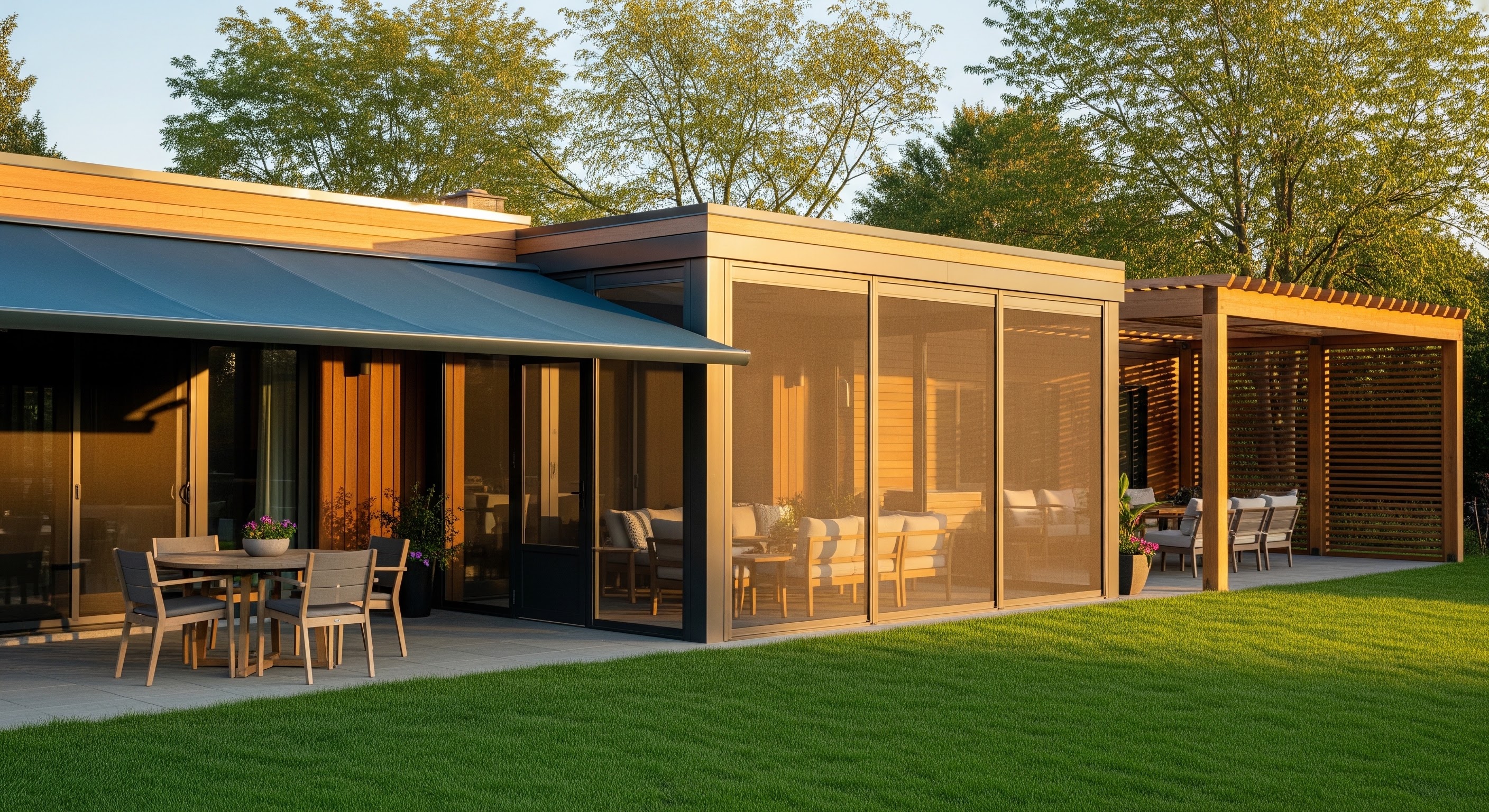
Awning, Screen, or Pergola: Which One Actually Saves Your Labor Day Party?
Awning, Screen, or Pergola: Which One Actually Saves Your Labor Day Party?
The last piece in this series named five things that tend to derail a Labor Day gathering in the Capital Region: sudden rain, direct sun, mosquitoes, wind, and having no backup plan for any of it. Three structures show up as the fix across those five — a motorized awning, a motorized retractable screen, and a motorized louvered pergola — and most homeowners researching this for the first time assume they're interchangeable. They're not. Each one solves a different half of the problem, and knowing which half matters more for your yard is the actual decision.
The awning: fastest fix for sun and a passing shower
A motorized awning extends over a specific zone — the grill, the table — and retracts fully when it isn't needed. It's the right first move for a property whose main problem is direct afternoon sun, or the kind of quick, passing shower this region's September rain record shows up as more often than a prolonged storm.
What it isn't built for is wind. Across the retractable awning industry generally, manufacturers typically recommend retracting once sustained wind climbs into the low-to-mid 20 mph range, with higher-end motorized units carrying wind sensors that retract automatically somewhat above that. That's a feature, not a flaw — an awning is meant to fold away rather than fight a gust — but it means an awning left extended is the wrong tool for the wind problem this series' first post covered. It's also worth being direct about a gap in what follows: Decadent Outdoors' own specific awning line — exact wind rating, fabric options, motor type — isn't yet documented in a form this series can cite by the numbers, so the figures above describe the awning category generally, not a specific certified product.
The motorized screen: the only one that actually stops bugs
Neither an awning nor an open pergola does anything about insects, because both leave the sides of the space open. A motorized retractable screen system encloses those sides, and for the Capital Region the mesh that matters is the tighter 20×20 no-see-um weave rather than the national-default 18×14 patio mesh, which lets through more than a mosquito can fit through. Screens also cut wind meaningfully at table height once closed, which is the second job they do in this comparison that an awning simply can't.
What a screen doesn't do is stop rain — mesh is a filter, not a barrier, and water passes through it the way air does. A screened space keeps the bugs and most of the wind out; it does not keep a September downpour off the table.
The pergola: the only fully enclosed, all-weather option
A motorized louvered pergola is the one option built to close against weather rather than retract ahead of it. It's covered at length elsewhere in Decadent Outdoors' content — the short version for this comparison is that it seals fully when closed and is engineered to handle wind actively (an optional sensor can auto-open the louvers in high wind to relieve pressure) rather than simply folding away from it. It's also the largest investment of the three, and the slowest to install, which makes it the wrong recommendation for anyone trying to solve this before next Monday specifically.
So which one, for Labor Day specifically?
If the honest answer to "what usually ruins our gatherings" is sun or an unpredictable afternoon shower, an awning is the faster, less expensive fix and the one most realistic to have installed before the holiday. If it's bugs — and given that mosquitoes remain active statewide through October, that's a fair bet for most properties — a motorized screen is the only one of the three built for that job specifically. A pergola is the right long-term answer for a property that wants to stop choosing between these problems altogether, but it's a next-season decision for anyone starting the search this close to the holiday.
The next piece in this series is a shorter, more practical one: a weekend-before checklist for whatever you already have, published September 3.
Frequently Asked Questions
Can an awning survive a windy Labor Day afternoon?
It's designed to retract before wind becomes a problem rather than withstand it while extended. Across the retractable awning industry generally, manufacturers commonly recommend retracting once sustained wind reaches the low-to-mid 20 mph range; higher-end motorized units with wind sensors typically retract automatically somewhat above that. It is not built to be left extended through a gusty afternoon.
Do motorized screens actually stop mosquitoes, or just larger bugs?
Specified correctly, yes. The Capital Region insect specification is a 20×20 no-see-um mesh, tighter than the national-default 18×14 patio mesh, which is what actually excludes mosquitoes and smaller biting insects rather than just larger flying insects.
Is a pergola overkill for just wanting to fix one Labor Day party?
For one specific date, yes — a pergola is a larger investment with a longer installation timeline, not a quick fix. It's the right answer for a household deciding to stop solving this problem season after season, not for someone trying to fix this coming weekend.
Sources
StruXure. Motorized Louvered Pergolas for Outdoor Living. Accessed August 2026. struxure.com
Fenetex. One-Track Motorized Retractable Screens. Accessed August 2026. onetrackscreens.com
General retractable awning wind-resistance guidance, compiled across multiple manufacturer and industry sources. Category-level information, not a Decadent Outdoors-specific product rating.