
DECADENT BLOG
The outdoor living guide for Capital Region homeowners.
Expert guidance on designing, investing in, and maximizing outdoor living spaces in the Capital Region's unique climate.
DECADENT BLOG
Decadent Blog
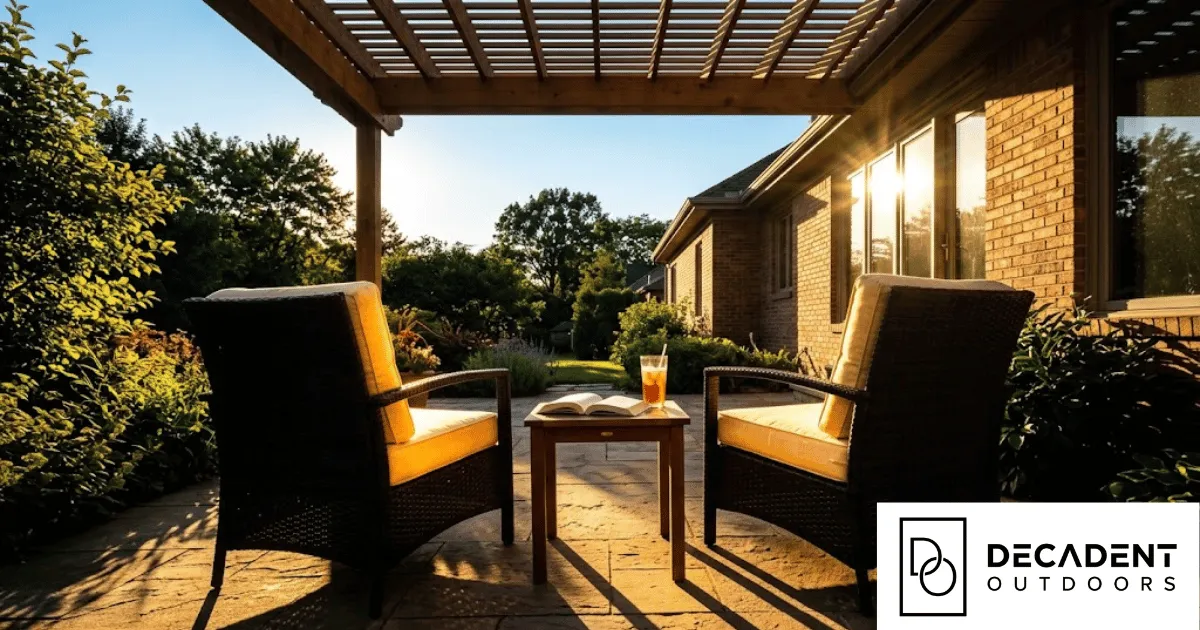
Sun, Glare, and the Late-Afternoon Patio — Capital Region NY
Sun, Glare, and the Late-Afternoon Patio: Why August Closes Your Outdoor Space Earlier Than You Think
Walk out the back door of a Capital Region home at 4:30 PM on a clear day in mid-August.
If the patio faces west — and a sizable share of patios in Saratoga County, Loudonville, Niskayuna, and the Hudson Valley do — the sun is now low enough to be horizontal rather than overhead. The pergola above doesn't help. The umbrella the homeowner bought last summer doesn't help. The patio stones, which absorbed heat all day, are radiating it back. The air temperature might be comfortable enough to suggest the patio should be usable. The reality is that the seating area is now somewhere between unpleasant and uninhabitable. The book the homeowner brought outside is hard to read against the glare. The wine glass has gone warm in eight minutes. By 5:15 PM, the household is back inside, the patio empty, the late afternoon — one of the most desirable outdoor windows of the year — surrendered.
Bug season has been the focus of Blog 4 in this series. The late-afternoon sun is a different friction with different mechanics. It runs across a different part of the calendar — mostly July and August, occasionally into early September on the hot years. It hits a different demographic of patios — west-facing and southwest-facing properties bear most of the load. And it's solved by a different specification of motorized screen mesh than the bug mesh that addresses the May-through-September biting calendar.
This is the eighth installment of The Fourth Wall. Blog 3 of this series covered the biological infrastructure outdoor space is supposed to deliver. This piece looks at one of the two largest interruptions to that delivery in the Capital Region calendar — the sun and glare problem — what it actually costs in lost outdoor hours, and the specific solution that addresses it.
Quick Answer
How much usable outdoor time does sun and glare actually cost a Capital Region homeowner?
A west-facing Capital Region patio typically loses three to four hours of usable outdoor time on clear summer afternoons — roughly 2:30 PM through 6:30 PM in late July and August. Across the eight-to-ten weeks of peak summer sun pressure, that's between 150 and 250 hours of outdoor time the household surrenders to glare, radiant heat, and the basic physical discomfort of unshaded west-facing exposure. The U.S. Department of Energy and the Professional Awning Manufacturers Association (PAMA) have documented that exterior shading systems reduce cooling energy use by 20 to 30 percent during peak sun-load hours. For homeowners running central air conditioning during the same hours the patio is unusable, that's a measurable utility cost on top of the lost outdoor hours. The fix is a solar-spec mesh deployed in a motorized retractable system — an 80-to-90% sun-blocking weave that drops the patio's radiant temperature, eliminates the glare, preserves enough view through the screen to keep the space usable, and reduces the indoor cooling load adjacent to the patio.
Why the Late-Afternoon Sun Hits Harder Than the Midday Sun
Most Capital Region homeowners assume the worst sun pressure comes at noon. The reality is the opposite. Noon sun is overhead and shaded by a pergola, a wide eave, an awning, or any reasonable overhead structure. The 4:30 PM sun, after the angle has dropped to thirty degrees above the horizon, comes in laterally — under the pergola, around the eave, through the gap the umbrella doesn't cover. The same overhead structure that protects the patio at noon does almost nothing at 4:30 PM.
Two physical factors compound the late-afternoon problem. First, the patio surface itself — whether bluestone, brick, concrete, or composite decking — has been absorbing solar radiation since mid-morning. By 4:30 PM that surface is radiating heat back into the seating area at a rate that's typically twenty to thirty degrees above ambient air temperature. The homeowner sitting in the chair is being heated both by direct sun coming in horizontally and by the patio surface radiating from below.
Second, the glare problem is largely independent of the heat problem. The horizontal sun angle means the patio surface, the table, the wine glasses, and any reflective material in the seating area all bounce light directly into the homeowner's field of vision. Reading a book becomes difficult. Conversation across the table involves squinting. The visual fatigue of high-glare conditions is what often drives the household indoors even before the heat itself becomes intolerable.
The two problems compound. The glare drives the household indoors at the perceptual level. The radiant heat would have driven them indoors at the physical level fifteen minutes later anyway. The combined effect is that the most beautiful golden-hour window of the summer day is also the hour the patio reliably closes.
The Hours Lost — Counted Out
For a west-facing or southwest-facing Capital Region patio without sun protection, the late-afternoon shutdown follows a predictable seasonal pattern. The table below maps it.
Across the eight-to-ten weeks of peak sun pressure (July through mid-September), a west-facing patio without solar shading loses roughly 150 to 250 hours of late-afternoon outdoor time. Those are hours the household paid for and didn't get to use — the same way bug season costs hours, just at a different time of day and through a different mechanism. The biological dose from Blog 3 doesn't accrue during these hours either. The afternoon coffee, the early-evening drink, the pre-dinner reading on the patio — the moments that the property was supposed to support are surrendered to a physical condition the homeowner can predict but cannot easily address.
The bug calendar closes the dinner hour. The sun calendar closes the late-afternoon hour. Combined, they cover the two most desirable outdoor windows of a typical Capital Region summer day — and most properties have neither solved.
The Indoor Cost — Where the Energy Bill Picks Up the Tab
The sun problem isn't only an outdoor cost. The same west-facing exposure that drives the household off the patio at 4:30 PM is loading the back of the house with solar radiation through windows, sliding doors, and the building envelope. The HVAC system runs harder. The indoor temperature near the back wall climbs even with the air conditioning on. The cooling bill at the end of August reflects the work the system did during the hours the patio sat empty.
The Professional Awning Manufacturers Association (PAMA), working with the University of Minnesota's Center for Sustainable Building Research, documented that exterior shading systems reduce solar heat gain at the building envelope by 65 to 77 percent — substantially more effective than interior window treatments because the heat is stopped before it enters the building. The U.S. Department of Energy has published parallel findings: exterior shading, properly specified for the building's solar orientation, reduces residential cooling energy use by 20 to 30 percent during peak sun-load hours.
For a Capital Region home with a west-facing patio and substantial west-facing window or door area, a deployed solar screen during the 3:00-to-6:30 PM peak window does two things at once. It restores the outdoor space to comfortable use. And it reduces the cooling load on the building envelope by blocking solar radiation before it reaches the glass and wall surfaces behind the patio. The solar mesh is functioning as exterior shading for the house itself, not just as comfort infrastructure for the patio.
The utility savings vary by home, climate-year, and HVAC system, but the directional effect is consistent. A homeowner running central air during the peak sun hours typically sees a 10 to 20 percent reduction in cooling energy use during those hours after installing exterior shading. Across the eight-to-ten weeks of peak summer load, that's a measurable annual savings — not enough to pay for the screen system on its own, but enough to be a meaningful secondary benefit on top of the recovered outdoor hours.
Why Solar Mesh Is a Different Specification Than Bug Mesh
Blog 6 covered the OneTrack system's five interchangeable mesh types. Two of those types — insect (bug) mesh and solar mesh — address different problems and are engineered differently.
Bug mesh is fine-gauge weave designed to block insects from passing through the screen while preserving maximum airflow and view. The weave is open enough that air, light, and view pass through it almost freely. The mesh's job is mechanical exclusion, not radiation blocking. A bug screen deployed against a 4:30 PM August sun does very little — the sun comes through the screen at nearly full intensity.
Solar mesh is a denser weave with a higher openness factor — typically rated to block 80 to 90 percent of direct solar transmission. The mesh fibers absorb and scatter the sun before it reaches the seating area. The view through the screen is preserved (the mesh isn't opaque), but the intensity of the light coming through is substantially reduced. The radiant heat load on the patio drops. The glare drops. The space becomes usable in the same window that was previously surrendered.
The right Capital Region solution for a homeowner facing both the bug problem and the sun problem is the multi-mesh OneTrack configuration described in Blog 6. The same frame and motor system can run bug mesh in the spring and early-summer hours when bugs are the issue, then switch to solar mesh in the late-summer afternoon when the sun is the issue. The screens themselves are interchangeable — the homeowner doesn't have to choose one problem to solve and live with the other.
The West-Facing Patio Specifically
The sun problem is acute on west-facing and southwest-facing patios. A south-facing patio gets some late-afternoon sun but the angle drops more steeply. A north-facing patio largely avoids the issue. East-facing patios deal with morning sun but the morning intensity is lower and the heat hasn't loaded the patio surface yet, so the experience is qualitatively different.
West-facing Capital Region patios are common for a specific reason. Most Capital Region homes were designed with the primary entertaining and outdoor-living space at the rear of the house, away from the road. In subdivisions and developments that ran east-west streets — which describes a substantial portion of Saratoga County, Niskayuna, Loudonville, and Slingerlands — the back of the house faces west. The setting-sun view that looked beautiful in the marketing photos is the same setting sun that closes the patio at 4:30 PM in August.
For homeowners on the lakefront properties, the river-adjacent properties in the Hudson Valley, and the rural Adirondack-edge properties, the orientation varies more — some properties were sited specifically to capture sunset views, while others were oriented to lake views in ways that put the patio on the opposite side. The sun problem applies wherever the primary outdoor seating area opens to the western half of the property. The same solution applies. The mesh specification doesn't care about the orientation; it cares about the sun load.
What the Series Looks at Next
The next blog, publishing July 21, gets to the question most homeowners want to ask but rarely do early in the conversation — what does a motorized retractable screen system actually cost in Saratoga County, what determines where in the range a specific project lands, and what the honest investment math looks like compared to the alternatives. The bug pressure, the sun pressure, the hosting decline, the biological infrastructure, the engineering inside the OneTrack system — all of it is the case for the investment. The next piece looks at the investment itself.
Frequently Asked Questions
Why does my west-facing patio get so much hotter than the rest of the yard in the late afternoon?
Two effects compound. First, the late-afternoon sun comes in laterally rather than from overhead, which means any pergola, eave, or umbrella overhead does much less to block it than at noon. The seating area receives direct horizontal solar radiation through the openings around the overhead structure. Second, the patio surface itself — bluestone, brick, concrete, or composite decking — has been absorbing solar heat since mid-morning. By 4:30 PM that surface is radiating heat back upward at twenty to thirty degrees above ambient air temperature. The person seated on the patio is heated both by direct sun from the side and by radiant heat from below. The combined effect is significantly more uncomfortable than the air temperature alone suggests.
Do exterior shades actually reduce my air conditioning bill?
Yes, measurably. Research from the U.S. Department of Energy and the Professional Awning Manufacturers Association (PAMA), in collaboration with the University of Minnesota Center for Sustainable Building Research, documented that properly specified exterior shading reduces residential cooling energy use by 20 to 30 percent during peak sun-load hours. The mechanism is straightforward — exterior shading blocks solar radiation before it reaches the building envelope, which is substantially more effective than interior window treatments that block heat after it has already passed through the glass. For Capital Region homes with significant west-facing window or door area near the patio, a deployed solar screen during the 3:00-to-6:30 PM peak window typically reduces cooling load by 10 to 20 percent during those hours.
What is the difference between solar mesh and bug mesh in motorized screens?
Bug mesh and solar mesh address different problems and have different weave specifications. Bug mesh is a fine-gauge insect-rated weave designed to mechanically exclude blackflies, mosquitoes, and (with the right specification) no-see-ums while preserving maximum airflow and view. It does very little to block solar radiation. Solar mesh is a denser weave engineered to block 80 to 90 percent of direct solar transmission while preserving enough view through the screen to keep the space visually usable. The Fenetex OneTrack system supports five interchangeable mesh types (insect, solar, privacy, clear vinyl, wind) in the same frame, so a homeowner facing both bugs and sun can swap between mesh types as conditions change rather than choosing one problem to solve and living with the other.
Will a solar screen make my patio feel dark or closed-in?
Solar screens are not opaque. The mesh is engineered to absorb and scatter direct solar radiation while preserving view through the screen — the homeowner can still see the property, the foliage, and the sky beyond the patio. The visual effect is closer to good polarized sunglasses than to a blackout shade: the harsh glare is gone, the contrast is more comfortable, the colors look better. The deployed solar screen also retracts completely when not needed, so the patio is fully open during the morning, midday, and evening hours when sun is not the dominant pressure. Solar screens are typically deployed only during the 3-to-4 hour peak window when the late-afternoon sun is the problem.
Is a pergola enough on its own, or do I really need motorized screens for sun?
A pergola is excellent overhead shade but largely doesn't address the late-afternoon horizontal sun on west-facing patios. The sun at 4:30 PM in August comes in under the pergola, around the eave, and through any opening at the perimeter of the seating area. A motorized louvered pergola (StruXure or similar) with adjustable louvers handles overhead sun at any angle but still leaves the lateral openings unprotected. The full solution for a west-facing Capital Region patio with sun pressure typically combines overhead pergola coverage (fixed or louvered) with motorized solar screens on the western-facing lateral opening. The pergola handles the overhead. The screens handle the horizontal. Together they address the full daily sun cycle.

Sun, Glare, and the Late-Afternoon Patio — Capital Region NY
Sun, Glare, and the Late-Afternoon Patio: Why August Closes Your Outdoor Space Earlier Than You Think
Walk out the back door of a Capital Region home at 4:30 PM on a clear day in mid-August.
If the patio faces west — and a sizable share of patios in Saratoga County, Loudonville, Niskayuna, and the Hudson Valley do — the sun is now low enough to be horizontal rather than overhead. The pergola above doesn't help. The umbrella the homeowner bought last summer doesn't help. The patio stones, which absorbed heat all day, are radiating it back. The air temperature might be comfortable enough to suggest the patio should be usable. The reality is that the seating area is now somewhere between unpleasant and uninhabitable. The book the homeowner brought outside is hard to read against the glare. The wine glass has gone warm in eight minutes. By 5:15 PM, the household is back inside, the patio empty, the late afternoon — one of the most desirable outdoor windows of the year — surrendered.
Bug season has been the focus of Blog 4 in this series. The late-afternoon sun is a different friction with different mechanics. It runs across a different part of the calendar — mostly July and August, occasionally into early September on the hot years. It hits a different demographic of patios — west-facing and southwest-facing properties bear most of the load. And it's solved by a different specification of motorized screen mesh than the bug mesh that addresses the May-through-September biting calendar.
This is the eighth installment of The Fourth Wall. Blog 3 of this series covered the biological infrastructure outdoor space is supposed to deliver. This piece looks at one of the two largest interruptions to that delivery in the Capital Region calendar — the sun and glare problem — what it actually costs in lost outdoor hours, and the specific solution that addresses it.
Quick Answer
How much usable outdoor time does sun and glare actually cost a Capital Region homeowner?
A west-facing Capital Region patio typically loses three to four hours of usable outdoor time on clear summer afternoons — roughly 2:30 PM through 6:30 PM in late July and August. Across the eight-to-ten weeks of peak summer sun pressure, that's between 150 and 250 hours of outdoor time the household surrenders to glare, radiant heat, and the basic physical discomfort of unshaded west-facing exposure. The U.S. Department of Energy and the Professional Awning Manufacturers Association (PAMA) have documented that exterior shading systems reduce cooling energy use by 20 to 30 percent during peak sun-load hours. For homeowners running central air conditioning during the same hours the patio is unusable, that's a measurable utility cost on top of the lost outdoor hours. The fix is a solar-spec mesh deployed in a motorized retractable system — an 80-to-90% sun-blocking weave that drops the patio's radiant temperature, eliminates the glare, preserves enough view through the screen to keep the space usable, and reduces the indoor cooling load adjacent to the patio.
Why the Late-Afternoon Sun Hits Harder Than the Midday Sun
Most Capital Region homeowners assume the worst sun pressure comes at noon. The reality is the opposite. Noon sun is overhead and shaded by a pergola, a wide eave, an awning, or any reasonable overhead structure. The 4:30 PM sun, after the angle has dropped to thirty degrees above the horizon, comes in laterally — under the pergola, around the eave, through the gap the umbrella doesn't cover. The same overhead structure that protects the patio at noon does almost nothing at 4:30 PM.
Two physical factors compound the late-afternoon problem. First, the patio surface itself — whether bluestone, brick, concrete, or composite decking — has been absorbing solar radiation since mid-morning. By 4:30 PM that surface is radiating heat back into the seating area at a rate that's typically twenty to thirty degrees above ambient air temperature. The homeowner sitting in the chair is being heated both by direct sun coming in horizontally and by the patio surface radiating from below.
Second, the glare problem is largely independent of the heat problem. The horizontal sun angle means the patio surface, the table, the wine glasses, and any reflective material in the seating area all bounce light directly into the homeowner's field of vision. Reading a book becomes difficult. Conversation across the table involves squinting. The visual fatigue of high-glare conditions is what often drives the household indoors even before the heat itself becomes intolerable.
The two problems compound. The glare drives the household indoors at the perceptual level. The radiant heat would have driven them indoors at the physical level fifteen minutes later anyway. The combined effect is that the most beautiful golden-hour window of the summer day is also the hour the patio reliably closes.
The Hours Lost — Counted Out
For a west-facing or southwest-facing Capital Region patio without sun protection, the late-afternoon shutdown follows a predictable seasonal pattern. The table below maps it.
Across the eight-to-ten weeks of peak sun pressure (July through mid-September), a west-facing patio without solar shading loses roughly 150 to 250 hours of late-afternoon outdoor time. Those are hours the household paid for and didn't get to use — the same way bug season costs hours, just at a different time of day and through a different mechanism. The biological dose from Blog 3 doesn't accrue during these hours either. The afternoon coffee, the early-evening drink, the pre-dinner reading on the patio — the moments that the property was supposed to support are surrendered to a physical condition the homeowner can predict but cannot easily address.
The bug calendar closes the dinner hour. The sun calendar closes the late-afternoon hour. Combined, they cover the two most desirable outdoor windows of a typical Capital Region summer day — and most properties have neither solved.
The Indoor Cost — Where the Energy Bill Picks Up the Tab
The sun problem isn't only an outdoor cost. The same west-facing exposure that drives the household off the patio at 4:30 PM is loading the back of the house with solar radiation through windows, sliding doors, and the building envelope. The HVAC system runs harder. The indoor temperature near the back wall climbs even with the air conditioning on. The cooling bill at the end of August reflects the work the system did during the hours the patio sat empty.
The Professional Awning Manufacturers Association (PAMA), working with the University of Minnesota's Center for Sustainable Building Research, documented that exterior shading systems reduce solar heat gain at the building envelope by 65 to 77 percent — substantially more effective than interior window treatments because the heat is stopped before it enters the building. The U.S. Department of Energy has published parallel findings: exterior shading, properly specified for the building's solar orientation, reduces residential cooling energy use by 20 to 30 percent during peak sun-load hours.
For a Capital Region home with a west-facing patio and substantial west-facing window or door area, a deployed solar screen during the 3:00-to-6:30 PM peak window does two things at once. It restores the outdoor space to comfortable use. And it reduces the cooling load on the building envelope by blocking solar radiation before it reaches the glass and wall surfaces behind the patio. The solar mesh is functioning as exterior shading for the house itself, not just as comfort infrastructure for the patio.
The utility savings vary by home, climate-year, and HVAC system, but the directional effect is consistent. A homeowner running central air during the peak sun hours typically sees a 10 to 20 percent reduction in cooling energy use during those hours after installing exterior shading. Across the eight-to-ten weeks of peak summer load, that's a measurable annual savings — not enough to pay for the screen system on its own, but enough to be a meaningful secondary benefit on top of the recovered outdoor hours.
Why Solar Mesh Is a Different Specification Than Bug Mesh
Blog 6 covered the OneTrack system's five interchangeable mesh types. Two of those types — insect (bug) mesh and solar mesh — address different problems and are engineered differently.
Bug mesh is fine-gauge weave designed to block insects from passing through the screen while preserving maximum airflow and view. The weave is open enough that air, light, and view pass through it almost freely. The mesh's job is mechanical exclusion, not radiation blocking. A bug screen deployed against a 4:30 PM August sun does very little — the sun comes through the screen at nearly full intensity.
Solar mesh is a denser weave with a higher openness factor — typically rated to block 80 to 90 percent of direct solar transmission. The mesh fibers absorb and scatter the sun before it reaches the seating area. The view through the screen is preserved (the mesh isn't opaque), but the intensity of the light coming through is substantially reduced. The radiant heat load on the patio drops. The glare drops. The space becomes usable in the same window that was previously surrendered.
The right Capital Region solution for a homeowner facing both the bug problem and the sun problem is the multi-mesh OneTrack configuration described in Blog 6. The same frame and motor system can run bug mesh in the spring and early-summer hours when bugs are the issue, then switch to solar mesh in the late-summer afternoon when the sun is the issue. The screens themselves are interchangeable — the homeowner doesn't have to choose one problem to solve and live with the other.
The West-Facing Patio Specifically
The sun problem is acute on west-facing and southwest-facing patios. A south-facing patio gets some late-afternoon sun but the angle drops more steeply. A north-facing patio largely avoids the issue. East-facing patios deal with morning sun but the morning intensity is lower and the heat hasn't loaded the patio surface yet, so the experience is qualitatively different.
West-facing Capital Region patios are common for a specific reason. Most Capital Region homes were designed with the primary entertaining and outdoor-living space at the rear of the house, away from the road. In subdivisions and developments that ran east-west streets — which describes a substantial portion of Saratoga County, Niskayuna, Loudonville, and Slingerlands — the back of the house faces west. The setting-sun view that looked beautiful in the marketing photos is the same setting sun that closes the patio at 4:30 PM in August.
For homeowners on the lakefront properties, the river-adjacent properties in the Hudson Valley, and the rural Adirondack-edge properties, the orientation varies more — some properties were sited specifically to capture sunset views, while others were oriented to lake views in ways that put the patio on the opposite side. The sun problem applies wherever the primary outdoor seating area opens to the western half of the property. The same solution applies. The mesh specification doesn't care about the orientation; it cares about the sun load.
What the Series Looks at Next
The next blog, publishing July 21, gets to the question most homeowners want to ask but rarely do early in the conversation — what does a motorized retractable screen system actually cost in Saratoga County, what determines where in the range a specific project lands, and what the honest investment math looks like compared to the alternatives. The bug pressure, the sun pressure, the hosting decline, the biological infrastructure, the engineering inside the OneTrack system — all of it is the case for the investment. The next piece looks at the investment itself.
Frequently Asked Questions
Why does my west-facing patio get so much hotter than the rest of the yard in the late afternoon?
Two effects compound. First, the late-afternoon sun comes in laterally rather than from overhead, which means any pergola, eave, or umbrella overhead does much less to block it than at noon. The seating area receives direct horizontal solar radiation through the openings around the overhead structure. Second, the patio surface itself — bluestone, brick, concrete, or composite decking — has been absorbing solar heat since mid-morning. By 4:30 PM that surface is radiating heat back upward at twenty to thirty degrees above ambient air temperature. The person seated on the patio is heated both by direct sun from the side and by radiant heat from below. The combined effect is significantly more uncomfortable than the air temperature alone suggests.
Do exterior shades actually reduce my air conditioning bill?
Yes, measurably. Research from the U.S. Department of Energy and the Professional Awning Manufacturers Association (PAMA), in collaboration with the University of Minnesota Center for Sustainable Building Research, documented that properly specified exterior shading reduces residential cooling energy use by 20 to 30 percent during peak sun-load hours. The mechanism is straightforward — exterior shading blocks solar radiation before it reaches the building envelope, which is substantially more effective than interior window treatments that block heat after it has already passed through the glass. For Capital Region homes with significant west-facing window or door area near the patio, a deployed solar screen during the 3:00-to-6:30 PM peak window typically reduces cooling load by 10 to 20 percent during those hours.
What is the difference between solar mesh and bug mesh in motorized screens?
Bug mesh and solar mesh address different problems and have different weave specifications. Bug mesh is a fine-gauge insect-rated weave designed to mechanically exclude blackflies, mosquitoes, and (with the right specification) no-see-ums while preserving maximum airflow and view. It does very little to block solar radiation. Solar mesh is a denser weave engineered to block 80 to 90 percent of direct solar transmission while preserving enough view through the screen to keep the space visually usable. The Fenetex OneTrack system supports five interchangeable mesh types (insect, solar, privacy, clear vinyl, wind) in the same frame, so a homeowner facing both bugs and sun can swap between mesh types as conditions change rather than choosing one problem to solve and living with the other.
Will a solar screen make my patio feel dark or closed-in?
Solar screens are not opaque. The mesh is engineered to absorb and scatter direct solar radiation while preserving view through the screen — the homeowner can still see the property, the foliage, and the sky beyond the patio. The visual effect is closer to good polarized sunglasses than to a blackout shade: the harsh glare is gone, the contrast is more comfortable, the colors look better. The deployed solar screen also retracts completely when not needed, so the patio is fully open during the morning, midday, and evening hours when sun is not the dominant pressure. Solar screens are typically deployed only during the 3-to-4 hour peak window when the late-afternoon sun is the problem.
Is a pergola enough on its own, or do I really need motorized screens for sun?
A pergola is excellent overhead shade but largely doesn't address the late-afternoon horizontal sun on west-facing patios. The sun at 4:30 PM in August comes in under the pergola, around the eave, and through any opening at the perimeter of the seating area. A motorized louvered pergola (StruXure or similar) with adjustable louvers handles overhead sun at any angle but still leaves the lateral openings unprotected. The full solution for a west-facing Capital Region patio with sun pressure typically combines overhead pergola coverage (fixed or louvered) with motorized solar screens on the western-facing lateral opening. The pergola handles the overhead. The screens handle the horizontal. Together they address the full daily sun cycle.
Stop giving up your outdoor season.
We come to you, assess your space, and give you a fixed price — before you decide anything.


COMPANY
WHO WE SERVE
PRODUCTS
LEGAL & TRUST
Copyright 2026. Decadent Outdoors . All Rights Reserved.