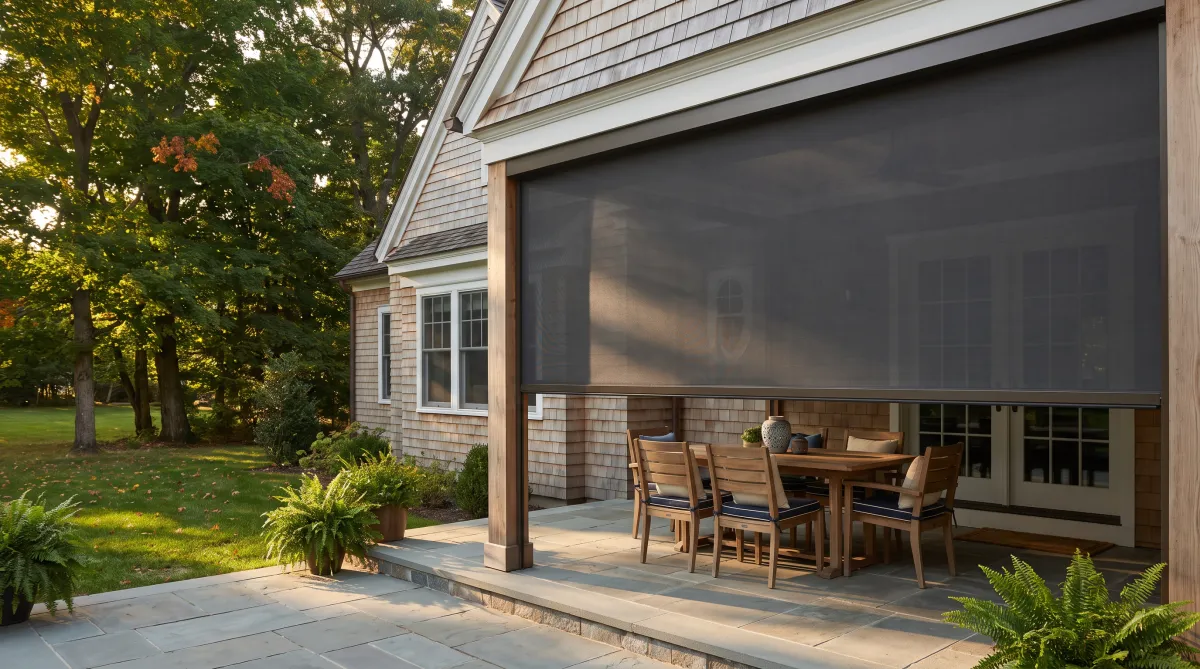
Best Motorized Retractable Screens in Albany NY
Best Motorized Retractable Screens in Albany, NY: What Matters Between Now and First Frost
There is a specific evening every Albany homeowner with a patio knows. The food is ready, the table is set outside, and somewhere between the first plate and the second glass everyone quietly agrees to move indoors. Nobody announces it. The mosquitoes arrive, or the sun drops to the angle where the west side of the property becomes unusable, and the meal finishes at the kitchen island under a pendant light.
The homeowner researching motorized retractable screens in early August is usually not shopping for a product. They are trying to recover hours. And the honest version of the answer they are looking for has two halves that most of the search results will not separate: whether the system is worth what it costs, and whether there is still enough calendar left to have one working this year.
The second half is the one nobody discusses in August, and it is the one that decides what a homeowner should do this week. Albany's first fall frost has arrived as early as the fourteenth of September in the National Weather Service record. A motorized screen system, on Decadent Outdoors' own published scheduling, takes eight to sixteen weeks from the first consultation to the first evening on the finished space. Those two numbers, set beside each other, are the whole decision.
This is the tenth installment of The Fourth Wall, and the first of four pieces written specifically for Albany County homeowners deciding between now and the end of the season.
Quick Answer
Are motorized patio screens worth it in Albany, NY?
For a Capital Region household with a covered patio, porch or pergola it already owns and no longer uses after mid-afternoon, generally yes: But. The answer turns on how many hours the space is currently losing, not on the product. Motorized retractable screens run roughly $15,000 to $45,000 installed in the Capital Region. That buys back two separate blocks of time: the late-afternoon hours a west-facing patio loses to sun and glare, and the evening hours it loses to insects during a mosquito season the New York State Department of Health tracks with weekly surveillance reports through the warm months. Screens are not worth it on a small east-facing deck used mostly at midday, on an open deck with no covered structure to mount a housing to, or in a household planning to move within three years. In August, the live question is timing rather than value. Decadent Outdoors publishes an eight-to-sixteen-week window from first consultation to completed installation, and Albany's earliest recorded fall frost is September 14 — which means a decision made this month is a decision about this autumn, and a decision made in October is a decision about next spring.
An Albany patio has two different problems, four hours apart
The reason so much retractable screen marketing feels vague is that it treats the patio as having one problem. It has two, they occur at different times of day, and they are solved by different fabric.
The afternoon problem is radiant. Between roughly three and seven o'clock, a west-facing or southwest-facing patio in Albany County takes direct low-angle sun. Shade from a roof or a pergola does nothing about light arriving horizontally. The surface temperature of the table rises, the glare makes screens and faces hard to look at, and the space becomes technically available and practically unused. This is a solar-transmission problem, and it is solved by a tightly woven shade fabric that intercepts the light before it reaches the space.
The evening problem is biological. The New York State Department of Health issued its seasonal mosquito-borne disease health advisory to local health departments and health care providers on July 15, 2026, and publishes weekly mosquito-borne disease activity reports through the season. The concern is not only nuisance. In 2024 New York State recorded what the Department described as an unprecedented level of Eastern equine encephalitis activity — two human cases including one death, twenty-two equine cases and two avian cases, spread across eighteen counties. This is an exclusion problem, and it is solved by aperture: a mesh whose openings are smaller than the insects in question.
A single fabric can compromise between the two, and some households should choose the compromise. But the useful mental model for anyone evaluating quotes is that a motorized screen system is a frame, a motor and a track, and the fabric running inside it is a separate decision that can be made differently for different months. That decision is the subject of the next piece in this series.
The patio does not have a bug problem. It has a three o'clock problem and a seven o'clock problem, and the homeowner who only prices the seven o'clock one buys half a solution.
Are motorized patio screens worth it?
Motorized patio screens are worth it when they convert an existing structure the household already paid for from a seasonal amenity into a space that gets used on ordinary weeknights. The arithmetic is not about the product. It is about the gap between the hours a patio theoretically offers and the hours it actually delivers.
Motorized retractable screens run roughly $15,000 to $45,000 installed in the Capital Region, a range Decadent Outdoors sets out in detail in what motorized screens cost in the Capital Region. Against a covered patio that already represents a five-figure investment and is currently being used perhaps two evenings a week from June through August, that spend is buying utilisation on an asset that already exists. Against a small uncovered deck, it is buying a new structure first and screens second, and the honest comparison changes completely.
When motorized screens are the right answer
Motorized retractable screens are the right answer for a household that already has a covered structure — a roofed porch, a pergola with a solid or louvered top, a cabana, a covered deck — and wants it usable on demand without giving up the open view when conditions are good. They suit properties where the wind, the sun and the insect pressure change through the day rather than staying constant, because a retractable system is the only one of the common options that can be wrong half the time and still be right. They suit households that entertain, because the screens deploy in seconds without anyone leaving the table. And they suit homeowners who care about the elevation of the house, since a deployed screen disappears entirely into a housing when it is not in use.
When motorized screens are not worth it
Motorized screens are not worth it in at least four situations, and any installer who will not name them is selling rather than specifying. They are not worth it on an uncovered deck or patio with no overhead structure, because the housing needs something to mount to and a screen with open sky above it solves neither the sun problem nor the rain problem. They are not worth it on a small east-facing space used mainly at midday, where neither the three o'clock problem nor the seven o'clock problem is severe enough to be recovering hours. They are not worth it for a household planning to sell within about three years, where a fixed screened enclosure or nothing at all is the more rational spend. And they are not the right answer for a homeowner who actually wants a room — insulated, heated, usable in February. That is a four-season addition, and the trade-offs between the three options are laid out in the comparison of screens, screened porches and four-season rooms.
Is it too late to install motorized screens for fall 2026?
For a project started in the first half of August 2026, no — but the window is roughly ninety days wide and it is closing at a predictable rate. The arithmetic is public on both sides, which is unusual in this category, so it is worth setting out plainly.
Decadent Outdoors publishes its own project timeline: roughly one hour for the consultation, two to three weeks for design and material selection, a further two to four weeks where the municipality requires a permit, and three to five days on site once materials arrive — eight to sixteen weeks in total from first conversation to first evening. On the other side, the National Weather Service record for Albany puts the earliest first fall temperature of 32°F or below at September 14, 1963, and the latest at November 12, 1883. The shortest growing season on record ran 113 days; the longest ran 218.
The counterintuitive part is that late summer, not spring, is when this decision is best made — and the Albany climate record explains why. The most consecutive days of 90°F or higher ever recorded at Albany ran from August 27 to September 5, 1953. The latest heat wave on record fell on September 24 to 26, 2017. September in the Capital Region is not reliably a cool month, which means the afternoon shade problem does not end when the calendar says summer does. What ends is the homeowner's sense of urgency about it.
A homeowner who starts this month is deciding about this autumn. A homeowner who waits until the first cold evening makes them want screens is deciding about next April, and does not yet know it.
Who installs motorized retractable screens near Albany, NY?
Four companies serve the Albany and Capital Region market for motorized retractable patio screens, and they are not interchangeable: They carry different manufacturers, and the manufacturer determines the edge-retention system, the wind rating and the warranty far more than the installer's own service promise does. What follows is written by one of the four, so read it as a starting point for questions rather than as a verdict, and confirm current product lines directly with each company.
What is the difference between zip-track and keder-edge retractable screens?
The difference between zip-track and keder-edge retractable screens is how the mesh is held in the side channel, and it is the single most consequential specification difference between systems in this market. A zip-track system runs a continuous zipper sewn or welded along each vertical edge of the mesh, which engages a corresponding profile in the track as the screen deploys. A keder system replaces the zipper with a continuous polymer bead — the keder, a term borrowed from sailboat rigging — captured mechanically inside the aluminium channel, with no textile fastener along the wind-loaded edge. Fenetex, the Jacksonville manufacturer behind the OneTrack system, states that its keder-based construction is what supports a 100 MPH wind rating and a lifetime warranty on the system.
What the available evidence does not settle is the comparative failure rate. There is no published independent third-party testing comparing zip-track and keder edge retention under Northeast freeze-thaw cycling, and any company claiming otherwise — including this one — is describing a mechanism rather than presenting a measurement. The argument for keder is geometric and it is a good one, but a homeowner is entitled to see the distinction between an engineering rationale and a test result. The mechanism, the wind ratings, and how to read them honestly are the subject of the third piece in this series.
Three questions that determine your specification
Before any consultation is useful, three answers have to exist. They are worth working out over a weekend rather than on the phone, because they narrow the specification more than any product comparison will.
First, what is the screen actually for?Insect exclusion, sun and glare control, or a shoulder-season enclosure that holds heat from a patio heater into October and November. These are three different fabrics, and a household that wants all three is specifying an interchangeable system rather than a single screen. Rank them; do not list them.
Second, what is it mounting to?A roofed porch, a covered deck, a pergola with a solid or louvered top, a cabana or a freestanding gazebo each present a different attachment condition, and an open deck with no overhead structure presents a problem that screens alone cannot solve. The structure decides the housing, the housing decides the track, and the track decides which systems are even available.
Third, what are the dimensions?Width and height of each opening to be screened, and how many openings. A single fourteen-foot opening and four ten-foot openings are entirely different projects with entirely different budgets, and the difference is not proportional. Rough measurements taken with a tape are sufficient at this stage.
One further note on what this article does not establish. The frost dates cited here are drawn from the National Weather Service's historical record for Albany and describe extremes, not forecasts; any given autumn varies by weeks in either direction. The eight-to-sixteen-week project timeline is Decadent Outdoors' own published scheduling range and assumes standard material lead times and no permit delay, neither of which is guaranteed. And the $15,000 to $45,000 range is a Capital Region range for a completed motorized screen project, not a quotation. What a specific property costs depends on the three answers above, and no honest company will give a number before it has them.
What this series covers next
The next three pieces take the three answers above in order. The first works through mesh: insect, solar and vinyl, what openness factor means, and which specification belongs on an Upstate New York property in August versus October. The second covers what the system has to survive here — wind ratings read honestly, the electrical requirement nobody puts in a brochure, and what determines how long a motorized screen actually lasts. The third covers installed cost, how to read two quotes against each other line by line, and the point in September after which the truthful answer becomes next spring.
For homeowners in Albany, Delmar, Loudonville, Slingerlands, Guilderland, Bethlehem, Colonie and the surrounding Capital Region who already have the three answers, a consultation takes about an hour and produces a fixed-price quote. Details of the systems themselves are on the motorized retractable screens page.
Frequently Asked Questions
Are motorized patio screens worth it in Albany, NY?
For a Capital Region household with a covered patio, porch or pergola it already owns and no longer uses after mid-afternoon, generally yes: But. The answer turns on how many hours the space is currently losing, not on the product. Motorized retractable screens run roughly $15,000 to $45,000 installed in the Capital Region. That buys back two separate blocks of time: the late-afternoon hours a west-facing patio loses to sun and glare, and the evening hours it loses to insects during a mosquito season the New York State Department of Health tracks with weekly surveillance reports through the warm months. Screens are not worth it on a small east-facing deck used mostly at midday, on an open deck with no covered structure to mount a housing to, or in a household planning to move within three years.
Is it too late to install motorized screens for fall 2026?
For a project started in the first half of August 2026, no. Decadent Outdoors publishes an eight-to-sixteen-week window from first consultation to completed installation, which places a mid-August start between mid-October and early December. A mid-September start lands between mid-November and early January, meaning the system is installed for the following spring rather than for this autumn. The Albany climate record supports the urgency: the earliest recorded first fall temperature of 32°F or below at Albany is September 14, 1963, and the latest is November 12, 1883. Both dates are extremes rather than forecasts, and any given autumn varies by weeks.
Who installs motorized retractable screens near Albany, NY?
Four companies serve the Albany and Capital Region market: Upstate Retractable Screens in Ballston Lake, which carries Phantom Screens; The Reynolds Group, which installs retractable awnings and motorized screens across the Capital Region; Shade Boys, which installs zip-track patio enclosures in the Albany area; and Decadent Outdoors in Ballston Lake, which installs the Fenetex OneTrack system. They are not interchangeable, because the manufacturer determines the edge-retention system, the wind rating and the warranty terms more than the installer does. Confirm current product lines directly with each company before comparing quotes.
What is the difference between zip-track and keder-edge retractable screens?
A zip-track system holds the mesh in the side channel with a continuous zipper sewn or welded along each vertical edge. A keder system replaces the zipper with a continuous polymer bead captured mechanically inside the aluminium track, leaving no textile fastener along the wind-loaded edge. Fenetex, the manufacturer of the OneTrack system, states that its keder construction supports a 100 MPH wind rating and a lifetime warranty. No published independent third-party testing comparing the two edge-retention methods under Northeast freeze-thaw cycling is currently available, so the case for keder is an engineering rationale rather than a measured result.
What information should a homeowner have before a screen consultation?
Three answers. First, the primary purpose, ranked rather than listed: insect exclusion, sun and glare control, or a shoulder-season enclosure that holds heat from a patio heater. Second, what does the system mounts to: A roofed porch, covered deck, pergola with a solid or louvered top, cabana or gazebo, since an open deck with no overhead structure cannot take a screen housing. Third, the rough width and height of each opening to be screened and how many openings there are, since a single wide opening and several narrow ones are different projects with non-proportional budgets. Tape measurements are sufficient at this stage.
Sources
New York State Department of Health.New York State Department of Health Reminds New Yorkers to Protect Themselves From Mosquito-Borne Diseases. July 15, 2026.health.ny.gov
New York State Department of Health.New York State Department of Health Reminds New Yorkers to Take Precautions Against West Nile Virus and Eastern Equine Encephalitis. July 22, 2025.health.ny.gov
National Weather Service, Albany NY.All-Time Extremes for Albany, NY. Updated January 2025.weather.gov
Decadent Outdoors.What Motorized Screens Cost in Saratoga County, NY. July 20, 2026.decadentoutdoors.com
Fenetex.One-Track Motorized Retractable Screens. Accessed August 2026.onetrackscreens.com
