
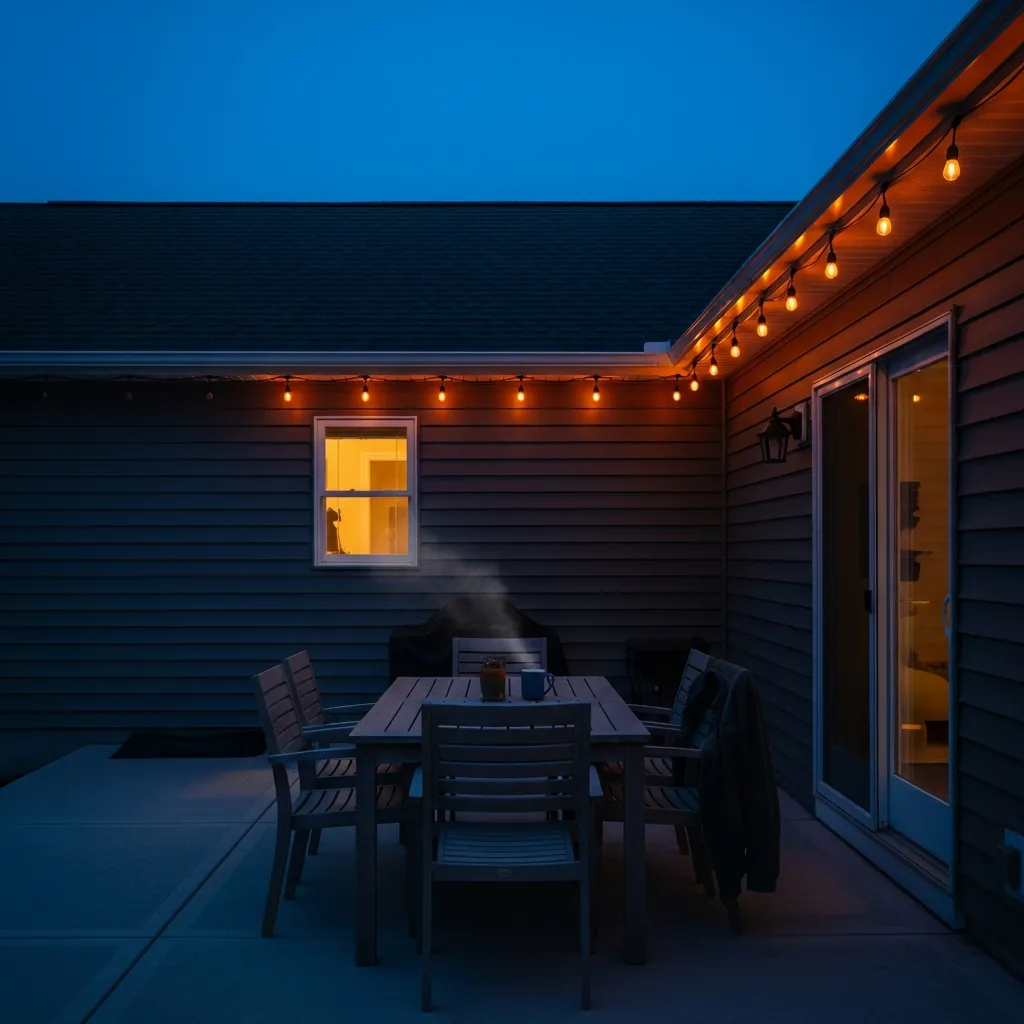
The Fourth Wall: Why a Capital Region Patio Only Really Works for Five Months
Most Capital Region patios have three walls, in the sense that matters. A house on one side, maybe a fence or a hedge on another, some kind of shade structure overhead. The fourth wall. The one facing the open yard, the one that decides whether the space works when the bugs come out or the wind picks up or the sun drops low enough to hit you directly in the eyes, is almost always missing. That open side is the reason a beautiful, expensive outdoor space gets used for a long weekend in June and then quietly abandoned.
This piece is part of The Fourth Wall, a series about what actually closes that gap — and about how short the season really is if nothing does.
Quick Answer
How long is the outdoor season in the Albany/Capital Region area, really?
Cornell Cooperative Extension puts Albany County's average frost-free window at May 2 to October 3 — about five months, based on NOAA climate-normal data. In practice a patio's comfortable-use season is shorter than even that, because the weeks on either end carry cold evenings, wind, and (starting in late June) biting insects that push people back indoors long before frost does. The structures that close "the fourth wall" — a motorized louvered roof, a properly specified retractable screen — are aimed at that in-between stretch, not just the calendar frost dates.
What "five months" actually means for a patio
Per Cornell Cooperative Extension's Albany County planting guidance, the average last spring frost falls around May 2 and the average first fall frost around October 3. A frost-free window of roughly five months, drawn from NOAA's 1991–2020 climate normal. That's the number used for tomatoes and peppers. A patio's real usable window is narrower, for reasons a garden doesn't have to deal with: nobody wants to sit outside at 52°F after sunset in early May, and by the third week of June, Capital Region evenings bring the insects that are the actual reason retractable screens exist in this market at all. A problem covered in depth in our piece on choosing screen mesh for an Upstate New York season.
Stack those two effects. The cold shoulder-seasons and the insect-heavy core of summer evenings, and a typical Capital Region patio without any enclosure is genuinely comfortable for something closer to three or four months a year than five. The other seven or eight months, the investment sits there, visible from the kitchen window, unused.
The actual problem isn't the weather — it's that nothing adapts to it
A fixed roof either always shades you or never does. A patio with no side enclosure is exposed to whatever the evening brings, every evening, with no way to change that. The frustration isn't really about the Capital Region's weather being unusually harsh — plenty of regions have shorter seasons — it's that a five-figure outdoor space is built as a single fixed condition, when the actual need changes hour to hour and month to month. A homeowner who paid for a beautiful patio shouldn't have to accept "great for sixteen weekends a year" as the ceiling on what that space can do.
Two categories of structure do this work, and they solve different halves of the problem.
A motorized louvered pergola closes the top. StruXure's system. The one Decadent Outdoors installs as the exclusive Upstate New York dealer, holds the industry's only ICC certification for motorized louvers, a structural-safety certification that specifically addresses snow load in northern climates and high wind, and its louvers seal watertight when closed, directing rain into a hidden gutter system rather than onto the furniture below. An optional rain sensor closes the louvers automatically at the first sign of precipitation, and a wind sensor can open them automatically in high-wind conditions to relieve pressure on the structure rather than fight it. None of that is marketing language. It's the manufacturer's own published engineering claim, and it's the reason a louvered roof extends the season on the hot, sunny and rainy ends of the calendar in a way a fixed roof or an umbrella can't: it changes shape to match the day instead of committing to one condition permanently.
A retractable screen system closes the side. This is the piece that matters most for the insect-heavy stretch of the calendar this article opened with, and it's specific enough — mesh counts, openness factors, frame engineering — that it has its own dedicated piece elsewhere in this series: a full breakdown of which mesh actually stops which insect.
Why no one else in this market is talking about this
A review of the six primary competitors serving the Capital Region outdoor-living market found that none of them offer a motorized, smart-controlled pergola system. Every one of them sells traditional fixed wood, vinyl, or fixed-louver structures as an add-on to a broader landscaping or hardscaping business. That's not a marginal gap. It means the category this series is about — a structure that actually adapts to the day rather than committing to one condition — is currently unclaimed in this specific market, in search results and in the conversations homeowners are having before they call anyone.
Decadent Outdoors is run by Jeffrey Mazzarelli, whose background — thirty-five years in construction, including international golf-course construction work with Robert Trent Jones Jr., per the company's own account — sits behind the exclusive StruXure dealership for Upstate New York specifically. It's a design-and-build approach to a category most of the region still treats as an accessory rather than its own decision.
What this series covers next
Later pieces in The Fourth Wall get specific: how a motorized screen system actually works mechanically, which mesh fabric solves which problem on an Upstate patio, and how to compare a pergola against an awning or a screened porch on the dimensions that actually matter rather than on price alone. This piece is the frame for all of it — the reason any of the rest is worth reading is that the season really is this short, and closing the fourth wall is the specific, buildable fix for that, not a vague upgrade.
Frequently Asked Questions
How many usable outdoor months does a typical Capital Region patio actually get?
The frost-free window itself runs about five months, per Cornell Cooperative Extension's Albany County frost dates (May 2 to October 3, based on NOAA climate normals). A patio with no enclosure typically feels comfortable for less than that — closer to three or four months — once cold shoulder-season evenings and the insect-heavy stretch of summer are factored in.
Is a motorized pergola actually different from a regular pergola, or is that a marketing term?
It's a structural difference, not just a feature. StruXure's motorized louvered system holds the only ICC certification in the industry for motorized louvers — a real structural-safety standard covering snow and wind loads — and the louvers seal watertight when closed, routing water through a built-in gutter system. A fixed pergola with open slats doesn't do either of those things regardless of how it's marketed.
Does anyone else in the Albany/Capital Region market offer this kind of system?
Not currently. A review of the region's primary outdoor-living competitors found none offering a motorized, smart-controlled pergola — every competitor examined sells fixed wood, vinyl, or fixed-louver structures as a secondary line to landscaping or hardscaping work.
Sources
Cornell Cooperative Extension Albany County.First Planting Dates / Average Frost Dates. albany. cce.cornell.edu
StruXure.Motorized Louvered Pergolas for Outdoor Living. Accessed August 2026. struxure.com