Screen Mesh for Upstate NY: Insect, Solar or Vinyl
Insect, Solar, or Vinyl: Choosing Screen Mesh for an Upstate New York Season
The mesh is the part of a motorized screen system that does the work, and it is the part most homeowners decide last and fastest. The frame, the motor and the track are a chassis. They determine whether the system survives fifteen Upstate winters. The fabric running inside them determines whether the space solves heat, or insects, or cold — and those are three different fabrics with three different published specifications.
This is good news, because it means the decision is specifiable rather than negotiable. Screen fabric is a manufactured product with numbers on it: mesh counts, aperture sizes, openness factors, UV blockage percentages, acoustic ratings. A homeowner who knows which numbers matter can walk into a consultation and specify the fabric rather than accept whatever the installer defaults to.
The default, in this region, is usually wrong. Most retractable screen mesh sold in the Northeast is the same 18×14 fabric sold in suburban Ohio, and it does not exclude the insect that actually ruins a June evening on a property near the Hudson or the Mohawk.
This is the eleventh installment of The Fourth Wall, and the second of four written for Capital Region homeowners deciding between now and the end of the season.
Quick Answer
Which screen mesh do I need for an Upstate New York patio?
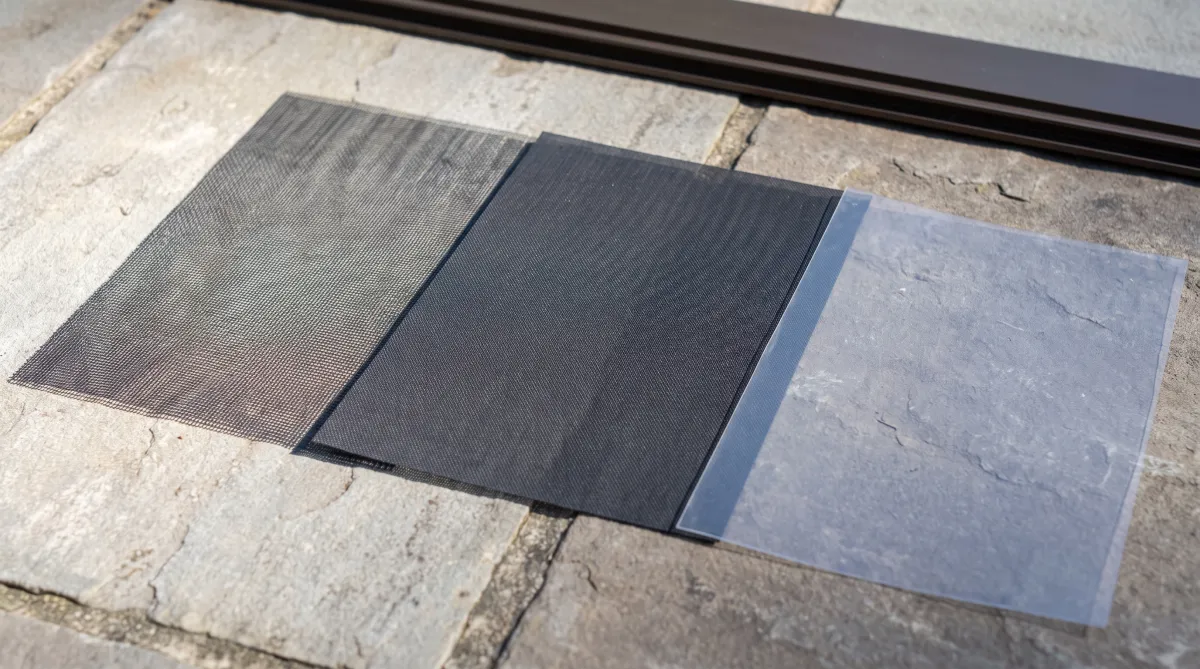
Most Capital Region properties need more than one, run at different times of year, which is why the frame matters as much as the fabric. For insects, the Upstate specification is 20×20 no-see-um mesh rather than the standard 18×14 patio mesh, because black flies and gnats pass through an aperture that stops mosquitoes. For late-afternoon sun and glare on a west or southwest elevation, a solar fabric is specified by openness factor: Phifer’s SunTex 95, 97 and 99 run approximately 5%, 3% and 1% openness and block approximately 95%, 97% and 99% of UV respectively, with view and airflow falling as the weave tightens. For shoulder-season use, a clear vinyl panel converts the space from a screened room to a semi-enclosed one that holds heat from a patio heater into October. One fabric can compromise across the first two: Phifer Solar Insect Screening runs about 32% openness, blocks about 68% of UV and up to 65% of heat and glare, and still stops no-see-ums. The decision that outlasts all of these is whether the frame allows the panel to be changed later.
Openness factor is the only number that matters
Openness factor is the percentage of a screen fabric that is hole rather than yarn, and it is the single number that predicts how a mesh will behave. Every quality a homeowner cares about — airflow, outward view, glare reduction, insect exclusion, how much the patio cools down — trades against it in the same direction. Higher openness means more air, more light, more view, and less protection. Lower openness means the reverse. There is no fabric that escapes the trade.
Two related terms appear on the same spec sheets and are worth separating. Mesh countis the pair of numbers in a product name like 18×14 or 20×20: per Phifer, it states how many yarns run vertically by how many run horizontally within one square inch of fabric. Apertureis the individual hole those yarns create, measured in square inches; across Phifer’s line it ranges from roughly 0.0005 to 0.004 square inches. Mesh count and aperture describe the geometry. Openness describes the consequence.
Phifer publishes an openness range across its insect screening and sun-shading fabrics running from about 73% at the open end down to about 3%, with SunTex 99 tighter still at approximately 1%. That is the whole design space. A homeowner choosing a screen is choosing a position on that line, whether or not anyone tells them so.
Every screen fabric is the same trade made at a different point. The only question is whether you made the trade deliberately or inherited it from whatever was on the installer’s truck.
Insect mesh — and why 18×14 is the wrong default here
The standard insect fabric on patio and pool projects is 18×14, and across most of the country it is the correct specification. In the Capital Region it frequently is not, because the insect that ends an evening here is smaller than the one 18×14 was designed to stop.
Phifer’s 20×20 mesh — sold as No-See-Um — is the tighter weave built for the smaller flying insects that inhabit marshy and low-lying ground: no-see-ums, gnats, sand flies and black flies. Properties in the Hudson and Mohawk valleys, near wetland, near the river flats, or backing onto conservation land are exactly the conditions that fabric exists for. A homeowner who specifies 18×14 on a property like that has bought a mosquito screen and will spend June discovering what else gets through.
The cost is airflow, and it should be stated rather than glossed. A 20×20 weave has more yarn and smaller apertures than an 18×14 weave over the same area. On a still July evening, the difference is noticeable. That is the trade, and for most properties in this region it is worth making — but a household on a breezy hilltop lot with no standing water within a quarter mile may reasonably decide otherwise.
Solar mesh — reading the openness ladder
Solar mesh is specified by openness factor, and the manufacturers publish the ladder. Phifer’s SunTex 95, 97 and 99 are a full basketweave vinyl-coated polyester built for exterior roller shade applications, with approximate openness factors of 5%, 3% and 1%, blocking approximately 95%, 97% and 99% of UV respectively. Phifer’s SheerWeave BASIC line runs the same three openness values with published UV blockage of approximately 95%, 97% and 99%, a fabric thickness of 0.025 inches, and a construction of 38% fiberglass core yarn to 62% vinyl.
Why the colour of the mesh changes the answer
Two fabrics at identical openness will not perform identically, because colour changes what the yarn does with the light it intercepts. Per Phifer, light colours such as white reflect solar energy away from the space and transmit diffused natural light into it. Dark colours absorb more of that energy and, in exchange, deliver a markedly better outward view and less glare, because the eye is not looking at a bright surface between itself and the landscape.
The practical rule for a Capital Region patio is that charcoal and dark bronze fabrics preserve the view a homeowner is paying for, while lighter fabrics reject more heat. Households that chose the patio for what it looks out on should default to dark and buy back the heat with a tighter openness. Households where the afternoon temperature is the whole problem should consider the reverse.
The acoustic side-effect nobody specifies for
Tight solar fabrics absorb sound, and the effect is not marginal. Phifer publishes acoustic values for the SheerWeave BASIC line: the 3% fabric carries an NRC of 0.60, the 1% fabric an NRC of 0.55, and the 5% fabric an NRC of 0.10. The tight weaves absorb roughly six times the sound energy of the open one.
For a property on a busy road, backing onto a commercial lot, or within earshot of the Northway, that is a genuine consideration that will not appear in any quote. The evidence boundary is worth stating: NRC is measured for interior roller shade applications, and a deployed exterior screen on an open-sided patio is a different acoustic situation entirely. Expect a real but partial benefit, not a sound wall.
The fabric that does both — and what it costs you
Phifer Solar Insect Screening is the fabric that refuses to choose. It runs approximately 32% openness with approximately 68% UV blockage, blocks up to 65% of the sun’s heat and glare, and is woven tightly enough to stop no-see-ums. It is a genuine three-in-one: insect exclusion, sun shading and improved daytime privacy, with outward visibility preserved.
It is also, unavoidably, a compromise. At 32% openness it lets through roughly ten times the light of a SunTex 97, so a household with a hard west exposure and real glare will find it insufficient. Against a dedicated 20×20 no-see-um mesh it gives up airflow. The honest position is that compromise is frequently the correct engineering answer — for a single-opening project on a mid-facing elevation, where the budget does not extend to interchangeable panels and the sun problem is moderate, one fabric doing eighty percent of two jobs beats two fabrics the household never swaps.
Vinyl panels and the shoulder season
Clear vinyl is the specification that changes what the space is. Mesh, at any openness, is a filter: air moves through it, and the temperature inside a screened patio tracks the temperature outside it. A vinyl panel is a barrier. It stops the wind, it stops the rain, and critically it holds the radiant heat from a patio heater inside the space instead of letting it dissipate. That is the difference between a patio heater making a small warm zone and a patio heater making the patio usable on a forty-five-degree October evening.
This is the fabric that matters most to the argument this series has been making, because it is the one that extends the season past the point where an Upstate patio normally closes. The timing arithmetic behind that is in the first piece in this arc.
What vinyl is not, and should never be sold as, is glazing. A vinyl panel is not insulated, carries no meaningful R-value, and does not make an outdoor space a four-season room. It will develop condensation on cold nights when warm air meets a cold panel. It is more sensitive to cold than mesh is, and it requires more care in cleaning and storage. A household that wants a heated, insulated, year-round room should be reading the comparison of screens, screened porches and four-season roomsinstead, because vinyl panels will disappoint anyone who bought them expecting February.
Mesh filters the outdoors. Vinyl encloses it. Neither one insulates it, and the households that end up unhappy are the ones sold the second as the third.
The frame decides whether you can change your mind
Everything above assumes the household gets to choose more than once, and that assumption depends entirely on hardware. A seasonal rotation: Insect mesh through the black fly and mosquito months, solar mesh through the August afternoons, vinyl through the shoulder season — only exists if the panels can be interchanged within the same frame, on the same track, driven by the same motor.
Fenetex states that five mesh types are available and interchangeable within a single OneTrack frame: standard insect mesh, solar mesh, privacy mesh, clear vinyl and a heavier wind mesh. Systems at the lower end of the market generally do not offer this; the fabric is specified at install and changing it later means replacing the screen unit. The engineering that makes interchange possible is covered in the piece on what is inside the system.
This is why the frame decision outranks the fabric decision even though the fabric is what the household experiences. A wrong fabric in an interchangeable frame is a corrected specification and a modest cost. A wrong fabric in a fixed frame is a system replacement.
Two limits on everything above are worth stating plainly. Openness factors and UV blockage percentages are nominal manufacturer specifications and are published as approximate; actual performance varies with fabric colour, production lot and installation geometry, and a specification sheet is not a measurement taken on your patio. And no independent third-party testing comparing insect exclusion across competing mesh brands at equivalent mesh counts is publicly available, which means the case for a 20×20 weave over an 18×14 rests on aperture geometry and field experience rather than on a published comparative trial.
What this series covers next
The next piece moves from the fabric to the conditions it has to survive: wind ratings and how to read them honestly against the design wind speed for this region, the electrical requirement that appears in no brochure, and what actually determines how long a motorized screen lasts. It publishes Monday, August 24.
For homeowners in Albany, Delmar, Loudonville, Slingerlands, Guilderland, Bethlehem, Colonie and the surrounding Capital Region working out which fabrics belong on which elevation, a consultation takes about an hour and starts with the exposure rather than the product. Details of the systems are on the motorized retractable screens page.
Frequently Asked Questions
Which screen mesh do I need for an Upstate New York patio?
Most Capital Region properties need more than one, run at different times of year, which is why the frame matters as much as the fabric. For insects, the Upstate specification is 20×20 no-see-um mesh rather than the standard 18×14 patio mesh, because black flies and gnats pass through an aperture that stops mosquitoes. For late-afternoon sun and glare on a west or southwest elevation, a solar fabric is specified by openness factor: Phifer’s SunTex 95, 97 and 99 run approximately 5%, 3% and 1% openness and block approximately 95%, 97% and 99% of UV respectively. For shoulder-season use, a clear vinyl panel converts the space from a screened room to a semi-enclosed one that holds heat from a patio heater into October.
What does openness factor mean on a screen mesh?
Openness factor is the percentage of a screen fabric that is open hole rather than woven yarn. It is the single number that predicts how a mesh behaves, because airflow, outward view, natural light, glare reduction and insect exclusion all trade against it in the same direction. Higher openness means more air, light and view with less protection; lower openness means the reverse. Phifer publishes an openness range across its insect and sun-shading fabrics running from about 73% at the open end down to about 3%, with SunTex 99 tighter still at approximately 1%. Mesh count — the 18×14 or 20×20 in a product name — describes how many yarns run vertically by horizontally within one square inch, and aperture describes the individual hole, ranging across Phifer’s line from roughly 0.0005 to 0.004 square inches.
Is 18×14 or 20×20 mesh better for Upstate New York?
For most Capital Region properties, 20×20 no-see-um mesh is the better specification. 18×14 is the national default patio and pool fabric and it excludes mosquitoes and larger insects, but black flies, gnats and sand flies pass through an aperture that stops a mosquito. Properties in the Hudson and Mohawk valleys, near wetland, on river flats or backing onto conservation land are exactly the conditions the tighter 20×20 weave exists for. The trade is airflow: a 20×20 weave carries more yarn and smaller apertures over the same area, and the difference is noticeable on a still evening. A breezy hilltop lot with no standing water nearby may reasonably specify 18×14 instead.
How much sun does solar mesh actually block?
It depends on the openness factor, and the manufacturers publish the numbers. Phifer’s SunTex 95, 97 and 99 carry approximate openness factors of 5%, 3% and 1% and block approximately 95%, 97% and 99% of UV respectively. Phifer’s SheerWeave BASIC line runs the same openness values with published UV blockage of approximately 95%, 97% and 99%. A dual-purpose fabric such as Phifer Solar Insect Screening sits much further open at about 32% openness, blocking about 68% of UV and up to 65% of the sun’s heat and glare while still excluding no-see-ums. All of these are nominal manufacturer figures published as approximate, and actual performance varies with fabric colour and installation geometry.
Can you change the mesh in a motorized screen later?
Only if the frame was specified for it. Interchangeable panels — running insect mesh in June, solar mesh in August and clear vinyl in October within the same frame, track and motor — are a hardware capability, not a fabric one. Fenetex states that five mesh types are available and interchangeable within a single OneTrack frame: standard insect mesh, solar mesh, privacy mesh, clear vinyl and a heavier wind mesh. Systems at the lower end of the market generally specify the fabric at install, and changing it later means replacing the screen unit rather than swapping a panel. This is why the frame decision outranks the fabric decision: a wrong fabric in an interchangeable frame is a corrected specification, and a wrong fabric in a fixed frame is a system replacement.
Sources
Phifer Incorporated.Understanding Window Screen Terms. December 2025.phifer.com
Phifer Incorporated.Solar Screening(SunTex product line). Accessed August 2026.phifer.com
Phifer Incorporated.SheerWeave BASICproduct specification. Accessed August 2026.phifer.com
Phifer Incorporated.Insect Screening and Sun Shading Fabricsproduct overview. Accessed August 2026.phifer.com
Fenetex.One-Track Motorized Retractable Screens. Accessed August 2026.onetrackscreens.com