
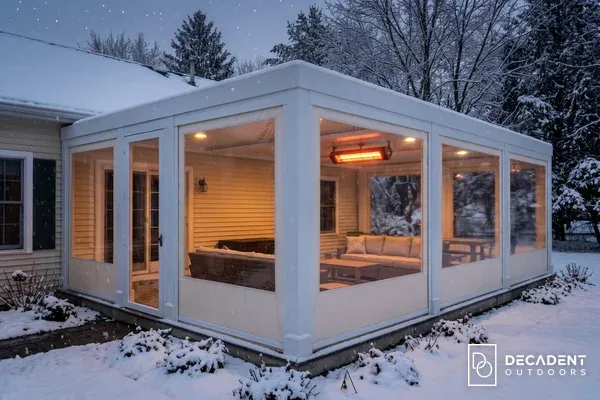
Clear Vinyl and Patio Heaters in Albany, NY: What Works and What’s Safe
You can use your patio well into an Albany winter with clear vinyl panels and a heater. The vinyl keeps wind, rain and snow off you, and the heater warms you directly. Two rules protect you and your home while you do it. Choose an electric infrared heater, and keep the vinyl out of the heater's hot zone, at the distance printed in that heater's own manual. A gas or propane heater should stay out of a closed-in patio unless its manufacturer says otherwise in writing.
The short version
Pair closed vinyl panels with an electric infrared heater. Keep gas and propane heaters out unless the manufacturer approves enclosed use in writing.
Keep deployed vinyl outside the heater's clearance zone. Infratech's W and WD Series manual calls for at least 36 inches in front of the heater.
Albany's normal January runs a 32.8°F high and a 15.9°F low (NWS, 1991–2020). Plan for the cold snap, not the average.
Roll vinyl up before a deep freeze. If it's already down when the cold arrives, leave it down until it warms up.
Decadent estimates that ceiling-mounted radiant heat adds 6 to 8 weeks at each end of the season.
The rest of this guide gives you the reasoning, the Albany numbers, the limits of vinyl and the safety checks that matter most. Where a figure comes from a manufacturer, the text says so. Where the sources don't settle a question, it says that too.
You paid for a patio. Why does an Albany winter take it back?
If you have owned a patio in the Capital Region for more than one year, you already know how this goes. A few good months, then the wind shows up before the cold does, and the first snow finds your furniture still out. By November you are watching the yard through a window. That is not a failure of your planning. It is what a short season does to even a well-built space.
The numbers show where the season slips away. These are the National Weather Service's 1991–2020 normals for Albany, from October through April:
On a normal night, Albany drops below freezing from November through March.
Read the table as a list of the evenings you can win back. October and April sit near 60°F, so you may need little help. November and March, with highs between 45°F and 50°F, are the months where wind protection and a heater turn "too cold" into "pour another cup, we're staying out." December through February asks more of your setup. A heater can still make a sheltered corner comfortable on a 33°F afternoon, but how well it works depends on the heater's output, the size of your space and how tight the enclosure is.
Plan for the cold snap, not the average. Albany's record low is far below any monthly figure above.
If you want the month-by-month picture of what a heated outdoor season can look like, Decadent's guide to four-season outdoor living walks through it. This guide stays on the two questions that post doesn't cover: what clear vinyl adds, and how to keep a heated, closed-in patio safe.
What can clear vinyl do for your patio, and where does it stop?
Think of clear vinyl as a wall you can see through. A mesh screen is a filter: air passes through it, so the temperature behind it tracks the temperature outside. A vinyl panel is a barrier. It stops the wind and the rain, and it keeps the warmth from your heater inside the space instead of letting it drift across the yard. You keep your view, which is why you built the patio in the first place.
It also has limits, and you are better off knowing them before you spend anything.
It is not glass. Vinyl has no meaningful insulating value. On a 15°F night the panel itself will be cold, and your heater is doing the work of warming you and the surfaces in front of it.
Wind is the limit that matters most. A solid panel catches wind the way a sail does, so the frame, the track and the way the edges are held matter more than the vinyl itself. Ask your installer what wind conditions the exact panel and frame on your patio are designed for. Fenetex, the maker of the OneTrack system, tells owners in its owner’s guide not to deploy screens during hurricanes or other severe weather unless the screen is rated for hurricanes.
Deep cold changes the material. Vinyl stiffens as it chills, and care guides from several motorized-screen makers set limits around freezing. One tells owners not to operate its clear vinyl screens below 0°C (32°F) and to leave them rolled down; another suggests not operating below 40°F and putting the vinyl in position before cold weather arrives. With a normal Albany January low of 15.9°F, the practical habit is simple: roll your vinyl up before a deep freeze, and if a panel is already down when the cold arrives, leave it down until it warms up. Forcing cold vinyl onto the roller can damage it.
Fire-retardant is not fireproof. Some clear vinyl is sold as flame-retardant and tested to NFPA 701, a standard that measures whether flame spreads on a fabric or film beyond the spot where it was lit. The standard itself says passing doesn’t show how a material behaves under more severe fire exposure, or when it’s used differently from the test. Ask for the test documentation, and don’t treat it as permission to put a panel near a hot heater.
Which heater should you pair with vinyl?
Start with how the heat reaches you. Infrared heaters don't warm the air around you. They send out radiant energy that warms you and the surfaces near you directly, the way sunlight does on a cool day. Because the air temperature matters less, infrared holds up better in wind than a heater that has to warm a volume of air first, and you feel it within seconds of switching it on.
From there, your choice splits by fuel.
Electric infrared
This is the pairing to choose when your vinyl panels are down. There is no combustion, so there is no carbon monoxide from the heater, no gas line and no fuel to store. According to Decadent's product page, residential electric systems run on 240V and range from 1,500 to 6,000 watts, come in flush-ceiling, pendant and wall-bracket mounts, and take dimmer, remote and smart-home control. Decadent installs Infratech, Bromic and Schwank heaters.
Natural gas and propane
Gas and propane heaters deliver more heat, with listed outputs of 30,000 to 60,000 BTU on Decadent's page, and they cost less to run across a large open area. They also burn fuel, which means they consume oxygen and release carbon monoxide. Their manuals are consistent: outdoor use only, never in an enclosed space, never in a tent, garage or home. That language is the reason a gas heater and a closed vinyl enclosure are a bad match for you and your family.
There is a gray zone. "Semi-enclosed" isn't a defined term in any manual reviewed here, and a patio with a roof, one open side and two panels down is a different case from one closed on all four sides. The manufacturer's instructions set the line, and some code officials will decide for themselves.
Why is carbon monoxide the risk you can't see?
Carbon monoxide, or CO, is a gas with no color, smell or taste. It is produced any time a fuel burns. Health agencies describe the early symptoms as headache, dizziness, weakness, nausea and confusion. Because those read like the flu, people often don't recognize what is happening, and someone who is asleep may not notice anything at all.
The national picture is sobering. Health organizations citing CDC figures put deaths from unintentional carbon monoxide poisoning not linked to fires at more than 400 a year in the U.S. No source reviewed here says how many of those involve patio enclosures, so no number is offered for that.
Here is why vinyl changes the math for you. A fuel-burning heater on an open patio sends its exhaust into a space that is effectively unlimited. Close the sides, and the exhaust has nowhere to go. The manuals say it plainly: the heater consumes oxygen and produces carbon monoxide, and using it in an enclosed space can kill you. One installer's guide adds a point for attached patios: keep fuel-burning heaters away from open windows and doors, so exhaust doesn't drift into your house.
Detectors are your backstop, not your plan. Health agencies recommend CO alarms on every level of a home and outside each sleeping area, with batteries checked on a schedule. Don’t count on an alarm on the patio itself. Typical home CO alarms list an operating range of 40°F to 100°F, and their manuals say not to install them in colder spaces such as porches and garages. That’s one more reason the real protection is keeping fuel-burning heaters out of a closed-in patio. If an alarm sounds, or anyone has symptoms, get everyone into fresh air and call 911.
How do you check clearances and ventilation?
What happens if your vinyl and heater get too close?
No injury or fire statistics for vinyl-enclosed patios in the Capital Region turned up in this research, and none are invented here. What the manuals and fire-safety guidance do give you is a set of scenarios worth picturing before a heater goes up.
The panel melts or warps. One clear vinyl distributor puts the rule of thumb this way: if you wouldn't be comfortable standing at a given distance from the heater for a long time, the vinyl won't be either. A heater placed too close can soften and deform a panel, and a deformed panel does not go back.
A gust pushes the panel into the heater. This is a scenario, not a statistic, but it is the one installers plan around. A loose or poorly tensioned panel can drift toward a hot surface when the wind picks up, which is why the way the edges are held matters as much as the distance on paper. Fire-safety guidance for patio heaters lists awnings, umbrellas and tent walls among the combustible items to keep away from them, and a vinyl panel belongs on that list.
A gas heater inside the enclosure stacks the risks. You get carbon monoxide, a heater drawing down the oxygen in a closed space, and a hot appliance next to combustible material, all in one place where you and your guests are sitting.
The only exit is a latched panel. If the enclosure closes tight, think about how you would get out fast. Keep at least one way out unlatched and unobstructed, and make sure everyone who uses the space knows how it opens.
None of this is a reason to give up on the project. It is a reason to care about the details of the install more than the vinyl itself.
How to check the numbers
Start with your heater’s manual, not a blog post. Every heater publishes its own minimum distances to combustible materials. Infratech’s installation manual for its W and WD Series electric heaters calls for at least 36 inches of clearance in front of the heater, 18 inches from its sides and ends, and 6 inches behind it, and says to keep drapery, furnishings and other combustibles at least 3 feet from the front. Treat a deployed vinyl panel as one of those combustibles. Other brands publish their own figures, so use the manual for the heater you own.
For portable gas heaters, the Fire Code of New York State adds its own floor. As the Town of Brookhaven’s fire-prevention advisory summarizes it, they can’t be used inside a tent, canopy or other membrane structure, and they can’t sit beneath or within 5 feet of combustible overhangs, awnings, sunshades or similar attachments to a building.
If your patio has a StruXure pergola overhead, Decadent's page says Infratech and Bromic ceiling heaters are designed to mount flush in the frame, with clearance requirements that fit within the bay depth.
Treat ventilation as a carbon monoxide control for fuel-burning heaters. If a gas heater is allowed in your configuration at all, the manufacturer’s instructions decide how much open area it needs. Don’t estimate it. With electric infrared, your concerns shift to clearance and how the panels are secured. Infratech’s manual also says never to block the heater and not to leave a powered heater unattended.
What could your patio look like when it's set up right?
Picture a Saturday in November. The wind is up and the leaves are down, and your neighbors went inside weeks ago. You press a button, the panels come down, and the heater overhead warms you within seconds. The grill is going, the kids have their coats off, and nobody is asking whether it's too cold to stay out. That is the evening a patio is supposed to give you, and it is available for more of the year than most Albany homeowners assume.
Clear vinyl is one route to it. It is not the only one, and it is not always the best fit for your space.
If your patio has a pergola overhead, your heater has a better home. According to Decadent's product page, StruXure pergola ceilings are engineered aluminum, non-combustible, and built to carry a heater load, and the ceiling bays are designed for flush heater mounting with no structural modification to the frame. Decadent is the exclusive StruXure dealer for the Capital Region, as stated on its site. Founder Jeffrey Mazzarelli brings more than 35 years in golf course and outdoor construction to the layout, which matters when your heater, your panels and your structure all have to meet in one place.
On the screen side, Decadent installs Fenetex One-Track motorized screens in three types: insect, solar and clear vinyl. You aren’t locked into one, but the swap has to be planned from day one. Setting the system up right means ordering the heavy-duty weight bar and the larger hood that clear vinyl needs. Built that way, a crew can swap your insect or solar screen for clear vinyl each fall and switch it back in spring. If you want to change on your own schedule, a dual setup runs two screen systems with their own motors. Clear vinyl also has smaller size limits than mesh, so the size of your opening helps decide which route fits. That gets settled at the consultation.
If you want a room that handles more weather than a vinyl panel allows, a screen room or a three-season room solves a different set of problems. Which one suits your yard depends on your space, your exposure and how you use it, and that is a question for a site visit, not a blog post.
What will it cost you to run an infrared heater?
Decadent's radiant heating page gives these figures for the Capital Region:
A 2,000-watt electric infrared heater costs roughly $0.30 to $0.50 per hour to run, at typical New York State electricity rates.
A single residential ceiling heater, installed, typically runs $1,500 to $4,000, depending on the model, the mounting and the electrical work.
A full system for a larger pergola or covered patio, with multiple zones, dimmer controls and smart-home integration, runs $4,000 to $10,000 or more.
The page says every quote is a fixed price after a site assessment. These are Decadent's own figures for its own systems, not an industry average.
Five patio safety tips you can use tonight
Pair an enclosed patio with an electric infrared heater. Keep gas and propane heaters for open-air use, or for a configuration the manufacturer approves for enclosed use in writing.
Measure the clearance. Find the minimum distance in your heater's manual, then measure it to the deployed vinyl and to anything else that can burn: furniture covers, cushions, curtains, a wood ceiling.
Keep a way out. Leave at least one entrance unlatched and unblocked, and make sure everyone who uses the space knows how it opens.
Secure the panels against wind. A panel that can billow toward a heater is a hazard. Ask how the edges are held and what the wind limit is for your exposure.
Put working CO alarms in your house. Place them on every level and outside sleeping areas, check the batteries on a schedule, and never leave a heater running when no one is there.
What is your next step?
You don't need to decide on vinyl, a heater or a pergola today. The useful first step is a look at your actual space: where the wind comes from, what your ceiling is made of, and what a heater can safely be mounted to. You get a free in-home consultation, and a fixed-price proposal arrives before any work begins.
Frequently asked questions
Can you run a patio heater inside a clear vinyl enclosure?
Yes, if it’s an electric infrared heater installed to the manufacturer’s clearances. Electric infrared burns no fuel, so the heater itself produces no carbon monoxide. Keep deployed vinyl outside its clearance zone; Infratech’s W and WD Series manual, for example, calls for at least 36 inches in front of the heater. Propane and natural gas heaters are different. They burn fuel and produce carbon monoxide, and the heater manuals reviewed for this guide say never to use them in an enclosed space. One commercial heater manual adds that some code authorities may treat a patio closed in almost entirely by a roof and walls as an indoor location.
How cold will your patio get in an Albany winter?
Colder than most people plan for. The National Weather Service’s 1991–2020 normals put Albany’s average January high at 32.8°F and the average low at 15.9°F. February isn’t much better, with an average low of 17.6°F, and March still averages a low of 26.1°F. A normal January also brings 15.6 inches of snow. The averages hide the extremes, too: Albany’s all-time record low is −28°F, set on January 19, 1971. That’s why the practical rule is to plan for the cold snap, not the average, when you choose a heater and decide how tightly to close in your patio.
How much extra season can a heater give you?
Decadent’s radiant heating page says a ceiling-mounted infrared system typically adds 6 to 8 weeks at each end of the season, from early April through November in the Capital Region. That’s Decadent’s own estimate for its own systems, not an industry figure. How much you actually gain depends on the heater’s output, the size of your space and how well the space is protected from wind. October and April evenings near 60°F may need little help, while November and March, with highs between 45°F and 50°F, are where a heater and wind protection make the biggest difference.
Does clear vinyl insulate like a window?
No. Clear vinyl is a barrier, not glazing. It stops wind and rain, which does most of the work on a cold evening, and it keeps the warmth from your heater inside the space instead of letting it drift across the yard. But it carries no meaningful insulating value, so on a 15°F night the panel itself will be cold and your heater does the work of warming you. Vinyl also stiffens in deep cold: roll it up before a deep freeze, and if a panel is already down when the cold arrives, leave it down until it warms up. It does not turn a patio into a four-season room.
What is the biggest safety risk?
Carbon monoxide from a fuel-burning heater in a space that can’t clear its exhaust. You can’t see it, smell it or taste it, and early symptoms such as headache, dizziness, weakness, nausea and confusion are easy to mistake for the flu. On an open patio, exhaust has room to disperse. Close the sides with vinyl and it has nowhere to go. That’s why the safer pairing for an enclosed patio is an electric infrared heater, with gas and propane heaters kept for open air unless the manufacturer approves enclosed use in writing. If anyone has symptoms, get everyone into fresh air and call 911.