
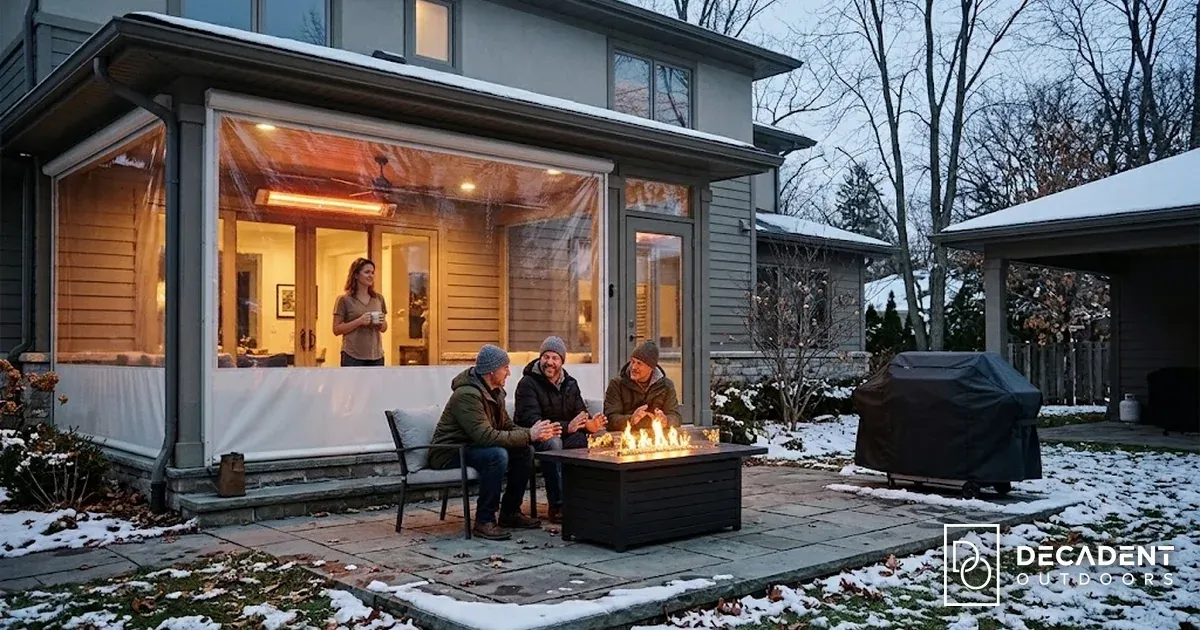
Fire Pits, Grills and Heaters Under Cover: Winter Fire and Carbon Monoxide Safety for Your Patio
Every flame on a covered patio has its own rule, and in winter those rules matter more because you're closer to the house and more likely to close things in. Fire tables go only where their manual allows, and many manuals don't allow any roof at all. Propane cylinders live outdoors, never in the garage. Portable gas heaters stay out of tents and canopies and at least 5 feet from combustible overhangs under New York’s fire code. For warmth under a roof with no flame and no exhaust, choose electric infrared.
Quick Answers
Can you grill under a covered patio?
Check two things: your grill’s manual and the fire code. Many grill manuals say not to operate under overhead combustible construction or any flammable canopy or overhang. Fire codes based on the International Fire Code keep open-flame grills 10 feet from combustible construction, with an exception for one- and two-family homes. The manual still applies even where the code exception does. Exhaust is the other problem: Connecticut’s poison control center counts a covered porch as an enclosed space for grilling, because carbon monoxide can build up. In winter, pull the grill out from under the roof to cook, and never cook inside an enclosure with the panels down.
Can you put a fire table under a pergola?
Only if its manual says so. Manuals vary widely: some forbid use under any overhead enclosure or structure, while others list a minimum distance to the ceiling, and the numbers change from one model to the next. That spread is the lesson: the manual for your specific fire table decides. If it says no overhead structure, the answer is no, however high your pergola is. A fire feature under a roof with the side panels down also burns fuel in a partly enclosed space, which brings back the carbon monoxide question. Keep a wood-burning pit out from under any roof unless both the manufacturer and your local fire official approve.
Where should you store propane in winter?
Outdoors, upright, on a firm surface, in a ventilated area. Never in your house, garage, basement or shed. When a grill or a propane patio heater comes inside for the winter, disconnect the cylinder first and leave it outside. If you have an electric infrared heater, keep cylinders at least 25 feet from it, per Infratech’s manual, so a spare tank doesn’t belong under your heated roof. Fire-safety guidance is consistent on all of this. It’s also the easiest winter mistake to make, because the garage is right there and the snow is not.
How far should a generator be from the house?
At least 20 feet, according to the U.S. Consumer Product Safety Commission, and never on a porch or in a carport. The CDC adds: away from windows, doors and vents. A covered patio looks like a dry place for a generator during a winter outage, but it puts the exhaust right against the house. The CDC has reported that carbon monoxide exposures rise in fall and winter, when people lean on heaters and generators. Pick the spot before the forecast turns, and keep battery-operated or battery-backup CO detectors near every sleeping area, so they keep working when the power is out.
What's the safest heat source under a roof?
Electric infrared. It has no combustion, so there's no flame and no carbon monoxide from the heater itself. It still has rules. Keep the clearances in its manual: Infratech’s W and WD Series call for 36 inches in front, 18 inches at the sides and ends, and 6 inches behind. Have it hard-wired by a licensed electrician, don’t leave a powered heater unattended, and keep flammable or explosive material, including propane cylinders, at least 25 feet away. But you aren’t managing a flame or an exhaust stream in the space you’re trying to keep warm.
Why does winter change the safety math on your patio?
You want to keep using your outdoor space after the leaves fall, and you should. But think about what changes in November. The grill moves closer to the back door because it's cold. The fire table comes under the pergola because that's where the heat stays. The side panels come down to stop the wind. A propane cylinder goes into the garage because it's out of the snow there. Each choice makes sense on its own. Together, they put more flame and more exhaust closer to your house, in a space with less air moving through it.
None of that means you should give up the season. It means the rules that were optional in July matter in January. This guide walks through every flame you're likely to have on a covered patio in winter, and the specific rule that keeps each one safe.
If you're heating a patio with clear vinyl panels, the first guide in this series covers carbon monoxide and heater clearances in detail.
How close is too close? The distances in one place
Different sources govern different equipment, so here is what the guidance reviewed for this article actually says, in one table. Your equipment's manual and your local fire official always have the final word.
What are the rules for each piece of equipment?
Can you grill under your covered patio this winter?
Here is where the rules get specific. Fire codes based on the International Fire Code, as fire departments including one in New York summarize them, prohibit charcoal grills and other open-flame cooking devices on combustible balconies and decks or within 10 feet of combustible construction, with an exception for one- and two-family homes. If you live in a single-family house, the code may not stop you. Your grill's manual still might.
Grill manuals are often stricter than the code. One propane grill manual says to use the grill outside only, in a well-ventilated area, and never under any flammable canopy or overhang. Another says not to operate it under overhead combustible construction. A wood ceiling, a fabric shade or a vinyl panel all count.
There's also the exhaust. Connecticut's poison control center warns against using gas or charcoal grills in enclosed spaces, and it names a covered porch as an example of one. Boston Fire's barbecue guidance says no gas grill should ever be used inside a house, garage or any enclosed area, because carbon monoxide can build up. Once your patio's panels come down, it starts to look a lot more like an enclosed area.
So the safe winter answer for most patios is simple. Pull the grill out from under the roof to cook, keep it clear of the house and anything that burns, and never cook inside an enclosure with the panels down.
Can you run a fire table or fire pit under a pergola?
This is the question with the most confusing answers online, and the reason is that the manuals themselves disagree.
Some gas fire table manuals say plainly not to use the unit under any overhead enclosure or overhead structure. Others list a minimum clearance above the unit and around it, and the numbers change from one model to the next.
That spread is the whole lesson. There's no general rule you can safely apply. The manual for your specific fire table decides whether it can go under your roof, and how far below the ceiling it has to sit. If the manual says no overhead structure, the answer is no, however high your pergola is.
Two more things to weigh. A fire feature under a roof with the side panels down is burning fuel in a partly enclosed space, which brings back the carbon monoxide question. And if you're considering a wood-burning pit, keep it out from under any roof unless both the manufacturer and your local fire official say otherwise. Wood fires throw embers, and a roof holds the smoke.
How should you store propane through an Albany winter?
Propane is the easiest winter mistake to make, because the garage is right there and the snow is not.
Fire-safety guidance is consistent: propane cylinders are stored outdoors, upright and stable, on a firm, level surface, in a well-ventilated area, and away from heat and ignition sources. They don't go in a house, garage, basement, shed or tent.
If you have an electric infrared heater, keep cylinders at least 25 feet from it, per Infratech’s manual.
When a grill or a propane patio heater comes inside for the winter, the cylinder doesn't come with it. Grill and heater guidance agrees: disconnect the cylinder and store it outdoors.
What about portable propane patio heaters?
If you use a freestanding propane heater, New York’s fire code sets a floor. As the Town of Brookhaven’s fire-prevention advisory summarizes the Fire Code of New York State, portable gas heaters can’t be used inside a tent, canopy or other membrane structure, and can’t sit beneath or within 5 feet of combustible decorations, overhangs, awnings, sunshades or similar attachments to a building. The model fire code it’s based on also keeps them at least 5 feet from buildings and from exits.
Their manuals add the rule that matters most in winter: outdoor use only, never in an enclosed space. The first guide in this series explains why a patio with its vinyl panels down can cross that line.
Where does your generator go when the power fails?
A winter storm can take out power for days, and a covered patio looks like a perfect, dry place for a generator. It isn't. The U.S. Consumer Product Safety Commission is direct about it: run portable generators outside only, at least 20 feet from the house, and don't run one on a porch or in a carport, because it's too close to the home. The CDC adds that a generator should sit more than 20 feet from any windows, doors and vents.
Carbon monoxide is the reason. The CDC has reported that carbon monoxide exposures and poisonings occur more often in fall and winter, when people are more likely to use gas furnaces, heaters and generators. Health organizations citing CDC figures put deaths from unintentional carbon monoxide poisoning not linked to fires at more than 400 a year in the U.S. The CDC recommends battery-operated or battery-backup carbon monoxide detectors near every sleeping area, which keep working when the power is out.
Decide where your generator goes before the forecast turns. In the middle of a storm is the worst time to measure 20 feet.
Why does electric infrared make so much of this simpler?
Look back over the rules above and you'll notice a pattern. Almost every one of them exists because something is burning: a burner, a charcoal bed, a propane jet, an engine. The flame creates a fire risk, and the exhaust creates a carbon monoxide risk.
Electric infrared heat removes both from the heating side of your patio. According to Decadent's radiant heating page, electric infrared heaters have no combustion and no gas line. They still need the clearances in their manuals, Infratech’s manual says they must be hard-wired by a licensed electrician, and it says not to leave a powered heater unattended. But you aren't managing a flame or an exhaust stream in a space you're trying to keep warm.
That doesn't mean you have to give up the fire table or the grill. It means you can give each flame its own place, out from under the roof, and let the heat overhead come from a source that doesn't burn anything.
Five rules to keep your winter patio safe
Cook out from under the roof. Follow your grill's manual on overhead clearance, and never grill inside an enclosure with the panels down.
Put fire features only where their manual allows. If the manual says no overhead structure, that's the answer.
Keep every propane cylinder outdoors. Upright, ventilated, away from ignition sources, and never in the garage.
Give the generator 20 feet. Never on the porch, never in the carport, and away from windows, doors and vents.
Keep CO alarms working. Battery-operated or battery-backup units near every sleeping area, tested before the season.
What is your next step?
If you'd like warmth under your roof without a flame to manage, a site visit is where that starts. It checks what your structure can carry, where a heater can safely mount, and how the rest of your patio fits around it.