
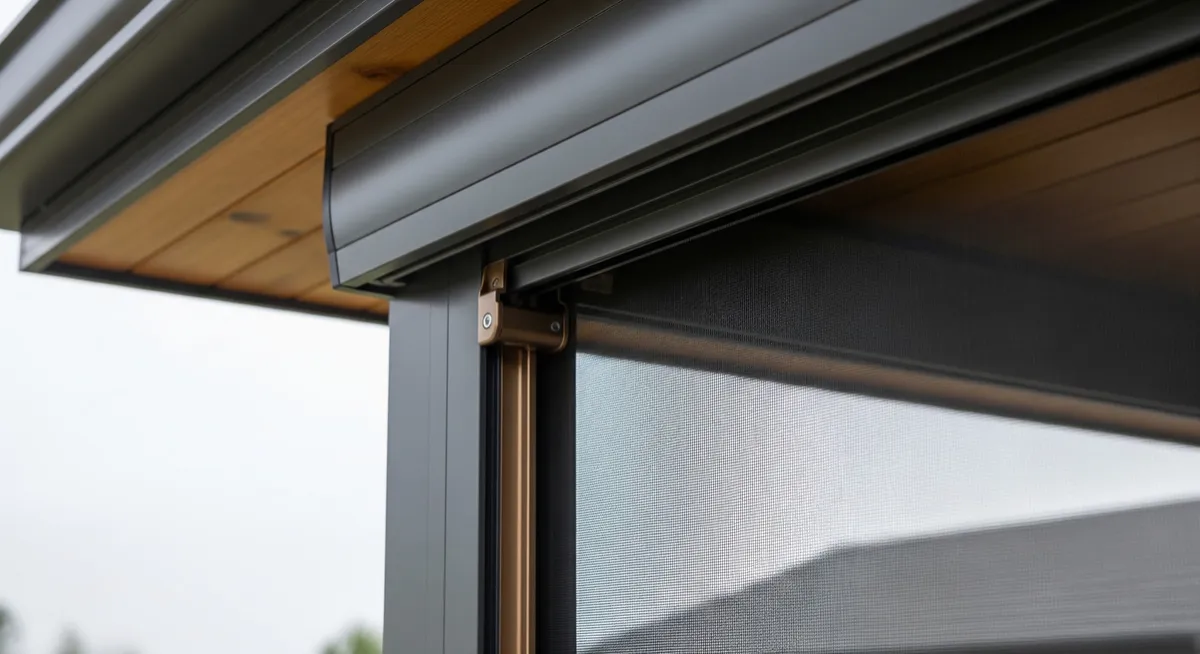
What a Motorized Screen Actually Has to Survive in Upstate New York: Wind, Power, and Lifespan
What a Motorized Screen Actually Has to Survive in Upstate New York: Wind, Power, and Lifespan
Most motorized screen marketing shows the mesh. It rarely shows what the system sits behind. A motor, a track, and a housing that have to survive a Capital Region year: nor'easters, ice, humidity, and a homeowner who wants it to work the same way in year eight as it did on day one. The mesh is the part a homeowner sees. The wind rating, the electrical circuit, and what actually determines lifespan are the parts that decide whether the system is still working in year eight.
This piece is part of The Fourth Wall, following our earlier breakdown of choosing screen mesh for an Upstate New York season.
Quick Answer
What does a motorized retractable screen actually need to survive in Upstate New York, and how long should it last?
Three things determine whether a system holds up: the wind rating, the electrical circuit it runs on, and the edge-retention hardware that takes the daily wear. Fenetex's OneTrack system is rated to 100 MPH wind loads and carries Florida Product Approval FL 8637 R15. A real, checkable state building-code approval, not a marketing number. In practice, any responsible system, OneTrack included, should be retracted in sustained winds above roughly 60 MPH; the rating is engineering headroom for normal Capital Region storms, not a claim that the screen should ride out a hurricane deployed. Electrically, a continuous-duty motor like this is the kind of load code treats as needing its own branch circuit rather than sharing one. The mistake to avoid is treating it as an afterthought wired in after the structure is closed up. On lifespan, the manufacturer backs the system with a lifetime warranty against defects, built around keder-edge retention (no zippers to corrode) and a reinforced nylon corner guide at the point where screens most commonly wear out. None of that guarantees a specific number of years. t describes what the system is engineered against, not a measured result for any given installation.
The wind rating means less than the number suggests — and more than "it'll be fine"
Fenetex's OneTrack system is engineered to 100 MPH wind loads, using a self-correcting track with reinforced corners built specifically for high-exposure locations. That's a real, specific manufacturer claim — not a rounded-up marketing figure. And it's worth reading correctly rather than either dismissing it or over-trusting it.
Most Capital Region homeowners never see anything close to 100 MPH sustained wind. The practical value of the rating is headroom: a system rated to 100 MPH is operating well inside its design envelope during the 30, 40, and 50 MPH gusts that show up in an ordinary summer thunderstorm or fall nor'easter, while a cheaper system rated to 40–60 MPH — or carrying no rating at all — is running close to its limit in those same conditions. That gap is where premature failures actually happen: not in the rare severe event, but in the routine gusty afternoon that a marginal system wasn't really built for.
The rating is not a claim that the screen should stay deployed through a hurricane. In sustained winds above roughly 60 MPH. A serious nor'easter, a summer microburst. Any responsible motorized screen system, OneTrack included, should be retracted to protect the equipment and the structure. A wind sensor that automates this is worth specifying for exactly that reason: the failure mode to avoid isn't the wind itself, it's a screen left deployed by a homeowner who wasn't home when the storm came through.
Florida Product Approval is a stronger credibility signal than most homeowners realize
Fenetex holds Florida Product Approval FL 8637 R15 for the OneTrack system. This matters for a reason that has nothing to do with Florida specifically: state product-approval programs of this kind require independent third-party testing against a building code, not a manufacturer's own claim about performance. It's a checkable number. Anyone can look up FL 8637 R15 against Florida's building-code product approval system. Which puts it in a different category from an unverifiable wind-rating claim with no certification behind it. A homeowner comparing quotes can reasonably ask any competing system for the equivalent: a real approval or certification number, not just a stated MPH figure.
The electrical requirement nobody puts in the brochure
A motorized screen is a continuous-duty motor load, not a lamp. The National Electrical Code treats motor circuits this way deliberately: Article 430 requires branch-circuit conductors and overcurrent protection sized specifically for the motor's full-load current, with its own dedicated wiring rather than a shared general-purpose circuit. In practice, that means the electrical rough-in for a motorized screen has to be planned before walls or soffits are closed up — running power to the housing after the fact, off whatever outlet happens to be nearby, is the kind of shortcut that shows up later as nuisance tripped breakers or a motor that struggles under load.
This is also why screens specified alongside a structure's design outperform screens retrofitted after the fact. The point made in this series 'breakdown of OneTrack's engineering. The housing needs somewhere to live, the track needs a true vertical to run in, and the motor needs a dedicated circuit planned in from the start. Sequence it after the fact and at least one of those three gets compromised.
What actually determines lifespan
Fenetex backs the OneTrack system with a lifetime warranty against defects in materials and workmanship. That warranty reflects specific engineering decisions rather than a marketing promise made in isolation. The system uses keder-edge retention. A continuous polymer bead captured mechanically in the track — instead of a sewn zipper, which removes the textile fastener that typically fails first at the wind-loaded edge. Smart motors are designed to halt the screen's downward motion instantly if it senses the screen coming out of its track, rather than continuing to force it. And Fenetex specifically reinforced the corner where the weight bar meets the screen. The point engineers identified as where wear shows up first — with a toughened nylon guide built to extend that connection's life.
What none of this gives is a specific number of years a given installation will last. That depends on exposure, usage frequency, and maintenance, and no manufacturer warranty or engineering feature substitutes for an actual measured lifespan figure across real Capital Region installations. That's a genuine gap in what can be said with confidence here, not a detail being glossed over.
What this series covers next
The next piece in this series covers installed cost. How to read two quotes against each other line by line, and the point in the calendar after which the honest answer becomes next spring.
Frequently Asked Questions
What wind rating do motorized retractable screens need in Upstate NY?
Look for a system rated well above the gusts you'd actually see. 100 MPH is Fenetex OneTrack's published rating, which gives headroom during ordinary 30–50 MPH summer and fall storms rather than operating near its limit. In sustained winds above roughly 60 MPH, any responsible system should be retracted regardless of its rating.
Do motorized screens need a dedicated electrical circuit?
Code treats a continuous-duty motor load this way for good reason — the National Electrical Code's Article 430 requires branch circuits and overcurrent protection sized to the motor's full-load current. Planning that circuit before the structure is closed up, rather than adding it afterward, is the difference between a clean installation and one prone to nuisance electrical problems later.
How long do motorized retractable screens actually last?
There's no independently measured lifespan figure to cite honestly. What can be said is that Fenetex backs the OneTrack system with a lifetime warranty against defects, built around keder-edge retention and a reinforced corner guide at the point that typically wears first — engineering decisions aimed at longevity, not a substitute for a measured number of years.
Sources
Decadent Outdoors. Motorized Retractable Screens | Fenetex One-Track. Accessed August 2026. decadentoutdoors.com
Decadent Outdoors. Inside OneTrack: The Engineering Behind a Disappearing Wall. May 29, 2026. decadentoutdoors.com
Fenetex.One Track. Accessed August 2026. fenetex.com
Fenetex.Technical Library— Florida Product Approval FL 8637 R15; Fenetex Lifetime Warranty. Accessed August 2026. fenetex.com
Electrical Contractor Magazine. Electric Motors: General NEC Rules for Their Installation. April 14, 2023. ecmag.com