
What Motorized Screens Actually Cost in the Capital Region — And How to Read Two Quotes Against Each Other
What Motorized Screens Actually Cost in the Capital Region? And How to Read Two Quotes Against Each Other
Every homeowner researching motorized screens eventually asks the same question, and almost no company answers it directly: what does this actually cost? Part of the reason is legitimate. The range is wide because the systems are custom, but part of it is that an honest range is less useful for a sales conversation than "it depends," so a lot of sites skip it entirely. This piece gives the actual range, what moves within it, and how to read two contractor quotes against each other without getting lost in numbers that don't mean the same thing from one company to the next.
This piece closes out The Fourth Wall series, following our earlier breakdowns of screen mesh selection and what a system has to survive.
Quick Answer
What do motorized retractable screens cost in the Capital Region, and how do I compare two quotes fairly?
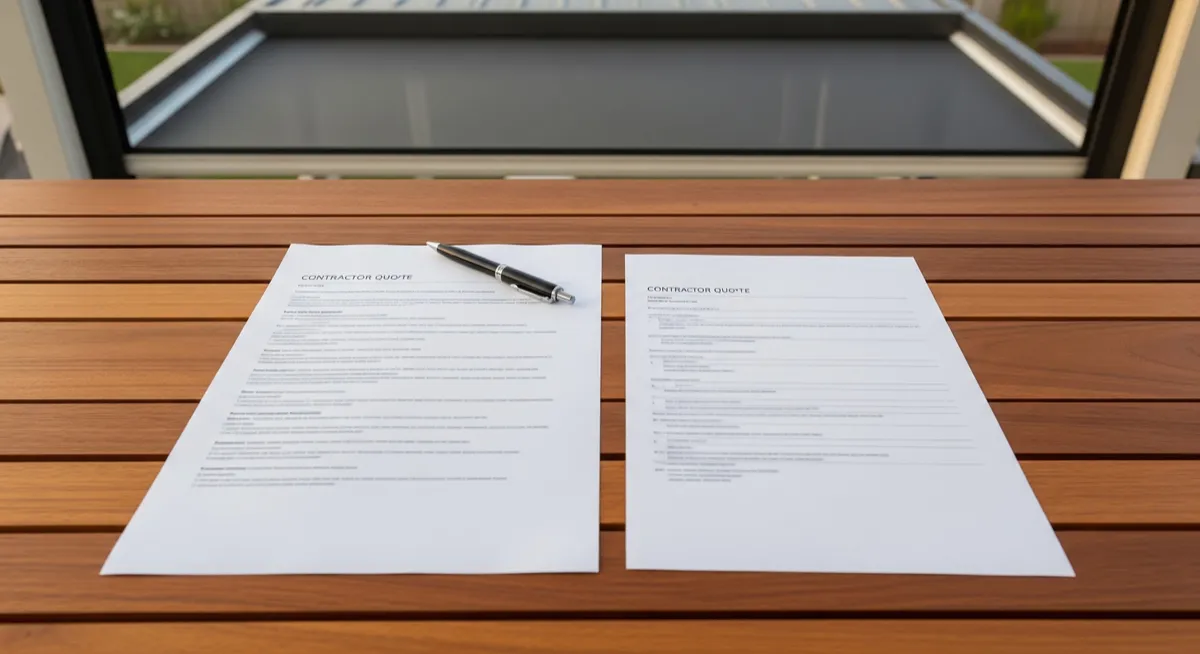
Motorized retractable screens vary widely in cost, depending on opening count and configuration. A single opening on an existing covered structure is a much smaller project than a multi-opening system enclosing a full outdoor room. The number alone doesn't tell you much — two quotes at the same price can represent very different systems. The number alone doesn't tell you much. Two quotes at the same price can represent very different systems. Compare them on five specifics: exact opening count and dimensions, the mesh brand and edge-retention method (keder vs. zipper), the wind rating and whether it's backed by an actual certification number or just a stated figure, who's responsible for the electrical rough-in, and what the warranty actually covers versus what voids it. A quote that's silent on any of these isn't necessarily dishonest, but it's incomplete, and incomplete quotes are how two "$28,000" bids end up representing very different systems.
The range, and what actually moves within it
Motorized retractable screens vary considerably in cost, depending on opening count and configuration. That's a wide spread for a reason: a single 12-foot opening on a patio that already has a roof is a fundamentally smaller project than a four-sided enclosure with multiple openings, each needing its own track, housing, and motor.
Opening count and total linear footage are the biggest cost drivers, but they're not the only ones. Mesh selection matters. Solar and privacy mesh typically cost more than standard insect mesh. Housing finish and color options add cost over a standard finish. And site conditions matter more than most quotes make explicit: an opening with easy access to power and a straightforward mounting surface costs less to execute than one requiring new electrical runs or structural reinforcement to the mounting point.
Why the same price can mean two different systems
A motorized screen quote isn't priced like a single product with a fixed spec sheet. It's closer to a small built-in system, where housing, track alignment, fabric, motor, controls, wiring, and installation all have to work together. That means the total number on two quotes can match while the systems underneath don't. A quote built around a lighter-duty edge-retention system, a lower wind rating, and no dedicated electrical planning can land at the same price as one built around keder-edge retention, a certified wind rating, and a properly planned circuit. Because the second quote is paying for things the first one is quietly skipping.
Five things to put side by side on any two quotes
Exact opening count and dimensions. "Screens for the patio" isn't a specification. A quote should state how many openings, each one's width and height, and whether that matches what was actually measured on site versus estimated from a description.
Mesh brand and edge-retention method. Ask specifically whether the system uses a zipper or a keder edge, and which manufacturer's mesh is being installed. This series covered why that distinction matters mechanically in the piece on what a screen has to survive. It's not a cosmetic detail, it's the part of the system most likely to fail first.
Wind rating, with a real number behind it. Any installer can state a wind rating. Ask whether it's backed by an independently tested certification. Fenetex OneTrack, for example, holds Florida Product Approval FL 8637 R15, a checkable state building-code number. A stated MPH figure with no certification behind it is a claim, not a verified spec.
Who handles the electrical rough-in.A motorized screen is a continuous-duty motor load that typically needs its own dedicated circuit. Ask directly whether that's included in the quoted price, who pulls the permit if one's required, and whether the rough-in happens before or after the structure is closed up. A quote that's silent on this is a quote where "installed" might not mean what you assume.
What the warranty actually covers, and what voids it. "Lifetime warranty" sounds identical from every company until you read what it excludes. Ask what happens if the screen is deployed during a wind event above the rated threshold, whether labor is covered or only parts, and whether the warranty is backed by the manufacturer or only by the installer.
The calendar question: when does "this year" become "next spring"?
A motorized screen system, on Decadent Outdoors' own published scheduling, takes roughly eight to sixteen weeks from first consultation to finished installation. About one hour for the consultation itself, two to three weeks for design and material selection, a further two to four weeks where a permit is required, and three to five days on site once materials arrive. The National Weather Service's Albany record puts the earliest recorded first fall temperature at or below 32°F at September 14; the latest on record is November 12. Both are extremes, not forecasts, and any given autumn varies by weeks.
Run the arithmetic honestly: a consultation booked in the first half of September, on the fast end of that eight-to-sixteen-week window, completes in mid-to-late October. After most of the useful shoulder season has already passed. A consultation booked any later than that is, realistically, a spring project. Neither is a wrong decision. But the honest answer to "can I still get this done this year" changes with the calendar, and no contractor should tell a homeowner in late September that a screen system booked that week will meaningfully extend this year's season.
Frequently Asked Questions
How much do motorized retractable screens cost in the Capital Region?
It depends on how many openings you're covering, how wide they are, and whether the screens are going onto an existing structure or into a new build. A single opening and a four-bay enclosure are different projects. We measure the openings, confirm what the structure will carry, and give you one fixed price before you commit to anything.
Why do two quotes at the same price sometimes represent completely different systems?
Because a motorized screen is priced as a small built-in system, not a single product with a fixed spec. Two quotes can land at the same total while one includes a certified wind rating, keder-edge retention, and a properly planned electrical circuit, and the other quietly skips one or more of those in favor of a lower-cost component.
Is it too late in the season to get a motorized screen installed?
It depends on when you start. Decadent Outdoors publishes an eight-to-sixteen-week window from first consultation to completed installation. A consultation booked in early September can still complete this autumn on the fast end of that window; one booked much later realistically becomes a spring project. The honest answer changes with the calendar, not with how badly you want it this year.
Sources
Decadent Outdoors. Motorized Screens vs. Screened Porch vs. Four-Season Room. June 22, 2026. decadentoutdoors.com
Decadent Outdoors. Inside OneTrack: The Engineering Behind a Disappearing Wall. May 29, 2026. decadentoutdoors.com
National Weather Service, Albany NY.All-Time Extremes for Albany, NY. Updated January 2025. weather.gov
Fenetex. Technical Library— Florida Product Approval FL 8637 R15. Accessed August 2026. fenetex.com